


Parental bereavement and the loss of purpose in life as a function of interdependent self-construal
- PMID: 26284002
- PMCID: PMC4515542
- DOI: 10.3389/fpsyg.2015.01078
Parental bereavement and the loss of purpose in life as a function of interdependent self-construal
Abstract
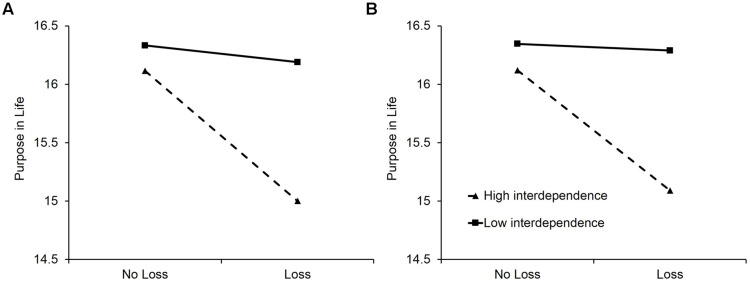
Children are often inextricably linked to their parents' hopes and dreams. As such, the loss of a child often represents one of the most traumatic experiences possible. The current research explores how this specific loss relates to one's sense of purpose in life. We further explore whether the loss of a child is particularly detrimental to one's sense of purpose for highly interdependent parents. Analyses of parents from the Midlife in the United States data set revealed, as expected, that the loss of child negatively predicts one's sense of purpose in life, and that this effect is most pronounced for parents high in interdependent self-construal. Potential mechanisms and implications of the present findings are discussed.
Keywords: adaptation; interdependent self-construal; parental bereavement; purpose in life; well-being.
Figures
References
-
- Ashton-James C. E., Kushlev K., Dunn E. W. (2013). Parents reap what they sow: child-centrism and parental well-being. Soc. Psychol. Pers. Sci. 4 635–642. 10.1177/1948550613479804 - DOI
-
- Baumeister R. F., Vohs K. D., Aaker J. L., Garbinsky E. N. (2013). Some key differences between a happy life and a meaningful life. J. Posit. Psychol. 8 505–516. 10.1080/17439760.2013.830764 - DOI
-
- Blanchflower D. G., Oswald A. J. (2004). Well-being over time in Britain and the USA. J. Public Econ. 88 1359–1386. 10.1016/S0047-2727(02)00168-8 - DOI
-
- Bochner S. (1994). Cross-cultural differences in the self-concept: a test of Hofstede’s individualism/collectivism distinction. J. Cross Cult. Psychol. 25 273–283. 10.1177/0022022194252007 - DOI
Grants and funding
LinkOut - more resources
Full Text Sources
Other Literature Sources
Research Materials
