


ACTN3 Polymorphism: Comparison Between Elite Swimmers and Runners
- PMID: 26284168
- PMCID: PMC4532721
- DOI: 10.1186/s40798-015-0023-y
ACTN3 Polymorphism: Comparison Between Elite Swimmers and Runners
Abstract
Background: The human ACTN3 gene encodes α-actinin-3, an actin-binding protein with a pivotal role in muscle structure and metabolism. A common genetic single nucleotide polymorphism (SNP) at codon 577 of the ACTN3 results in the replacement of an arginine (R) with a stop codon (X). The R allele is a normal functional version of the gene, whereas the X allele contains a sequence change that completely stops production of functional α-actinin-3 protein. The ACTN3 R577X polymorphism was found to be associated with power athletic performance especially among track and field athletes. The aim of the current study was to compare allelic and genotype frequencies of the ACTN3 R577X polymorphism among runners and swimmers specializing in different distances, and >non-athletic controls.
Methods: One hundred and thirty-seven runners, 91 swimmers and 217 controls, participated in the study. Runners were assigned to two subgroups according to their event specialty-long-distance runners (LDR) and short-distance runners (SDR). Swimmers were also assigned to two subgroups according to their main swimming event-long-distance swimmers (LDS) and short-distance swimmers (SDS). Genomic DNA was extracted from peripheral EDTA-treated anti-coagulated blood using a standard protocol. Genotypes were determined using the Taqman allelic discrimination assay.
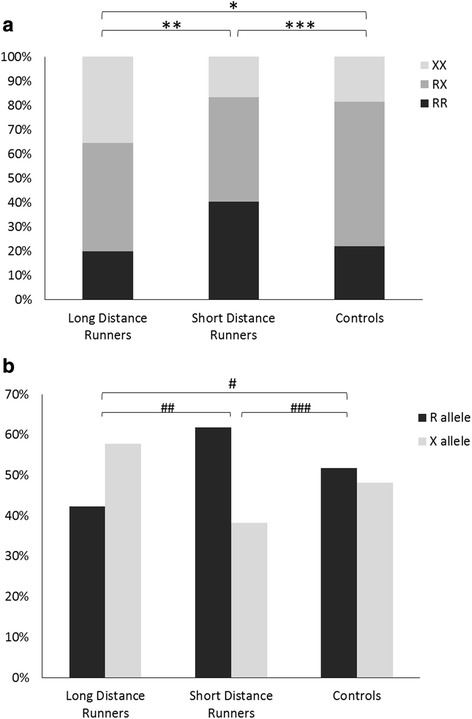
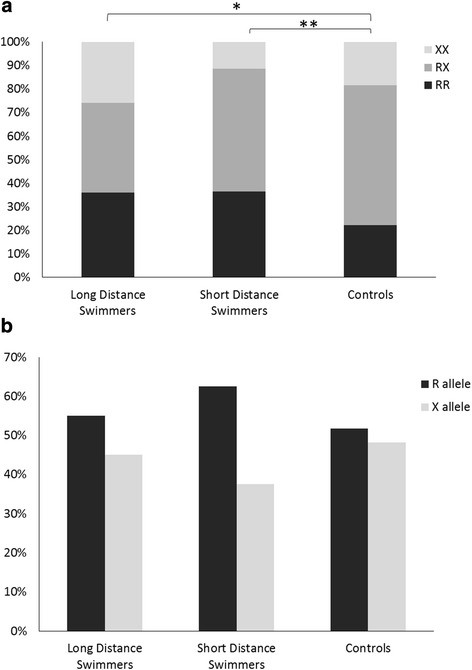
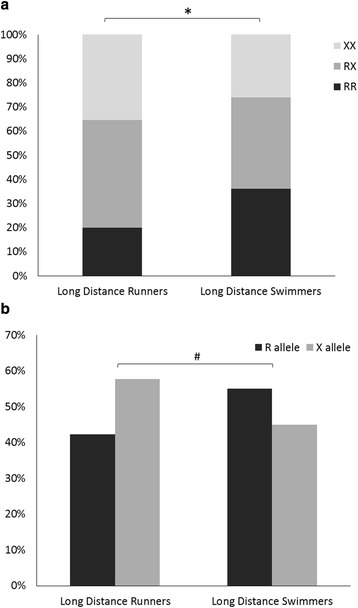
Results: Runners' genotype and allele differed significantly between LDR, SDR, and controls, with the lowest prevalence of RR genotype and R allele among LDR. XX genotype and X allele prevalence was significantly higher among LDR compared to the other groups (p < 0.01 for all). On the other hand, swimmers' genotype and allele frequencies did not differ significantly between subgroups (LDS and SDS). Yet, LDS had significantly higher RR genotype and R allele frequencies compared to LDR.
Conclusions: The findings suggest that while ACTN3 R577X polymorphism is a genetic polymorphism that may distinguish between SDR and LDR, it cannot differentiate significantly between SDS and LDS.
Trial registration: ClinicalTrials.gov: NCT01319032.
Key points: ACTN3 R577X polymorphism is largely associated with running events specialization, with high prevalence of RR genotype and R allele frequency among short-distance runners compare to long-distance runners.Unlike in running, ACTN3 R577X polymorphism is not associated with swimming specialization.The inability of the ACTN3 R577X polymorphism to distinguish between swimmers specializing in different events, presumably since other factors such as body physique, technique, tactics, etc., are more likely to determine such a distinction.
Keywords: ACTN3; Genetic polymorphism; Runners; Swimmers.
Figures
References
Associated data
LinkOut - more resources
Full Text Sources
Other Literature Sources
Medical
Miscellaneous
