


Severe Infections in HIV-Exposed Uninfected Infants Born in a European Country
- PMID: 26284528
- PMCID: PMC4540431
- DOI: 10.1371/journal.pone.0135375
Severe Infections in HIV-Exposed Uninfected Infants Born in a European Country
Abstract
Background: Several studies indicate that HIV-exposed uninfected (HEU) children have a high infectious morbidity. We previously reported an increased incidence of group B streptococcus (GBS) infections in HEU infants born in Belgium.
Methods: This study was undertaken to evaluate the incidence and risk factors of all cause severe infections in HEU infants born in Belgium between 1985 and 2006, including the pre-antiretroviral (ARV) prophylaxis era (1985 to 1994). The medical charts of 537 HEU infants followed in a single center were reviewed.
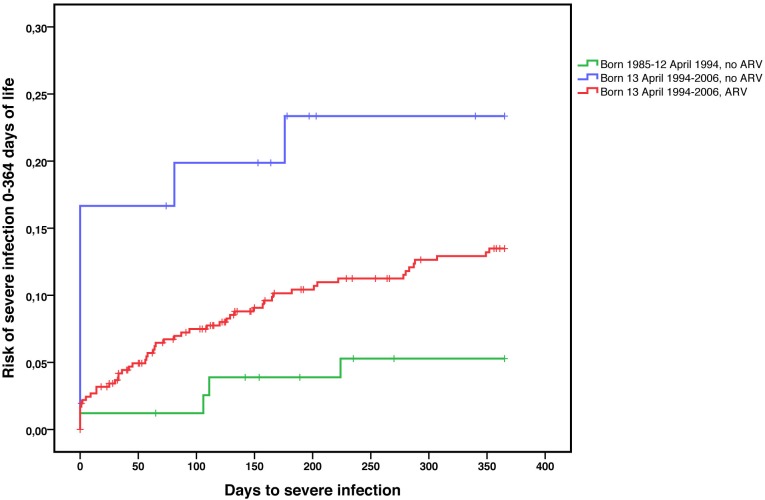
Results: The incidence rate of severe infections during the first year of life was 16.8/100 HEU infant-years. The rates of invasive S. pneumoniae (0.62/100 infant-years) and GBS infections (1.05/100 infant-years) were, respectively, 4 and 13-fold higher in HEU infants than in the general infant population. Preterm birth was a risk factor for severe infections in the neonatal period (aOR = 21.34, 95%CI:7.12-63.93) and post-neonatal period (aHR = 3.00, 95%CI:1.53-5.88). As compared to the pre-ARV prophylaxis era, infants born in the ARV prophylaxis era (i.e., after April 1994) had a greater risk of severe infections (aHR = 2.93; 95%CI:1.07-8.05). This risk excess was present in those who received ARV prophylaxis (aHR 2.01, 95%CI 0.72-5.65) and also in those born in the ARV prophylaxis era who did not benefit from ARV prophylaxis as a result of poor access to antenatal care or lack of compliance (aHR 3.06, 95%CI 0.88-10.66).
Conclusions: In HEU infants born in an industrialized country, preterm birth and being born during the ARV prophylaxis era were risk factors of severe infections throughout the first year of life. These observations have important implications for the clinical management of HIV-infected mothers and their infants.
Conflict of interest statement
Figures
References
-
- ECS. Mother-to-child transmission of HIV infection in the era of highly active antiretroviral therapy. Clin Infect Dis 2005;40(3):458–65. - PubMed
-
- Le Chenadec J, Mayaux MJ, Guihenneuc-Jouyaux C, Blanche S. Perinatal antiretroviral treatment and hematopoiesis in HIV-uninfected infants. Aids 2003;17(14):2053–61. - PubMed
-
- ECS. Levels and patterns of neutrophil cell counts over the first 8 years of life in children of HIV-1-infected mothers. Aids 2004;18(15):2009–17. - PubMed
Publication types
MeSH terms
LinkOut - more resources
Full Text Sources
Other Literature Sources
Medical
Miscellaneous
