


Laparoscopy decreases complications for obese patients undergoing elective rectal surgery
- PMID: 26286013
- PMCID: PMC5291075
- DOI: 10.1007/s00464-015-4463-8
Laparoscopy decreases complications for obese patients undergoing elective rectal surgery
Abstract
Introduction: While there are many reported advantages to laparoscopic surgery compared to open surgery, the impact of a laparoscopic approach on postoperative morbidity in obese patients undergoing rectal surgery has not been studied. Our goal was to determine whether obese patients undergoing laparoscopic rectal surgery experienced the same benefits as non-obese patients.
Methods: We identified patients undergoing rectal resections using the National Surgical Quality Improvement Project Participant Use Data File. We performed multivariable analyses to determine the independent association between laparoscopy and postoperative complications.
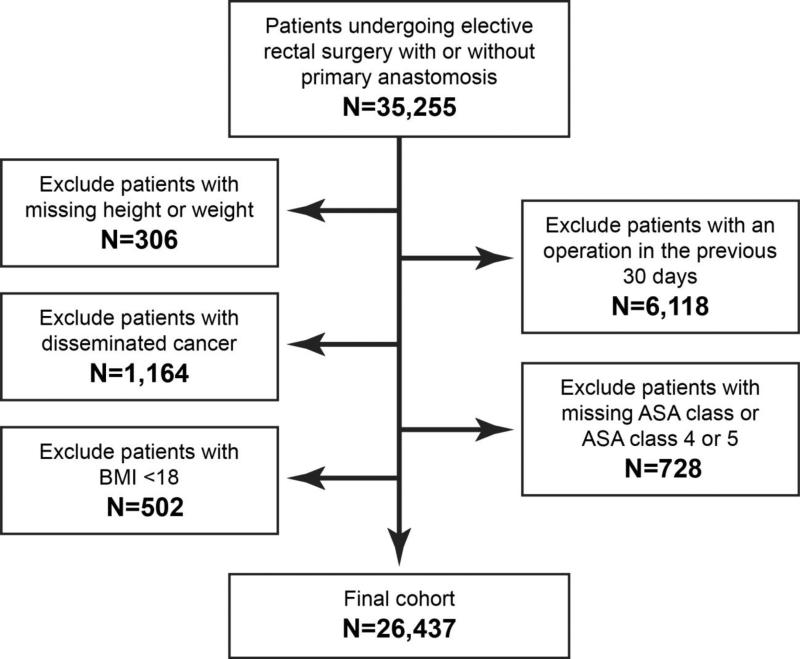
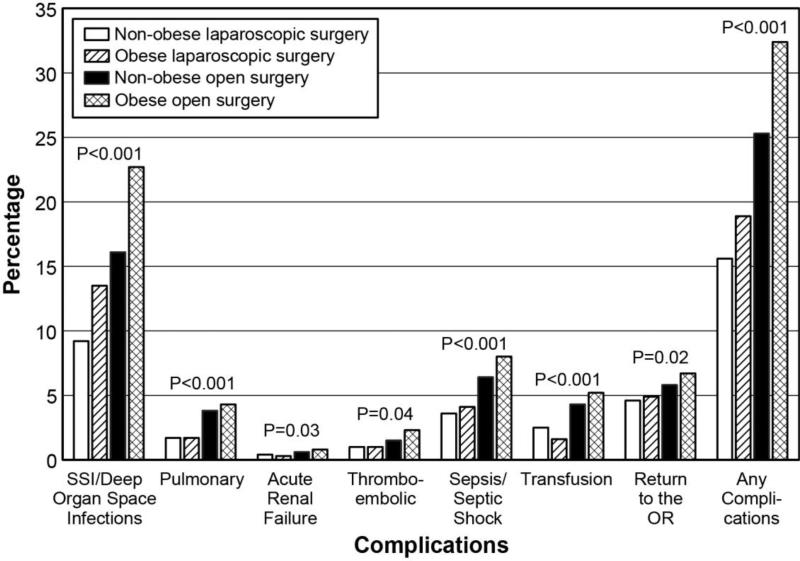
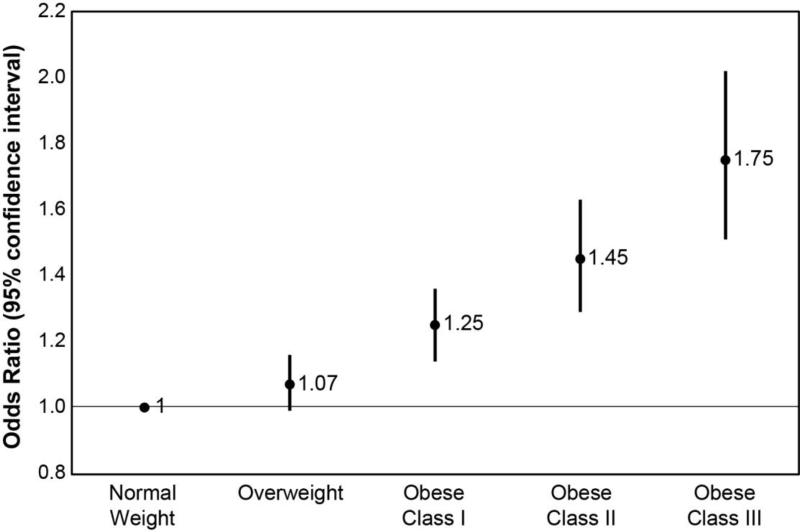
Results: A total of 26,437 patients underwent rectal resection. The mean age was 58.5 years, 32.6 % were obese, and 47.2 % had cancer. Laparoscopic procedures were slightly less common in obese patients compared to non-obese patients (36.0 vs. 38.2 %, p = 0.0006). In unadjusted analyses, complications were lower with the laparoscopic approach in both obese (18.9 vs. 32.4 %, p < 0.0001) and non-obese (15.6 vs. 25.3 %, p < 0.0001) patients. In a multivariable analysis controlling for potential confounders, the risk of postoperative complications increased as the degree of obesity worsened. The likelihood of experiencing a postoperative complication increased by 25, 45, and 75 % for obese class I, obese class II, and obese class III patients, respectively. A laparoscopic approach was associated with a 40 % decreased odds of a postoperative complication for all patients (OR 0.60, 95 % CI 0.56-0.64).
Conclusion: Laparoscopic rectal surgery is associated with fewer complications when compared to open rectal surgery in both obese and non-obese patients. Obesity was an independent risk factor for postoperative complications. In appropriately selected patients, rectal surgery outcomes may be improved with a minimally invasive approach.
Keywords: Laparoscopic versus open surgery; Obesity; Pelvic surgery; Rectal surgery; Surgical outcomes.
Figures
References
Publication types
MeSH terms
Grants and funding
LinkOut - more resources
Full Text Sources
Other Literature Sources
Medical
