


Is adductor pollicis muscle thickness a good predictor of lean mass in adults?
- PMID: 26286900
- PMCID: PMC5000778
- DOI: 10.1016/j.clnu.2015.07.022
Is adductor pollicis muscle thickness a good predictor of lean mass in adults?
Abstract
Background & aims: Lean mass (LM) is an important parameter in clinical outcomes, which highlights the necessity of reliable tools for its estimation. The adductor pollicis muscle thickness (APMT) is easily accessible and suffers minimal interference from the adjacent subcutaneous fat tissue.
Objective: To assess the relationship between the APMT and LM in a sample of Southern Brazilian adults.
Methods: Participants were adults from the 1982 Pelotas (Brazil) Birth Cohort. LM was measured by dual energy X-ray absorptiometry (DXA). LM and lean mass index (LMI - LM divided by the square of height - kg/m(2)) were the outcomes. APMT was measured using a skinfold caliper. The mean of three measurements in the non-dominant hand was used in the analyses. APMT was described according to socio-demographic characteristics and nutritional status. The relationship between APMT and both LM and LMI was evaluated by correlation coefficient and linear regression using APMT as a single anthropometric parameter and also in addition to BMI.
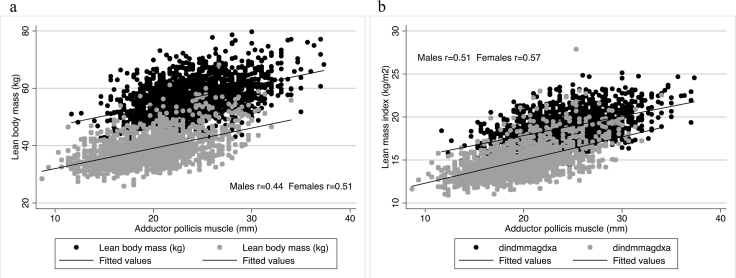
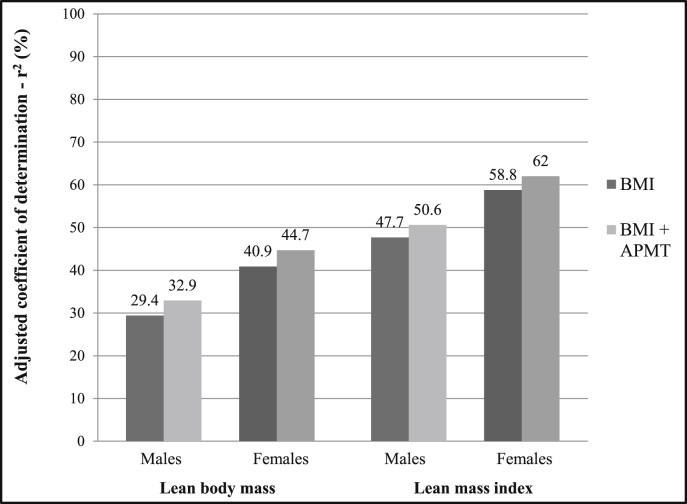
Results: APMT was assessed in 3485 participants. APMT was higher in males, non-whites, less-schooled and obese individuals. APMT was moderately correlated to LM and LMI (ranged from 0.44 to 0.57). Correlation coefficients were higher for LMI as outcome and in females (LM: 0.51 and LMI: 0.57). APMT explained 19% and 26% of the variance in LM in males and females, respectively, whereas it explained 26% and 33% of the variance in LMI. APMT increased the prediction for LM in 3 and 4 percentage points in males and females, in comparison to explained by BMI. BMI explained 48% and 59% of the variance of LMI in males and females whereas APMT increased it to 51% and 62% for both sexes, respectively.
Conclusions: Results were not good enough to promote the APMT as a single predictor of LM or LMI in epidemiological studies. APMT has a little predictive capacity in estimating LM or LMI when BMI is also considered.
Keywords: Adductor pollicis muscle; Adults; Anthropometry; Lean mass.
Copyright © 2015 The Authors. Published by Elsevier Ltd.. All rights reserved.
Figures
References
-
- Thibault R., Genton L., Pichard C. Body composition: why, when and for who? Clin Nutr. 2012;31(4):435–447. - PubMed
-
- Muller M.J., Lagerpusch M., Enderle J., Schautz B., Heller M., Bosy-Westphal A. Beyond the body mass index: tracking body composition in the pathogenesis of obesity and the metabolic syndrome. Obes Rev. 2012;13(Suppl. 2):6–13. - PubMed
-
- Oliveros E., Somers V.K., Sochor O., Goel K., Lopez-Jimenez F. The concept of normal weight obesity. Prog Cardiovasc Dis. 2014;56(4):426–433. - PubMed
-
- Amundson D.E., Djurkovic S., Matwiyoff G.N. The obesity paradox. Crit Care Clin. 2010;26(4):583–596. - PubMed
-
- Gonzalez M.C., Pastore C.A., Orlandi S.P., Heymsfield S.B. Obesity paradox in cancer: new insights provided by body composition. Am J Clin Nutr. 2014;99(5):999–1005. - PubMed
Publication types
MeSH terms
Grants and funding
LinkOut - more resources
Full Text Sources
Other Literature Sources
