


Effect of Brewing Duration on the Antioxidant and Hepatoprotective Abilities of Tea Phenolic and Alkaloid Compounds in a t-BHP Oxidative Stress-Induced Rat Hepatocyte Model
- PMID: 26287152
- PMCID: PMC6331988
- DOI: 10.3390/molecules200814985
Effect of Brewing Duration on the Antioxidant and Hepatoprotective Abilities of Tea Phenolic and Alkaloid Compounds in a t-BHP Oxidative Stress-Induced Rat Hepatocyte Model
Abstract
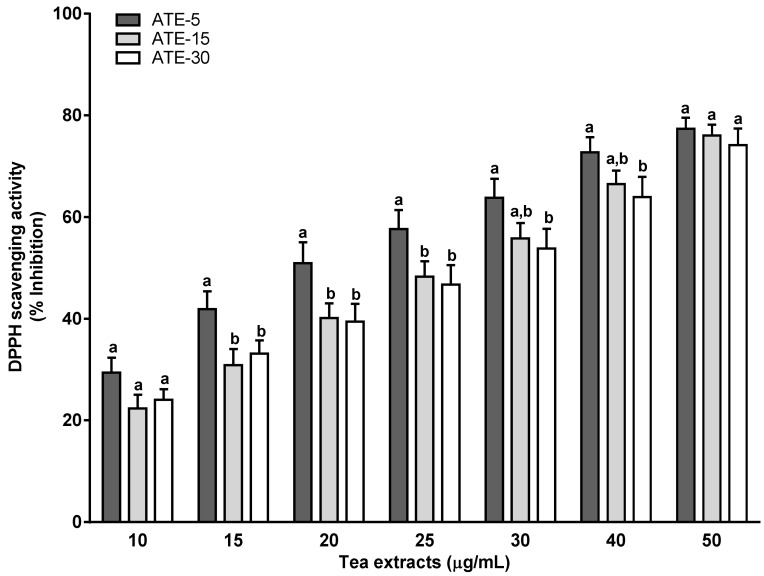
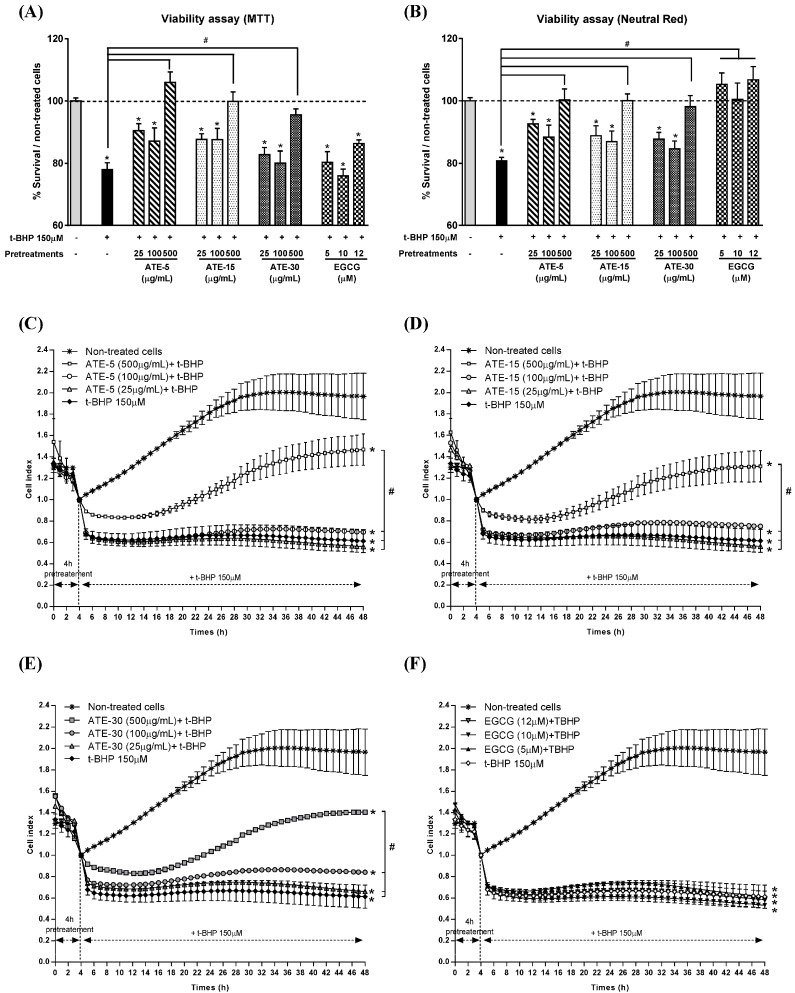
Tea is an interesting source of antioxidants capable of counteracting the oxidative stress implicated in liver diseases. We investigated the impact of antioxidant molecules provided by a mixture of teas' leaves (green, oolong, pu-erh) after different infusion durations in the prevention of oxidative stress in isolated rat hepatocytes, by comparison with pure epigallocatechin-3-gallate (EGCG), the main representative of tea catechins. Dried aqueous tea extracts (ATE) obtained after 5, 15 and 30 min infusion time were characterized for total polyphenols (gallic acid equivalent), catechins, gallic acid and caffeine (HPLC-DAD/ESI-MS) contents, and for scavenging ability against 2,2-diphenyl-1-picrylhydrazyl free radical. Hepatoprotection was evaluated through hepatocyte viability tests using tert-butyl hydroperoxide as a stress inducer, (3-(4,5-dimethylthiazol-2-yl)-2,5-diphenyltetrazolium bromide, neutral red uptake, real-time cellular impedance) and mitochondrial function tests. We showed that a 5-min incubation time is sufficient for an optimal bioaccessibility of tea compounds with the highest antioxidative ability, which decreases for longer durations. A 4-h pretreatment of cells with ATE significantly prevented cell death by regulating reactive oxygen species production and maintaining mitochondrial integrity. Pure EGCG, at doses similar in ATE (5-12 µM), was inefficient, suggesting a plausible synergy of several water-soluble tea compounds to explain the ATE beneficial effects.
Keywords: Camellia sinensis; EGCG; ROS; antioxidant; bioaccessibility; hepatocytes; mitochondrial membrane integrity; polyphenols; tea.
Conflict of interest statement
L. Braud’s Ph.D. student salary was funded by “Thés de la Pagode Company”. L. Peyre, G. de Sousa, M. Armand, R. Rahmani, and J-M. Maixent, declare no conflict of interest. The funding sponsors had no role in the design of the study; in the collection, analyses, or interpretation of data; in the writing of the manuscript, and in the decision to publish the results.
Figures


References
-
- Roberts E.A.H. The phenolic substances of manufactured tea. II.—Their origin as enzymic oxidation products in fermentation. J. Sci. Food Agric. 1958;9:212–216. doi: 10.1002/jsfa.2740090405. - DOI
-
- Peterson J., Dwyer J., Bhagwat S., Haytowitz D., Holden J., Eldridge A.L., Beecher G., Aladesanmi J. Major flavonoids in dry tea. J. Food Compos. Anal. 2005;18:487–501. doi: 10.1016/j.jfca.2004.05.006. - DOI
Publication types
MeSH terms
Substances
LinkOut - more resources
Full Text Sources
Other Literature Sources
Medical
Research Materials
