Review
. 2015 Aug 13;5(3):1855-69.
doi: 10.3390/biom5031855.

Genome Instability in Development and Aging: Insights from Nucleotide Excision Repair in Humans, Mice, and Worms

Affiliations
Review

Genome Instability in Development and Aging: Insights from Nucleotide Excision Repair in Humans, Mice, and Worms

Diletta Edifizi et al. Biomolecules. .

Abstract

DNA damage causally contributes to aging and cancer. Congenital defects in nucleotide excision repair (NER) lead to distinct cancer-prone and premature aging syndromes. The genetics of NER mutations have provided important insights into the distinct consequences of genome instability. Recent work in mice and C. elegans has shed new light on the mechanisms through which developing and aging animals respond to persistent DNA damage. The various NER mouse mutants have served as important disease models for Xeroderma pigmentosum (XP), Cockayne syndrome (CS), and trichothiodystrophy (TTD), while the traceable genetics of C. elegans have allowed the mechanistic delineation of the distinct outcomes of genome instability in metazoan development and aging. Intriguingly, highly conserved longevity assurance mechanisms respond to transcription-blocking DNA lesions in mammals as well as in worms and counteract the detrimental consequences of persistent DNA damage. The insulin-like growth factor signaling (IIS) effector transcription factor DAF-16 could indeed overcome DNA damage-driven developmental growth delay and functional deterioration even when DNA damage persists. Longevity assurance mechanisms might thus delay DNA damage-driven aging by raising the threshold when accumulating DNA damage becomes detrimental for physiological tissue functioning.

Keywords: Cockayne syndrome (CS); DNA damage; Global-genome nucleotide-excision repair (GG-NER); Nucleotide-excision repair (NER); Transcription-coupled nucleotide excision repair (TC-NER); Ultraviolet Light (UV); aging; growth hormone/insulin-like growth factor 1 (GH/IGF1) signaling; longevity; somatotropic axis.


Figures
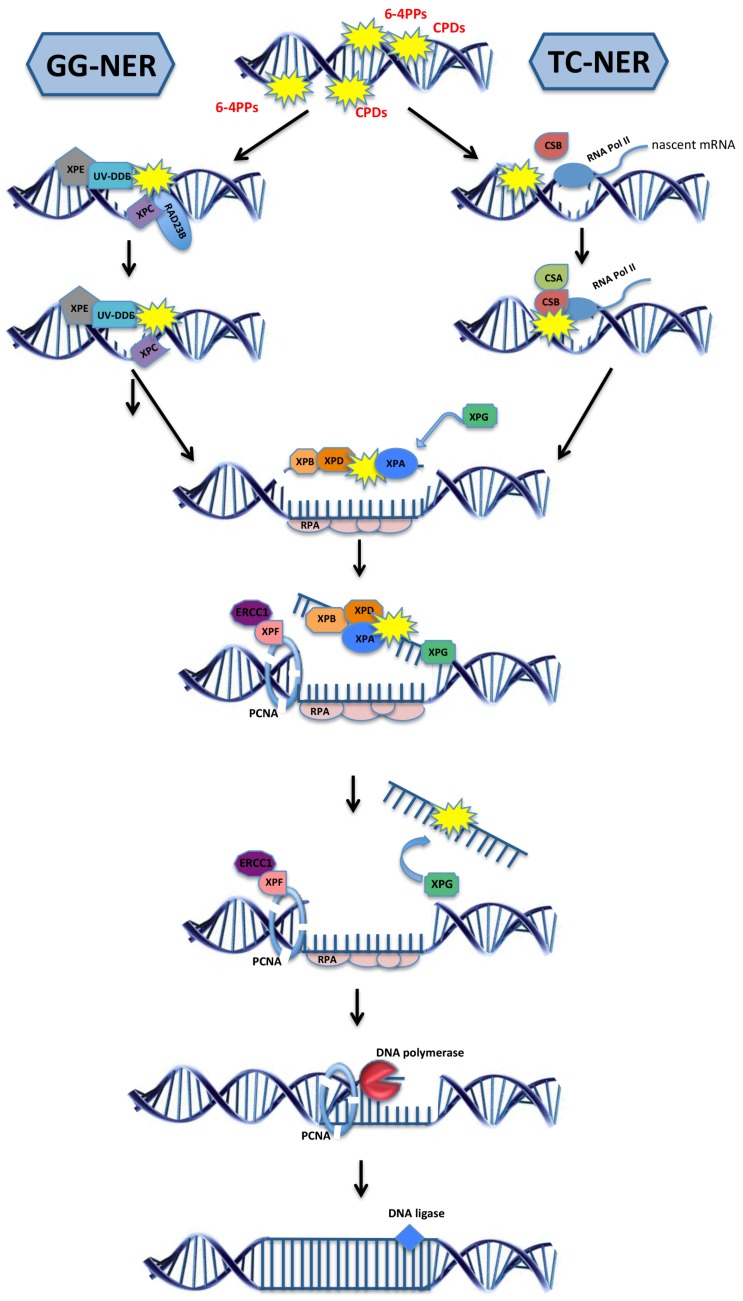
Figure 1
Figure 1
The two sub-pathways of the nucleotide excision repair. Global genome nucleotide excision repair (GG-NER; left) is initiated when the damage sensor proteins XPC and XPE identify helix-distorting lesions throughout the genome. Transcription-coupled NER (TC-NER; right) is initiated by CSB upon the stalling of RNA polymerase II at the site of a lesion, followed by the recruitment of CSA protein. After damage recognition, the TFIIH complex subunits XPB and XPD, together with XPA, are recruited at the lesion site and unwind the helix. The damaged DNA strand is incised by the endonucleases ERCC1, XPF, and XPG while the other single-strand DNA is coated and protected by the protein replication protein A (RPA). DNA polymerases fill the gap and the final nick is sealed by DNA ligases. Over 30 distinct proteins take part in NER and only selected ones are depicted here.
Figure 2
Figure 2
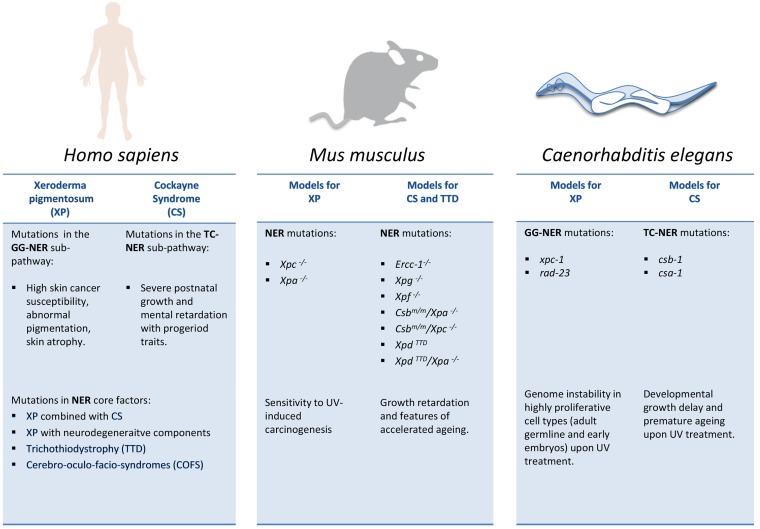
NER mutations in cancer susceptibility, developmental failure, and premature aging. Comparison of distinct consequences of NER mutations in human patients and NER models in mice and C. elegans. Note that in contrast to human patients, genetic inactivation of GG-NER (e.g., Xpc) or TC-NER (Csb or Csa) genes alone in mice have comparatively mild consequences and mainly elevate susceptibility to UV-induced carcinogenesis. However, when genetically combined, the mutations give rise to severe CS-like phenotypes such as retarded postnatal developmental growth and features of premature aging.

References

    1. Kirkwood T.B. Understanding the odd science of aging. Cell. 2005;120:437–447. doi: 10.1016/j.cell.2005.01.027. - DOI - PubMed
    1. Schumacher B., Garinis G.A., Hoeijmakers J.H.J. Age to survive: DNA damage and aging. Trends Genet. 2008;24:77–85. doi: 10.1016/j.tig.2007.11.004. - DOI - PubMed
    1. Vijg J., Suh Y. Genome instability and aging. Annu. Rev. Physiol. 2013;75:645–668. doi: 10.1146/annurev-physiol-030212-183715. - DOI - PubMed
    1. Baker D.J., Jeganathan K.B., Cameron J.D., Thompson M., Juneja S., Kopecka A., Kumar R., Jenkins R.B., de Groen P.C., Roche P., et al. BubR1 insufficiency causes early onset of aging-associated phenotypes and infertility in mice. Nat. Genet. 2004;36:744–749. doi: 10.1038/ng1382. - DOI - PubMed
    1. Hoeijmakers J.H.J. DNA damage, aging, and cancer. N. Engl. J. Med. 2009;361:1475–1485. doi: 10.1056/NEJMra0804615. - DOI - PubMed

Publication types