


Concentration, Size Distribution, and Infectivity of Airborne Particles Carrying Swine Viruses
- PMID: 26287616
- PMCID: PMC4545937
- DOI: 10.1371/journal.pone.0135675
Concentration, Size Distribution, and Infectivity of Airborne Particles Carrying Swine Viruses
Abstract
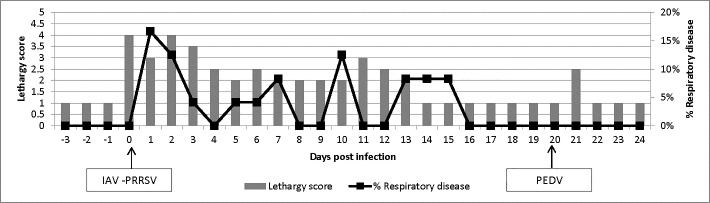
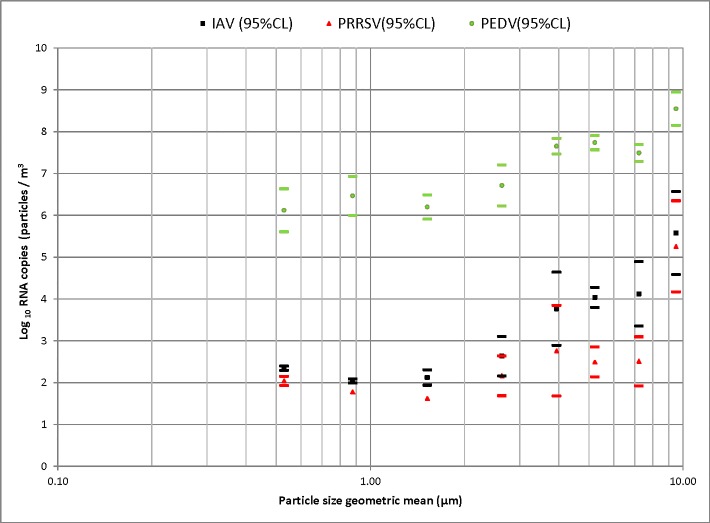
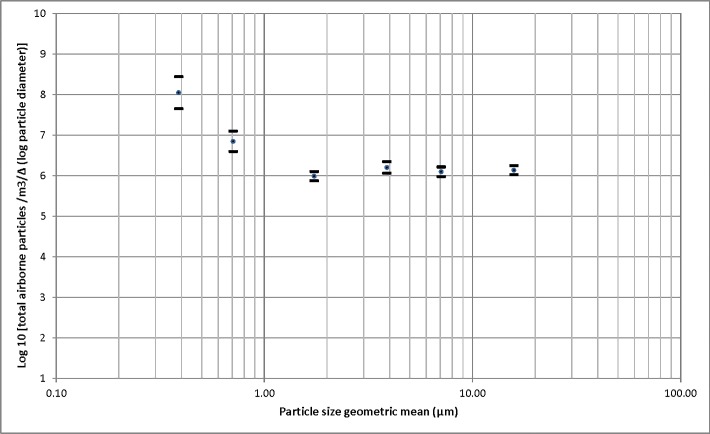
When pathogens become airborne, they travel associated with particles of different size and composition. Particle size determines the distance across which pathogens can be transported, as well as the site of deposition and the survivability of the pathogen. Despite the importance of this information, the size distribution of particles bearing viruses emitted by infectious animals remains unknown. In this study we characterized the concentration and size distribution of inhalable particles that transport influenza A virus (IAV), porcine reproductive and respiratory syndrome virus (PRRSV), and porcine epidemic diarrhea virus (PEDV) generated by acutely infected pigs and assessed virus viability for each particle size range. Aerosols from experimentally infected pigs were sampled for 24 days using an Andersen cascade impactor able to separate particles by size (ranging from 0.4 to 10 micrometer (μm) in diameter). Air samples collected for the first 9, 20 and the last 3 days of the study were analyzed for IAV, PRRSV and PEDV, respectively, using quantitative reverse transcription polymerase chain reaction (RT-PCR) and quantified as geometric mean copies/m(3) within each size range. IAV was detected in all particle size ranges in quantities ranging from 5.5x10(2) (in particles ranging from 1.1 to 2.1 μm) to 4.3x10(5) RNA copies/m(3) in the largest particles (9.0-10.0 μm). PRRSV was detected in all size ranges except particles between 0.7 and 2.1 μm in quantities ranging from 6x10(2) (0.4-0.7 μm) to 5.1x10(4) RNA copies/m(3) (9.0-10.0 μm). PEDV, an enteric virus, was detected in all particle sizes and in higher quantities than IAV and PRRSV (p < 0.0001) ranging from 1.3x10(6) (0.4-0.7 μm) to 3.5x10(8) RNA copies/m(3) (9.0-10.0 μm). Infectious status was demonstrated for the 3 viruses, and in the case of IAV and PRRSV, viruses were isolated from particles larger than 2.1 μm. In summary, our results indicated that airborne PEDV, IAV and PRRSV can be found in a wide range of particle sizes. However, virus viability is particle size dependent.
Conflict of interest statement
Figures
References
-
- Hyslop NS. Factors influencing the epidemiology and epizootiology of airborne diseases. J Am Vet Med Assoc 1971;159(11):1500–7. - PubMed
-
- Austin E, Brock J, Wissler E. A model for deposition of stable and unstable aerosols in the human respiratory tract. Am Ind Hyg Assoc J 1979;40(12):1055–1066. - PubMed
-
- Zuo ZL, Kuehn TH, Verma H, Kumar S, Goyal SM, Appert J, et al. Association of Airborne Virus Infectivity and Survivability with its Carrier Particle Size. Aerosol Science and Technology 2013;47(4):373–382 10.1080/02786826.2012.754841 - DOI
-
- Xie X, Li Y, Chwang ATY, Ho PL, Seto WH. How far droplets can move in indoor environments—revisiting the Wells evaporation-falling curve. Indoor Air 2007;17(3):211–25. - PubMed
Publication types
MeSH terms
Substances
LinkOut - more resources
Full Text Sources
Other Literature Sources
