Menstrual characteristics and prevalence of dysmenorrhea in college going girls
- PMID: 26288786
- PMCID: PMC4535108
- DOI: 10.4103/2249-4863.161345
Menstrual characteristics and prevalence of dysmenorrhea in college going girls
Abstract
Background: Dysmenorrhea is a common gynecological condition with painful menstrual cramps of uterine origin. Prevalence of primary dysmenorrhea is not yet clearly studied in central India.
Objective: To study prevalence of primary dysmenorrhea in young girls and to evaluate associated clinical markers of dysmenorrhea.
Materials and methods: In a cross-sectional study, data was collected among 310 girls (18-25 years) on age at menarche, presence and absence of dysmenorrhea, dysmenorrhea duration, pre-menstrual symptoms (PMS), family history, menses irregularities, menstrual history, severity grading using visual analogue scale (VAS) using a semi-structured questionnaire.
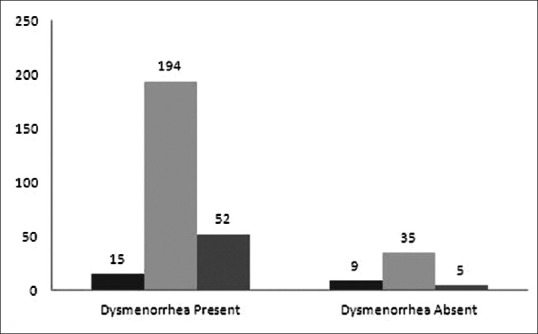
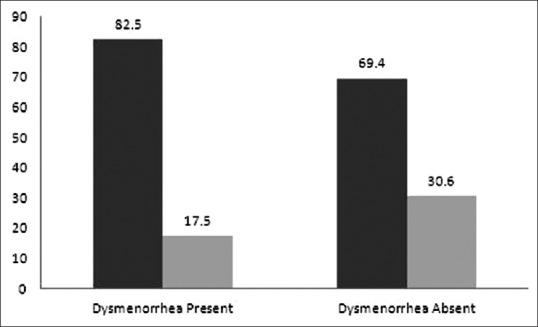
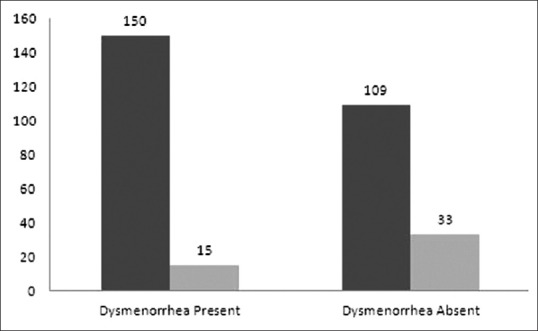
Results: Dysmenorrhea was reported in 84.2% (261) girls and 15.8% (49) reported no dysmenorrhea. Using VAS, 34.2% of girls experienced severe pain, 36.6% moderate and 29.2% had mild pain. Bleeding duration was found to be significantly associated with dysmenorrhea (χ(2) = 10.5; P < 0.05), girls with bleeding duration more than 5 days had 1.9 times more chance of getting dysmenorrhea (OR: 1.9; 95% CI: 1.7-3). Moreover, girls with the presence of clots had 2.07 times higher chance of having dysmenorrhea (OR: 2.07; 95% CI: 1.04-4.1) (P < 0.05). Almost 53.7% girls who had some family history of dysmenorrhea, 90.9% experience the condition themselves (χ(2) = 11.5; P < 0.001). Girls with family history of dysmenorrhea had three times greater chance of having the same problem (OR: 3.0; 95% CI: 1.5-5.8; P = 0.001).
Conclusion: Dysmenorrhea is found to be highly prevalent among college going girls. Family history, bleeding duration and presence of clots were significant risk factors for dysmenorrhea.
Keywords: Dysmenorrhea; prevalence; young girls.
Conflict of interest statement
Figures
References
-
- Zaiei S, Faghihzadeh S, Sohrabvand F, Lamyian M, Emamgholy T. A randomised placebo-controlled trial to determine the effect of vitamin E in treatment of primary dysmenorrhoea. BJOG. 2001;108:1181–3. - PubMed
-
- Harlow SD, Park M. A longitudinal study of risk factors for the occurrence, duration and severity of menstrual cramps in a cohort of college women. Br J Obstet Gynaecol. 1996;103:1134–42. - PubMed
-
- Nag RM. Calcutta: Medical Allied Agency; 1982. Adolescent in India; pp. 18–26.
LinkOut - more resources
Full Text Sources
Other Literature Sources