. 2016 Jan;159(1):111-21.
doi: 10.1093/jb/mvv082. Epub 2015 Aug 19.

The role of intra-domain disulfide bonds in heat-induced irreversible denaturation of camelid single domain VHH antibodies

Affiliations

The role of intra-domain disulfide bonds in heat-induced irreversible denaturation of camelid single domain VHH antibodies

Yoko Akazawa-Ogawa et al. J Biochem. 2016 Jan.

Abstract

Camelid-derived single domain VHH antibodies are highly heat resistant, and the mechanism of heat-induced VHH denaturation predominantly relies on the chemical modification of amino acids. Although chemical modification of disulfide bonds has been recognized as a cause for heat-induced denaturation of many proteins, there have been no mutagenesis studies, in which the number of disulfide bonds was controlled. In this article, we examined a series of mutants of two different VHHs with single, double or no disulfide bonds, and scrutinized the effects of these disulfide bond modifications on VHH denaturation. With the exception of one mutant, the heat resistance of VHHs decreased when the number of disulfide bonds increased. The effect of disulfide bonds on heat denaturation was more striking if the VHH had a second disulfide bond, suggesting that the contribution of disulfide shuffling is significant in proteins with multiple disulfide bonds. Furthermore, our results directly indicate that removal of a disulfide bond can indeed increase the heat resistance of a protein, irrespective of the negative impact on equilibrium thermodynamic stability.

Keywords: antibody engineering; disulfide bonds; protein chemical modification; protein engineering; protein stability.


Figures

Fig. 1
Fig. 1
Wild-type and mutant anti-hCG and anti-βLA VHHs used to examine the effect of disulfide bonds on heat-induced denaturation. Amino acid sequences of wild-type anti-hCG (A) and anti-βLA (B) VHHs are shown in upper case, and the amino acids in bold and underlined are the mutation positions. The residual Met of both VHHs expressed in E. coli, and linker and His-tag anti-βLA VHH are shown in lower case. The broken lines in the schematic representation of sequences indicate the disulfide bonds, and the bold and underlined characters are the introduced mutations.
Fig. 2
Fig. 2
Heat-induced irreversible denaturation of 2-SS (A) and 1-SS (B) anti-hCG VHHs by repetitive heating–cooling cycles or continuous incubation at 90°C. Anti-hCG VHH (100 nM) was subjected to repetitive (open circle) or continuous (closed circle) incubation at 90°C. The experiments were carried out at pH 7.4 in HBS buffer. In heating–cooling cycles, a given number of reaction segments, which consisted of heating at 90°C for 5 min and cooling at 20°C for 5 min, were repeated. Thus, one cycle corresponded to 5 min of continuous incubation. The solid and broken lines represent a single exponential curve fitted to the time-dependent denaturation of wild-type and mutant VHHs, respectively. In all panels, error bars represent standard deviations.
Fig. 3
Fig. 3
Heat-induced irreversible denaturation of anti-hCG VHHs lacking disulfide bonds at 90°C. 0-SS (WA) (A) and (AA) (B) anti-hCG VHHs (100 nM) were subjected to repetitive (open circle) or continuous (closed circle) incubation at 90°C. The denaturation of 0-SS (AI) (C) and 0-SS (WG) (D) anti-hCG VHHs by continuous heat treatment was also measured in HBS buffer. The solid and broken lines represent a single exponential curve fitted to the time-dependent denaturation of wild-type and mutant VHHs, respectively. In all panels, error bars represent standard deviations.
Fig. 4
Fig. 4
Heat-induced irreversible denaturation of anti-βLA VHHs lacking disulfide bonds at 90°C. Anti-βLA hCG mutants (100 nM), 0-SS (AA) (A) and 0-SS (AV) (B) were subjected to repetitive (open circle) or continuous (closed circle) incubation at 90°C at pH 7.4 in HBS buffer. The solid and broken lines represent a single exponential curve fitted to the time-dependent denaturation of wild-type and mutant VHHs, respectively. The insets show the ratio of residual activities in repetitive and continuous experiments at the same total incubation time, and the broken line represents the theoretical curve fitted by a single exponential equation. Error bars represent standard deviations.
Fig. 5
Fig. 5
The effect of protein concentration on VHH denaturation. Wild-type, 1-SS and 0-SS (WA) anti-hCG VHHs at different concentrations in HBS buffer (pH 7.4) were subjected to 400 min continuous heat treatment at 90°C. As the residual activity of 2-SS anti-hCG VHH was <10% after 400 min heat treatment, the concentration dependency of residual activity of 2-SS anti-hCG VHH was estimated based on 200 min incubation at 90°C. Error bars represent standard deviations.
Fig. 6
Fig. 6
The relationship between equilibrium thermodynamic stability and heat resistance of VHHs. The t1/290°C of wild-type and mutant anti-hCG and anti-βLA VHHs are plotted against the difference in Tm with wild-type VHH. VHHs with a different number of disulfide bonds were grouped by broken lines. Error bars represent standard deviations in the curve fitting analysis of the denaturation curves.
Fig. 7
Fig. 7
Temperature dependency of denaturation of wild-type and disulfide mutants of VHHs. Wild-type, 2-SS, 1-SS and 0-SS (WA) anti-hCG VHHs (100 nM) were subjected to continuous incubation for 200 min at different temperatures in HBS buffer (pH 7.4). Error bars represent standard deviations.
Fig. 8
Fig. 8
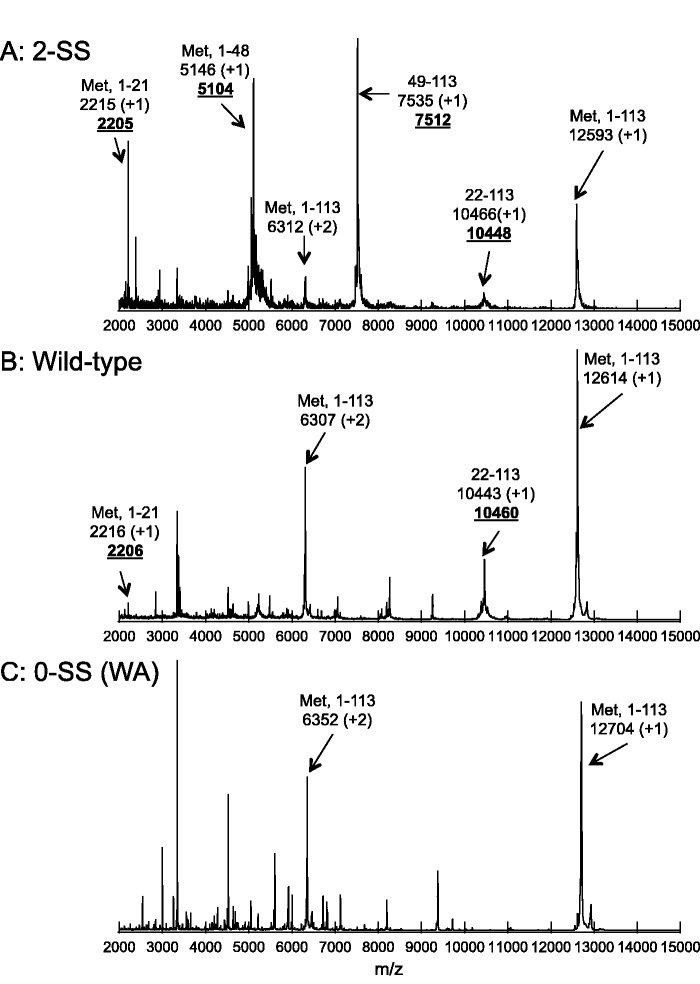
MALDI-TOF mass spectra of 2-SS (A), wild-type (B) and 0-SS (WA) (C) anti-hCG VHHs after heat treatment. The samples (5 µM) were incubated for 1600 min at 90°C in HBS buffer (pH 7.4). The arrows indicate full length VHH and hypothetical fragments resulting from digestion occurring at the cystines. The numbers at second line show the calculated molecular weight of hypothetical fragments with protonation states in parenthesis. The bold and underlined numbers at third line are measured m/z.
Fig. 9
Fig. 9
Heat-induced dimer formation of wild-type VHH. (A) Different concentrations of wild-type anti-hCG VHH, with and without heat treatment (90°C for 200 min in HBS buffer at pH 7.4), were analysed by SDS-PAGE. Different concentrations of untreated and heated samples were run on lanes 3–7, and lanes 9–13, respectively, under non-reducing condition. (B) After incubation at 90°C for 200 min, 50 and 100 µM of wild-type anti-hCG VHH were alkylated by iodoacetamide (lanes 4 and 5) and reduced by dithiothreitol (lanes 6 and 7). As a control, samples without heat treatment were run on lanes 2 and 3. Molecular weight markers were subjected to lane 1 and the numbers on the left of the panels indicate the molecular weights of marker proteins. The lane numbers are shown at the top of the panels.

References

    1. van der Linden R.H., Frenken L.G., de Geus B., Harmsen M.M., Ruuls R.C., Stok W., de Ron L., Wilson S., Davis P., Verrips C.T. (1999) Comparison of physical chemical properties of llama VHH antibody fragments and mouse monoclonal antibodies. Biochim Biophys Acta 1431, 37–46 - PubMed
    1. Perez J.M., Renisio J.G., Prompers J.J., van Platerink C.J., Cambillau C., Darbon H., Frenken L.G. (2001) Thermal unfolding of a llama antibody fragment: a two-state reversible process. Biochemistry 40, 74–83 - PubMed
    1. Dumoulin M., Conrath K., Van Meirhaeghe A., Meersman F., Heremans K., Frenken L.G., Muyldermans S., Wyns L., Matagne A. (2002) Single-domain antibody fragments with high conformational stability. Protein Sci. 11, 500–515 - PMC - PubMed
    1. Ladenson R.C., Crimmins D.L., Landt Y., Ladenson J.H. (2006) Isolation and characterization of a thermally stable recombinant anti-caffeine heavy-chain antibody fragment. Anal. Chem. 78, 4501–4508 - PubMed
    1. Omidfar K., Rasaee M.J., Kashanian S., Paknejad M., Bathaie Z. (2007) Studies of thermostability in Camelus bactrianus (Bactrian camel) single-domain antibody specific for the mutant epidermal-growth-factor receptor expressed by Pichia. Biotechnol. Appl. Biochem. 46, 41–49 - PubMed