Review
. 2014 May 15:56:2.
doi: 10.1186/2055-0391-56-2. eCollection 2014.

Hanwoo cattle: origin, domestication, breeding strategies and genomic selection

Affiliations
Review

Hanwoo cattle: origin, domestication, breeding strategies and genomic selection

Seung-Hwan Lee et al. J Anim Sci Technol. .

Abstract

Hanwoo (Korean cattle) is the native, taurine type of cattle breed of Korea and its history as a draft animal dates back to 5000 Years. In earlier times Hanwoo was used extensively for farming, transportation. Over the period of time, Hanwoo has changed to be meat type cattle. Full-scale production of Hanwoo as meat-type cattle has occurred since 1960s with the rapid growth of the Korean economy. Hanwoo is one of the most economically important species in Korea as it is a significant source of nutrition to the Korean people. Hanwoo beef is the most cherished food of Korea. One of the main goals of researchers is to increase the meat quality, quantity and taste of the beef. In this review we describe the origin, domestication of Hanwoo cattle and breeding program initiated from 1980's. Moreover the advent of technological advancement had provided us a platform to perform genome wide selection on economic traits and its implementation into traditional breeding programs.

Keywords: Domestication and breeding program; Hanwoo (Korean cattle); Origin.


Figures
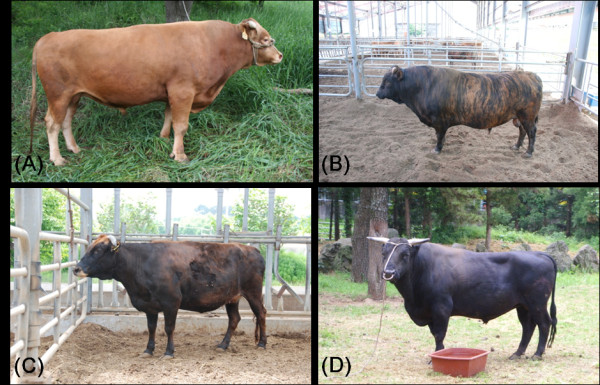
Figure 1
Figure 1
Pictures of four Hanwoo cattle. (A) Brown Hanwoo, (B) Brindle Hanwoo, (C) Black Hanwoo and (D) Jeju black Hanwoo.
Figure 2
Figure 2
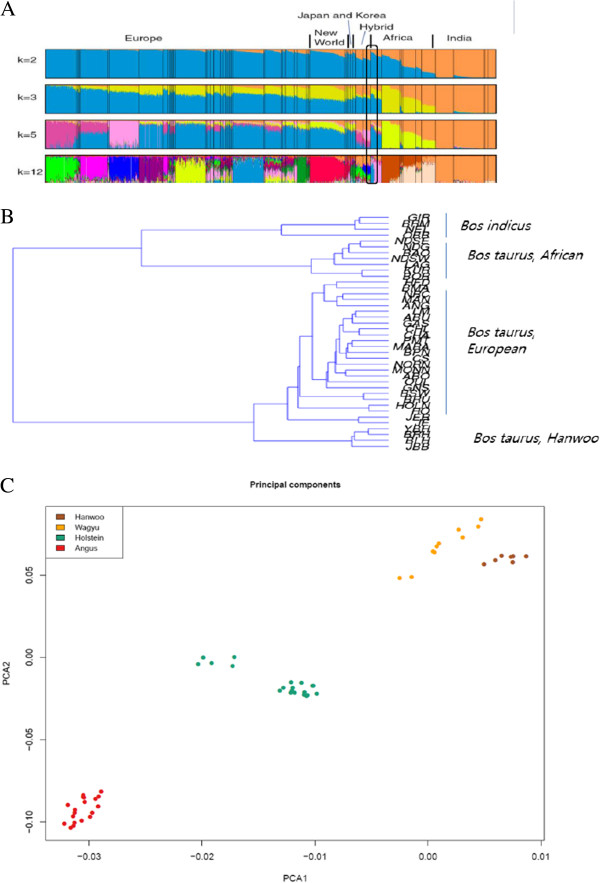
Comparison of Hanwoo compared to other taurine cattle. (A) Model-based population assignment for individuals based on the 50K SNP panel using STRUCTURE (K=3), YBH: Yanbian, CHB: Korean brindle, CS: Chosun, JBB: Jeju black, Ag: Angus, BS: Brown swiss, LM: Limousine, HF: Hereford, H: Holstein, BR: Brahman, HW: Hanwoo (B) A neighbor joining tree based on Pairwise Fst values, (C) Principal component analysis capturing a clear difference of north-east asian cattle.
Figure 3
Figure 3
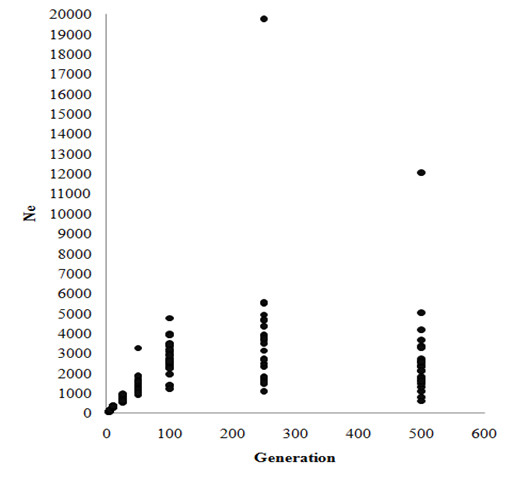
Effective population size from chromosome of the past Hanwoo (Korean cattle) population. Effective population size was estimated in each autosomal chromosome. The generation in the past population was calculated as 1/2c. Ne is plotted against the past generation up to 500 generation. (Extracted from [10]).
Figure 4
Figure 4
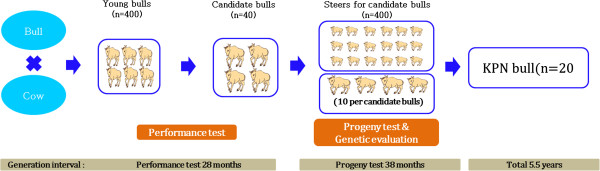
Pictorial representation of Hanwoo performances and progeny test (HPPT) program.
Figure 5
Figure 5
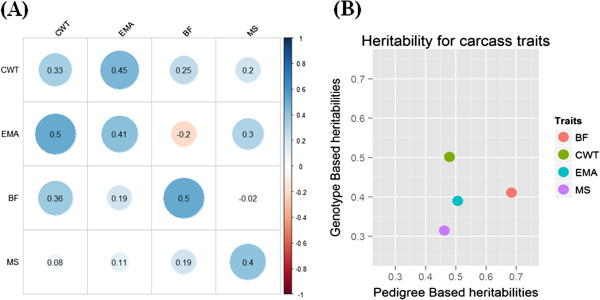
Heritability and genetic correlation for carcass trait in Hanwoo. Data are taken from a report for Hanwoo genetic improvement meeting (2013). (A) Along the diagonal (From upper left) are heritability values, upper triangle shows variance for genetic correlation and lower triangle shows residual variance. (B) Estimate of heritability from a pedigree and genotype for carcass traits in Hanwoo.
Figure 6
Figure 6
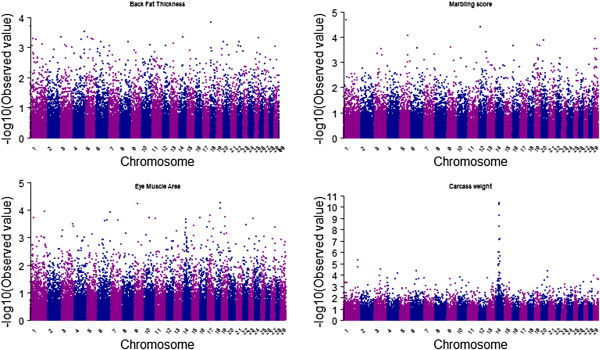
Association of SNPs with the carcass traits in the Hanwoo shown as a Manhattan plot.
Figure 7
Figure 7
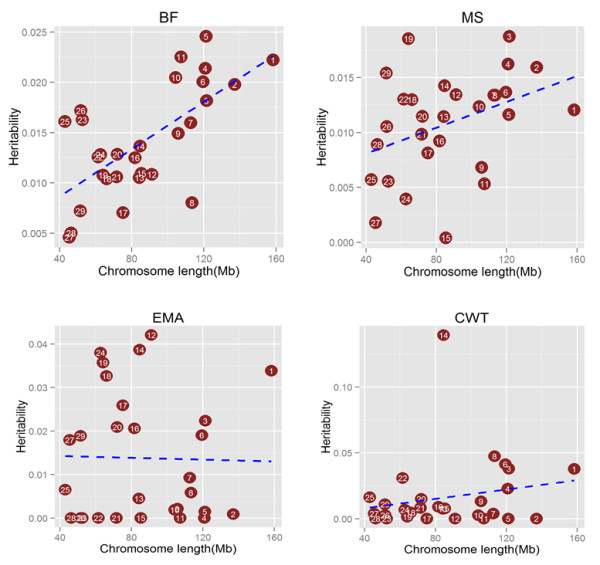
Proportion of variance attibuted to each chromosome averaged across four carcass traits against chromosome length.

References

    1. Korea Meat Trade Association (KMTA) Information and Data of Agricultural Statistics Of Korea. 2011.
    1. Jo C, Cho SH, Chang J, Nam KC. Keys to production and processing of Hanwoo beef: a perspective of tradition and science. Anim Front. 2012;2(4):32–38. doi: 10.2527/af.2012-0060. - DOI
    1. Cho SH, Kim J, Park BY, Seong PN, Kang GH, Kim JH, Jung SG, Im SK, Kim DH. Assessment of meat quality properties and development of a palatability prediction model for Korean Hanwoo steer beef. Meat Sci. 2010;86:236–242. doi: 10.1016/j.meatsci.2010.05.011. - DOI - PubMed
    1. Han SW. The Breed of Cattles. 1996. pp. 148–160.
    1. Lee C, Pollak EJ. Genetic antagonism between body weight and milk production in beef cattle. J Anim Sci. 2002;80:316–321. - PubMed