


Diffuse Lung Disease in Biopsied Children 2 to 18 Years of Age. Application of the chILD Classification Scheme
- PMID: 26291470
- PMCID: PMC4627419
- DOI: 10.1513/AnnalsATS.201501-064OC
Diffuse Lung Disease in Biopsied Children 2 to 18 Years of Age. Application of the chILD Classification Scheme
Abstract
Rationale: Children's Interstitial and Diffuse Lung Disease (chILD) is a heterogeneous group of disorders that is challenging to categorize. In previous study, a classification scheme was successfully applied to children 0 to 2 years of age who underwent lung biopsies for chILD. This classification scheme has not been evaluated in children 2 to 18 years of age.
Objectives: This multicenter interdisciplinary study sought to describe the spectrum of biopsy-proven chILD in North America and to apply a previously reported classification scheme in children 2 to 18 years of age. Mortality and risk factors for mortality were also assessed.
Methods: Patients 2 to 18 years of age who underwent lung biopsies for diffuse lung disease from 12 North American institutions were included. Demographic and clinical data were collected and described. The lung biopsies were reviewed by pediatric lung pathologists with expertise in diffuse lung disease and were classified by the chILD classification scheme. Logistic regression was used to determine risk factors for mortality.
Measurements and main results: A total of 191 cases were included in the final analysis. Number of biopsies varied by center (5-49 biopsies; mean, 15.8) and by age (2-18 yr; mean, 10.6 yr). The most common classification category in this cohort was Disorders of the Immunocompromised Host (40.8%), and the least common was Disorders of Infancy (4.7%). Immunocompromised patients suffered the highest mortality (52.8%). Additional associations with mortality included mechanical ventilation, worse clinical status at time of biopsy, tachypnea, hemoptysis, and crackles. Pulmonary hypertension was found to be a risk factor for mortality but only in the immunocompetent patients.
Conclusions: In patients 2 to 18 years of age who underwent lung biopsies for diffuse lung disease, there were far fewer diagnoses prevalent in infancy and more overlap with adult diagnoses. Immunocompromised patients with diffuse lung disease who underwent lung biopsies had less than 50% survival at time of last follow-up.
Keywords: interstitial lung disease; pathology; rare pediatric lung disease.
Figures


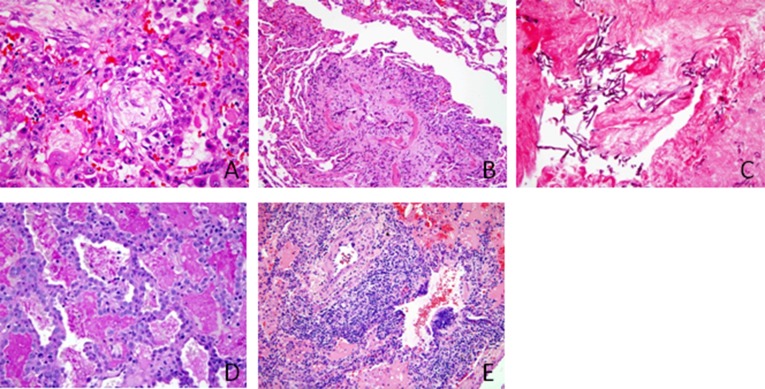
Comment in
-
Pushing chILD Forward: The Bright Future of Children's Interstitial Lung Diseases.Ann Am Thorac Soc. 2015 Oct;12(10):1428-9. doi: 10.1513/AnnalsATS.201508-550ED. Ann Am Thorac Soc. 2015. PMID: 26448346 No abstract available.
References
-
- Das S, Langston C, Fan LL. Interstitial lung disease in children. Curr Opin Pediatr. 2011;23:325–331. - PubMed
-
- Deterding R. Evaluating infants and children with interstitial lung disease. Semin Respir Crit Care Med. 2007;28:333–341. - PubMed
-
- Fan LL, Langston C. Pediatric interstitial lung disease: children are not small adults. Am J Respir Crit Care Med. 2002;165:1466–1467. - PubMed
-
- Deterding RR, Pye C, Fan LL, Langston C. Persistent tachypnea of infancy is associated with neuroendocrine cell hyperplasia. Pediatr Pulmonol. 2005;40:157–165. - PubMed
Publication types
MeSH terms
Grants and funding
LinkOut - more resources
Full Text Sources
Medical
