. 2015 Aug 22;16(1):631.
doi: 10.1186/s12864-015-1819-3.

Stool microbiota composition is associated with the prospective risk of Plasmodium falciparum infection

Affiliations

Stool microbiota composition is associated with the prospective risk of Plasmodium falciparum infection

Shibu Yooseph et al. BMC Genomics. .

Abstract

Background: In humans it is unknown if the composition of the gut microbiota alters the risk of Plasmodium falciparum infection or the risk of developing febrile malaria once P. falciparum infection is established. Here we collected stool samples from a cohort composed of 195 Malian children and adults just prior to an intense P. falciparum transmission season. We assayed these samples using massively parallel sequencing of the 16S ribosomal RNA gene to identify the composition of the gut bacterial communities in these individuals. During the ensuing 6-month P. falciparum transmission season we examined the relationship between the stool microbiota composition of individuals in this cohort and their prospective risk of both P. falciparum infection and febrile malaria.

Results: Consistent with prior studies, stool microbial diversity in the present cohort increased with age, although the overall microbiota profile was distinct from cohorts in other regions of Africa, Asia and North America. Age-adjusted Cox regression analysis revealed a significant association between microbiota composition and the prospective risk of P. falciparum infection; however, no relationship was observed between microbiota composition and the risk of developing febrile malaria once P. falciparum infection was established.

Conclusions: These findings underscore the diversity of gut microbiota across geographic regions, and suggest that strategic modulation of gut microbiota composition could decrease the risk of P. falciparum infection in malaria-endemic areas, potentially as an adjunct to partially effective malaria vaccines.


Figures
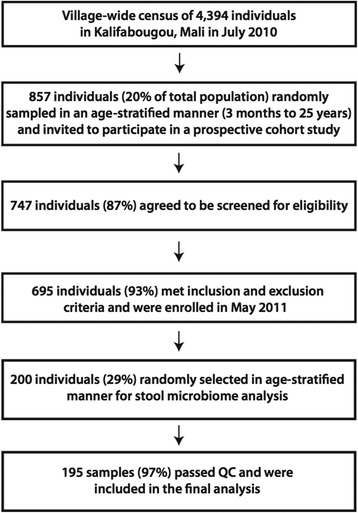
Fig. 1
Fig. 1
Selection of study subjects for stool microbiota analysis
Fig. 2
Fig. 2
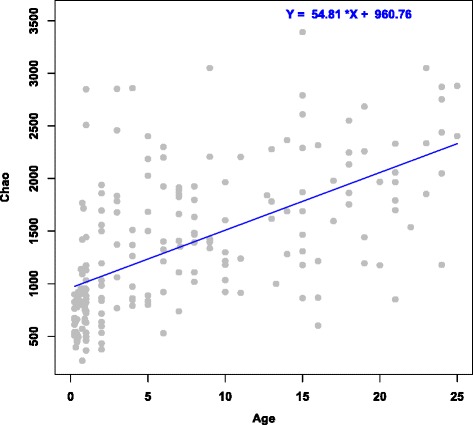
Increase in microbial taxa diversity with age in the Malian cohort. For each stool microbiota sample, the alpha diversity (Chao estimate) of the microbial community (y-axis) was plotted against the individual’s age in years (x-axis). The blue line is the linear model fit and has a positive slope (P < 10−15)
Fig. 3
Fig. 3
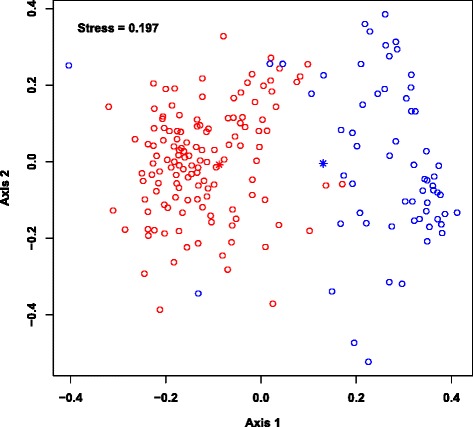
An NMDS ordination of the microbiota samples. The taxonomic profiles of the samples were used to compute a sample dissimilarity matrix (using Bray-Curtis measure) and this matrix was used to compute an ordination of the samples in two dimensions (Axis 1 and Axis 2). The goodness of fit (or stress) associated with this ordination is 0.197. The circles in this plot denote the samples. The two sample groups (or Dirichlet components) identified using the mixture modeling are denoted in red (DC1) and blue (DC2). The average ages for the groups are 10.3 years (DC1) and 1.3 years (DC2). Asterisks denote the vectors of mean taxa proportions associated with the corresponding Dirichlet components
Fig. 4
Fig. 4
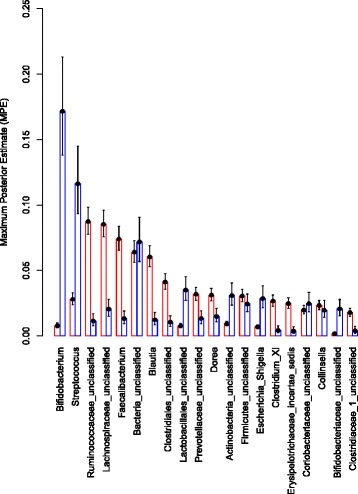
Mean proportions (calculated using Maximum Posterior Estimate) of the twenty most abundant taxa (based on abundance in one of the groups) in the two Dirichlet components: the older DC1 group (red) and younger DC2 group (blue). The lower and upper 95 % credible intervals are shown as error bars
Fig. 5
Fig. 5
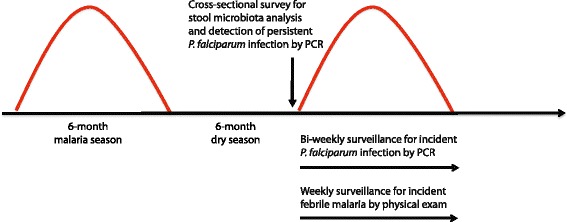
Definition of persistent P. falciparum infection, incident P. falciparum infection, and incident febrile malaria. This longitudinal cohort study in Mali was designed to take advantage of the sharply demarcated 6-month malaria season (July – December) and 6-month dry season (January – June) during which there is either intense or negligible P. falciparum transmission, respectively. Stool microbiota composition was determined for all study subjects in a cross-sectional survey at the end of the 6-month dry season. For each subject, we examined the relationship between stool microbiota composition and the risk of persistent P. falciparum infection, incident P. falciparum infection and incident febrile malaria. Individuals with P. falciparum infections that persisted without symptoms through the dry season were identified by PCR analysis of fingerprick blood samples in a cross-sectional survey at the end of the 6-month dry season (at the time of stool collection). For subjects who began the malaria season without P. falciparum infection, incident P. falciparum infections during the ensuing malaria season were detected prospectively through bi-weekly PCR analysis of fingerprick blood samples. For all subjects who became infected with P. falciparum blood-stage parasites, incident cases of febrile malaria (axillary temperature ≥37.5 °C and ≥2500 asexual parasites/μl of blood) were detected prospectively during the ensuing malaria season through weekly physical examination by the study physician and blood smear microscopy if malaria was suspected
Fig. 6
Fig. 6
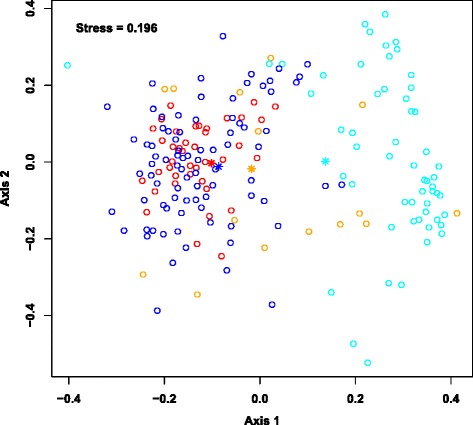
NMDS ordination of the Mali samples on the basis of P. falciparum infection status at the end of the 6-month dry season. Samples from subjects with persistent, asymptomatic P. falciparum infection at the end of the dry season fall into two components PP1 (orange) and PP2 (red); samples from P. falciparum-uninfected subjects fall into two components as well – PN1 (cyan) and PN2 (blue). The mean vector of each component is labeled with an asterisk in their respective color. The average ages for the groups are 3.2 years (PP1), 13.6 years (PP2), 1.3 years (PN1) and 9.2 years (PN2)
Fig. 7
Fig. 7
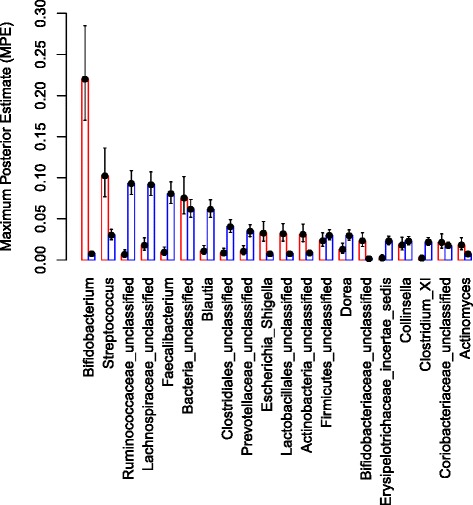
Mean proportions (Maximum Posterior Estimate) of the twenty most abundant taxa in the two Dirichlet components PP2 (red) and PN2 (blue). The lower and upper 95 % credible intervals are shown as error bars
Fig. 8
Fig. 8
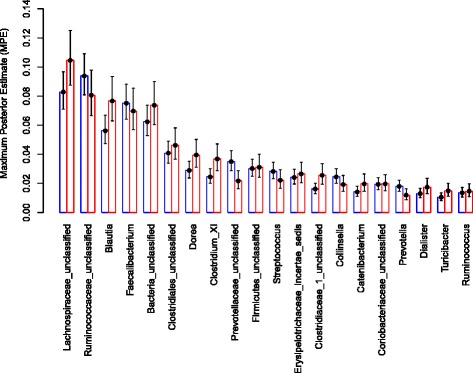
Mean proportions (Maximum Posterior Estimate) of the twenty most abundant taxa in the two Dirichlet components FM1 (red) and FM2 (blue). The lower and upper 95 % credible intervals are shown as error bars
Fig. 9
Fig. 9
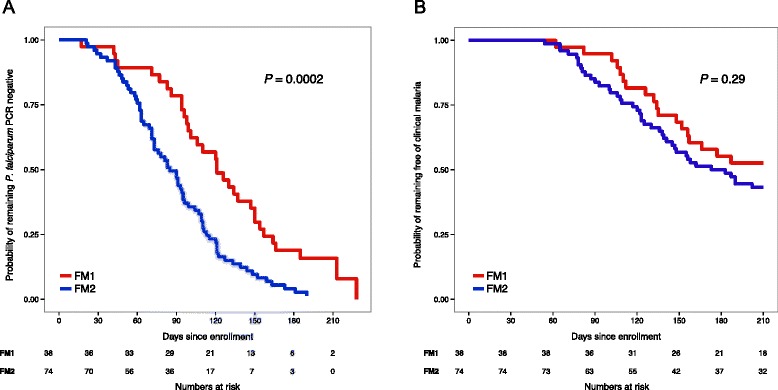
Stool microbiota composition is associated with the prospective risk of P. falciparum infection but not the prospective risk of febrile malaria. Kaplan-Meier plots showing time to (a) the first PCR-confirmed P. falciparum blood-stage infection (irrespective of whether symptoms were present) and (b) the first febrile malaria episode among subjects with documented P. falciparum infection, stratified by the two DMM sample groups FM1 and FM2. P values comparing FM1 to FM2 were calculated by the log-rank test

References

    1. Gill SR, Pop M, Deboy RT, Eckburg PB, Turnbaugh PJ, Samuel BS, Gordon JI, Relman DA, Fraser-Liggett CM, Nelson KE. Metagenomic analysis of the human distal gut microbiome. Science. 2006;312(5778):1355–9. doi: 10.1126/science.1124234. - DOI - PMC - PubMed
    1. Human Microbiome Project C Structure, function and diversity of the healthy human microbiome. Nature. 2012;486(7402):207–14. doi: 10.1038/nature11234. - DOI - PMC - PubMed
    1. Human Microbiome Project C A framework for human microbiome research. Nature. 2012;486(7402):215–21. doi: 10.1038/nature11209. - DOI - PMC - PubMed
    1. Qin J, Li R, Raes J, Arumugam M, Burgdorf KS, Manichanh C, Nielsen T, Pons N, Levenez F, Yamada T, et al. A human gut microbial gene catalogue established by metagenomic sequencing. Nature. 2010;464(7285):59–65. doi: 10.1038/nature08821. - DOI - PMC - PubMed
    1. Yatsunenko T, Rey FE, Manary MJ, Trehan I, Dominguez-Bello MG, Contreras M, Magris M, Hidalgo G, Baldassano RN, Anokhin AP, et al. Human gut microbiome viewed across age and geography. Nature. 2012;486(7402):222–7. - PMC - PubMed

Publication types

MeSH terms