


The topology of pen-2, a γ-secretase subunit, revisited: evidence for a reentrant loop and a single pass transmembrane domain
- PMID: 26296997
- PMCID: PMC4546279
- DOI: 10.1186/s13024-015-0037-4
The topology of pen-2, a γ-secretase subunit, revisited: evidence for a reentrant loop and a single pass transmembrane domain
Abstract
Background: The γ-secretase complex, composed of transmembrane proteins termed presenilin (PS), anterior pharynx defective (APH), nicastrin (NCT), and presenilin enhancer-2 (Pen-2) catalyzes intramembranous hydrolysis of a variety of Type I membrane protein substrates. In order to understand aspects of subunit assembly, interactions, dynamics and catalysis, it is essential to clarify the membrane topology of each polypeptide. Hydophathicity plots predict that the 101 amino acid Pen-2 molecule has two hydrophobic domains (HP1 and HP2) that may serve as transmembrane spanning domains. Earlier reports indicated that transiently overexpressed Pen-2 uses these two hydrophobic domains as transmembrane helices that generates a "U-shaped" hairpin topology with both amino- (N-) and carboxyl-(C-) termini facing the lumen. In this report, we have reexamined the topology of endogenous Pen-2 and Pen-2 chimeras that are stably expressed in mammalian cells, and have assessed the function of these molecules in rescuing γ-secretase activity in Pen-2-deficient fibroblasts.
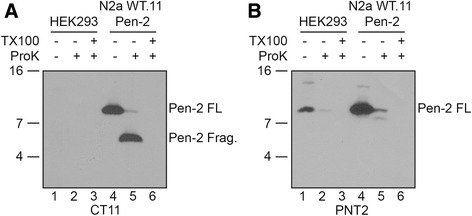
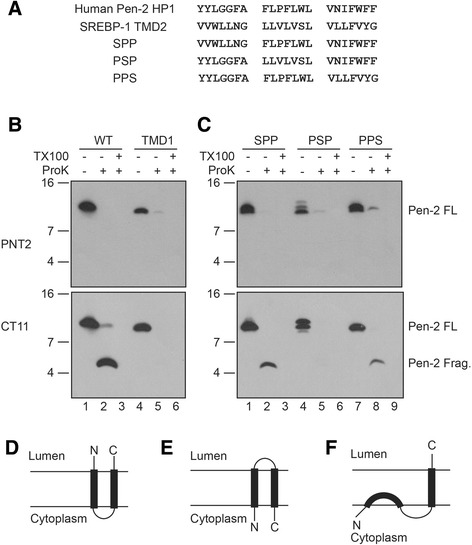
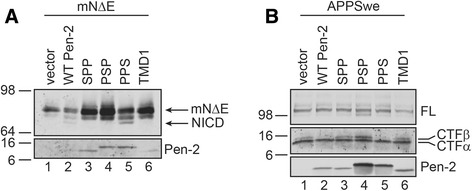
Results: We confirm that the Pen-2 C-terminus is lumenal, but the N-terminus of Pen-2 is exposed to the cytoplasm, thus indicating that HP1 does not traverse the lipid bilayer as a transmembrane domain. Domain swapping studies reveal the importance of specific regions within the first hydrophobic domain of Pen-2 that are critical for generating the topology that is a prerequisite for mediating PS1 endoproteolysis and γ-secretase activity. Finally, we report that the first fourteen amino acids of the Pen-2 HP1 are required for γ-secretase activity.
Conclusions: We propose that the first hydrophobic domain of Pen-2 forms a structure similar to a reentrant loop while the second hydrophobic domain spans the lipid bilayer.
Figures
References
-
- Fraering PC, LaVoie MJ, Ye W, Ostaszewski BL, Kimberly WT, Selkoe DJ, et al. Detergent-dependent dissociation of active gamma-secretase reveals an interaction between Pen-2 and PS1-NTF and offers a model for subunit organization within the complex. Biochemistry. 2004;43(2):323–333. doi: 10.1021/bi035748j. - DOI - PubMed
Publication types
MeSH terms
Substances
Grants and funding
LinkOut - more resources
Full Text Sources
Other Literature Sources
