. 2015 Sep 15:286:33-41.
doi: 10.1016/j.jneuroim.2015.07.003. Epub 2015 Jul 11.

Increased production of IL-17 in children with autism spectrum disorders and co-morbid asthma

Affiliations

Increased production of IL-17 in children with autism spectrum disorders and co-morbid asthma

Marjannie Eloi Akintunde et al. J Neuroimmunol. .

Abstract

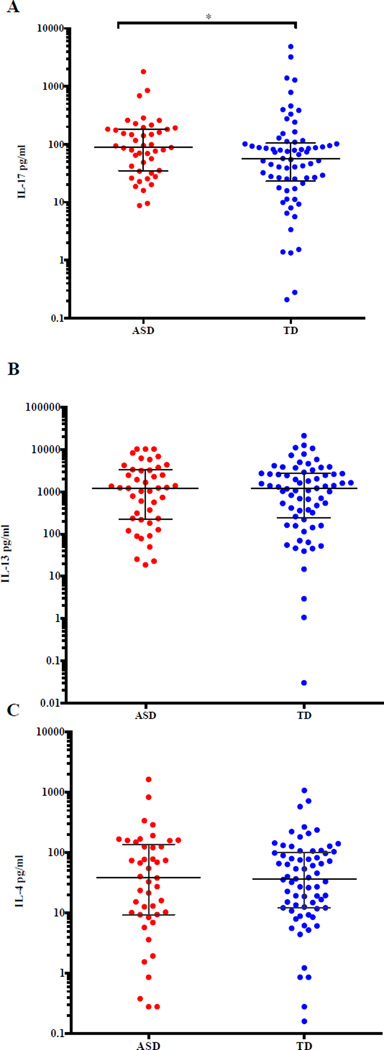
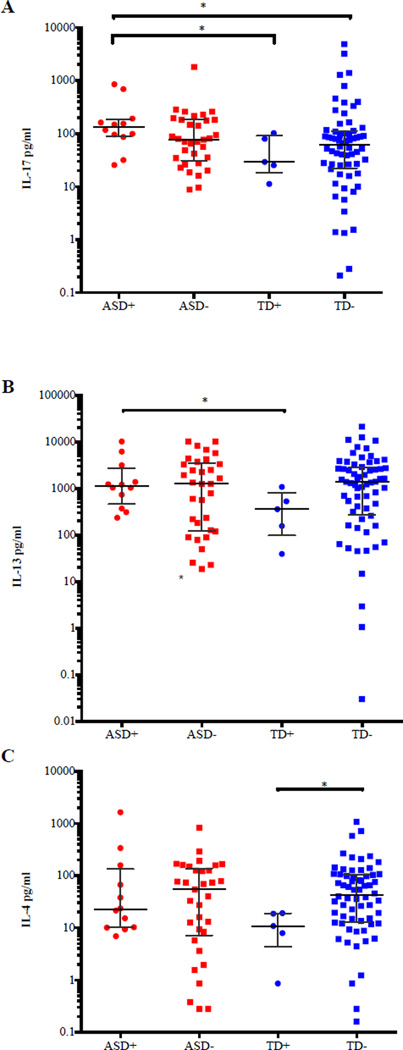
Inflammation and asthma have both been reported in some children with autism spectrum disorder (ASD). To further assess this connection, peripheral immune cells isolated from young children with ASD and typically developing (TD) controls and the production of cytokines IL-17, -13, and -4 assessed following ex vivo mitogen stimulation. Notably, IL-17 production was significantly higher following stimulation in ASD children compared to controls. Moreover, IL-17 was increased in ASD children with co-morbid asthma compared to controls with the same condition. In conclusion, children with ASD exhibited a differential response to T cell stimulation with elevated IL-17 production compared to controls.

Keywords: Asthma; Autism; Food allergies; IL-17.


Figures

Figure 1
Figure 1
Cytokine expression of IL-17, IL-13 and IL-4 in PHA-stimulated cell culture supernatant from ASD and TD participants. A) There is a significant difference in PHA-stimulated IL-17 levels in ASD cases compared to TD controls (p=0.047). B) No significant difference was observed from PHA-stimulated IL-13 levels from cell culture supernatants between groups. C) No significant difference was observed from PHA-stimulated IL-4 levels from cell culture supernatants between groups. P-values were determined by a two-tailed Mann-Whitney U t-test. (*p<0.05, **p<0.001). Bars represent the median and interquartile range on a log10 Y-axis.
Figure 2
Figure 2
IL-17, IL-13 and IL-4 expression in ASD and TD participants with and without asthma. A) There is a highly significant difference in PHA-stimulated IL-17 levels from ASD cases with asthma compared to TD controls with asthma (p=0.019) and TD controls without asthma (p=0.018). B) There is a significant difference in PHA-stimulated IL-13 levels between ASD cases with asthma compared to TD cases with asthma (p=0.047). C) There is a significant difference in PHA-stimulated IL-4 levels between TD cases with and without asthma where those typically developing children without asthma produce higher amounts of IL-4 (p=0.022) respectively. P-values were determined by a two-tailed Mann-Whitney U test. (*p<0.05, **p<0.001). (+) with asthma; (−) asthma. Bars represent the median and interquartile range on a log10 Y-axis.
Figure 3
Figure 3
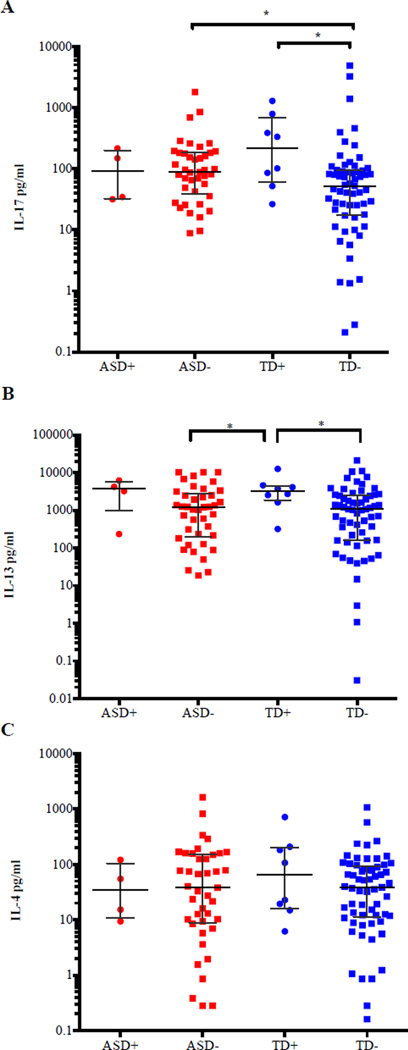
IL-17, IL-13 and IL-4 expression in ASD, TD participants with and without reported food allergies. A) There was a significant difference in PHA-stimulated IL-17 levels from ASD cases without reported food allergies compared to TD cases without reported food allergies (p=0.011). In addition, there was a significant difference in PHA-stimulated IL-17 levels between TD cases with and without food allergies (p=0.021). B) There was a significant difference in PHA-stimulated IL-13 levels from TD cases with reported food allergy compared to ASD cases without any reported food allergy (p=0.030) and TD cases without a reported allergy (p=0.013). C) No significant difference was observed for PHA-stimulated IL-4 levels from cell culture supernatants between groups. P-values were determined by a two-tailed Mann-Whitney U test. (*p<0.05, **p<0.001). (+) with reported food allergy ; (−) without any reported food allergy. Bars represent the median and interquartile range on a log10 Y-axis.

References

    1. Al-Ayadhi LY, Mostafa GA. A lack of association between elevated serum levels of S100B protein and autoimmunity in autistic children. J Neuroinflammation. 2012;9:54. - PMC - PubMed
    1. Ashwood P, Enstrom A, Krakowiak P, Hertz-Picciotto I, Hansen RL, Croen LA, Ozonoff S, Pessah IN, Van de Water J. Decreased transforming growth factor beta1 in autism: a potential link between immune dysregulation and impairment in clinical behavioral outcomes. Journal of neuroimmunology. 2008;204:149–153. - PMC - PubMed
    1. Ashwood P, Krakowiak P, Hertz-Picciotto I, Hansen R, Pessah I, Van de Water J. Elevated plasma cytokines in autism spectrum disorders provide evidence of immune dysfunction and are associated with impaired behavioral outcome. Brain Behav. Immun. 2010a;25:40–45. - PMC - PubMed
    1. Ashwood P, Krakowiak P, Hertz-Picciotto I, Hansen R, Pessah IN, Van de Water J. Altered T cell responses in children with autism. Brain Behav. Immun. 2010b - PMC - PubMed
    1. Ashwood P, Krakowiak P, Hertz-Picciotto I, Hansen R, Pessah IN, Van de Water J. Altered T cell responses in children with autism. Brain Behav. Immun. 2011a;25:840–849. - PMC - PubMed

Publication types