


Hepatitis C virus (HCV) disease progression in people who inject drugs (PWID): A systematic review and meta-analysis
- PMID: 26298331
- PMCID: PMC4577462
- DOI: 10.1016/j.drugpo.2015.07.004
Hepatitis C virus (HCV) disease progression in people who inject drugs (PWID): A systematic review and meta-analysis
Abstract
Background: Understanding HCV disease progression rates among people who inject drugs (PWID) is important to setting policy to expand access to detection, diagnosis and treatment, and in forecasting the burden of disease. In this paper we synthesize existing data on the natural history of HCV among PWID, including fibrosis progression rates (FPR) and the incidence of compensated cirrhosis (CC), decompensated cirrhosis (DC), and hepatocellular carcinoma (HCC).
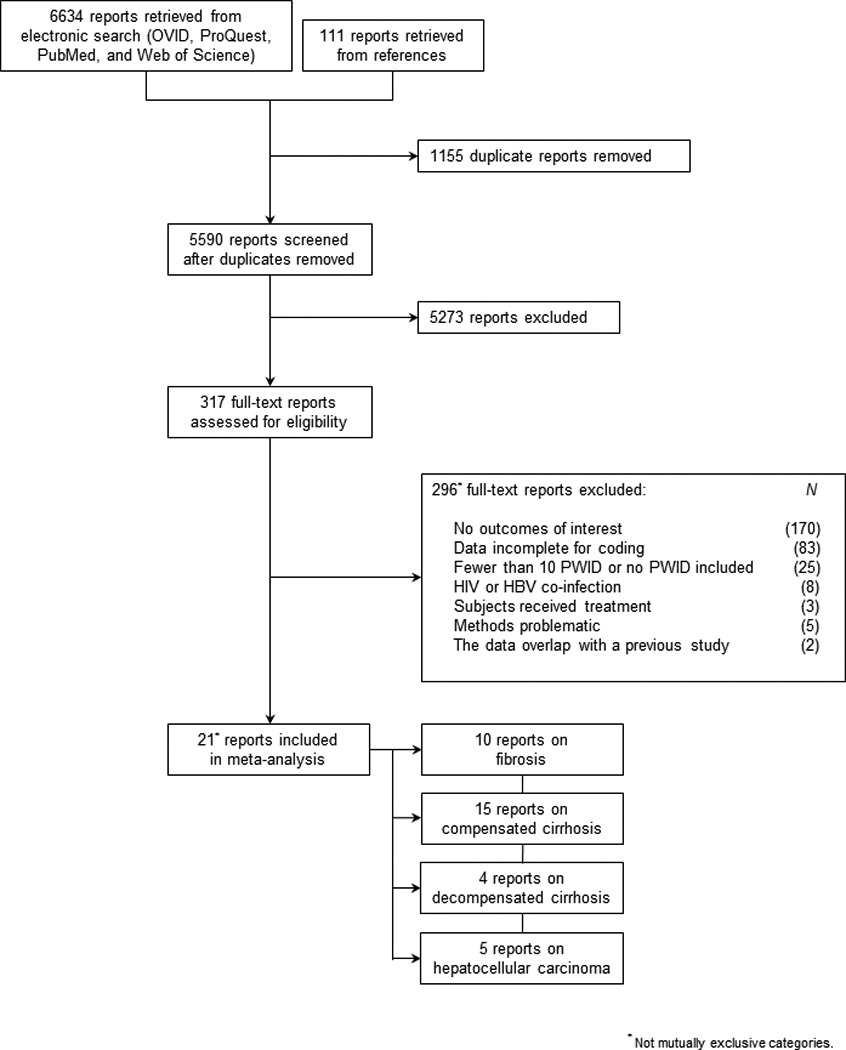
Methods: We conducted electronic and manual searches for published and unpublished literature. Reports were eligible if they (i) included participants who were chronically infected with HCV and reported current or previous injection drug use; (ii) presented original data on disease progression in a study sample comprised of at least 90% PWID; (iii) published between January 1, 1990, and December 31, 2013; and (iv) included data from upper-middle- or high-income countries. Quality ratings were assigned using an adaptation of the Quality In Prognosis Studies (QUIPS) tool. We estimated pooled FPRs using the stage-constant and stage-specific methods, and pooled incidence rates of CC, DC, and HCC.
Results: Twenty-one reports met the study inclusion criteria. Based on random-effect models, the pooled stage-constant FPR was 0.117 METAVIR units per year (95% CI, 0.099-0.135), and the stage-specific FPRs were F0→F1, 0.128 (95% CI 0.080, 0.176); F1→F2, 0.059 (95% CI 0.035, 0.082); F2→F3, 0.078 (95% CI 0.056, 0.100); and F3→F4, 0.116 (95% CI 0.070, 0.161). The pooled incidence rates of CC, DC, and HCC were 6.6 (95% CI 4.8, 8.4), 1.1 (95% CI 0.8, 1.4), and 0.3 (95% CI -0.1, 0.6) events per 1000 person-years, respectively. Following the stage-constant estimate, average time to cirrhosis is 34 years post-infection, and time to METAVIR stage F3 is 26 years; using the stage-specific estimates, time to cirrhosis is 46 years and time to F3 is 38 years.
Conclusion: Left untreated, PWID with chronic HCV infection will develop liver sequelae (including HCC) in mid- to late-adulthood. Delaying treatment with the new drug regimens until advanced fibrosis develops prolongs the period of infectiousness to perhaps thirty years. Scaling up of effective HCV prevention and early engagement in care and treatment will facilitate the elimination HCV as a source of serious disease in PWID.
Keywords: Cirrhosis; Hepatitis C; Liver fibrosis; Natural history; People who inject drugs.
Copyright © 2015 Elsevier B.V. All rights reserved.
Conflict of interest statement
The authors have no conflicts of interest to disclose.
Figures
References
-
- Aceijas C, Rhodes T. Global estimates of prevalence of HCV infection among injecting drug users. International Journal of Drug Policy. 2007;18(5):352–358. - PubMed
-
- Adeyemi O, Jensen D, Attar B, Ghaoui R, Gallagher M, Wolen D, Cotler S. Hepatitis C treatment eligibility in an urban population with and without HIV coinfection. AIDS Patient Care STDs. 2004;18:239–245. - PubMed
-
- Alter M. HCV routes of transmission: What goes around comes around. Seminars in Liver Diseases. 2011;31(4):340–346. - PubMed
-
- American Association for the Study of Liver Diseases, Infectious Diseases Society of America, & International Antiviral Society—USA. Recommendations for testing, managing, and treating hepatitis C. 2015 Retrieved 9th January 2015 from http://www.hcvguidelines.org. - PMC - PubMed
-
- Averhoff F, Glass N, Holtzman D. Global burden of hepatitis C: considerations for healthcare providers in the United States. Clinical Infectious Diseases. 2012;55(Supplement 1):S10–S15. - PubMed
Publication types
MeSH terms
Grants and funding
LinkOut - more resources
Full Text Sources
Other Literature Sources
Medical
Miscellaneous
