


Assessment of the risk of falling with the use of timed up and go test in the elderly with lower extremity osteoarthritis
- PMID: 26300633
- PMCID: PMC4535541
- DOI: 10.2147/CIA.S86001
Assessment of the risk of falling with the use of timed up and go test in the elderly with lower extremity osteoarthritis
Abstract
Background: Falling in the elderly results in a significant number of admissions to hospitals and long-term care facilities, especially among patients with lower extremity osteoarthritis (OA).
Objective: The aim of the study was to assess the risk of falling in adults older than 60 years with OA using timed up and go (TUG) test.
Materials and methods: A total of 187 patients (aged >60 years) were enrolled in the study. The assessment included: basic activities of daily living (ADLs), lower extremity strength with the use of the 30-second chair stand test (30 CST), and assessment of the risk of falling (TUG test). Pain intensity was evaluated with the numeric rating scale (NRS).
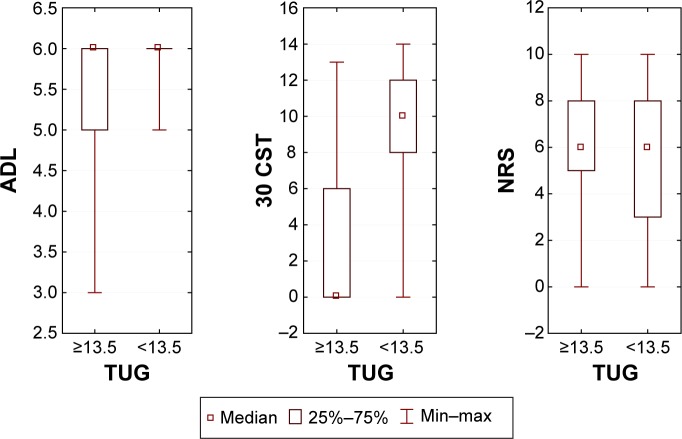
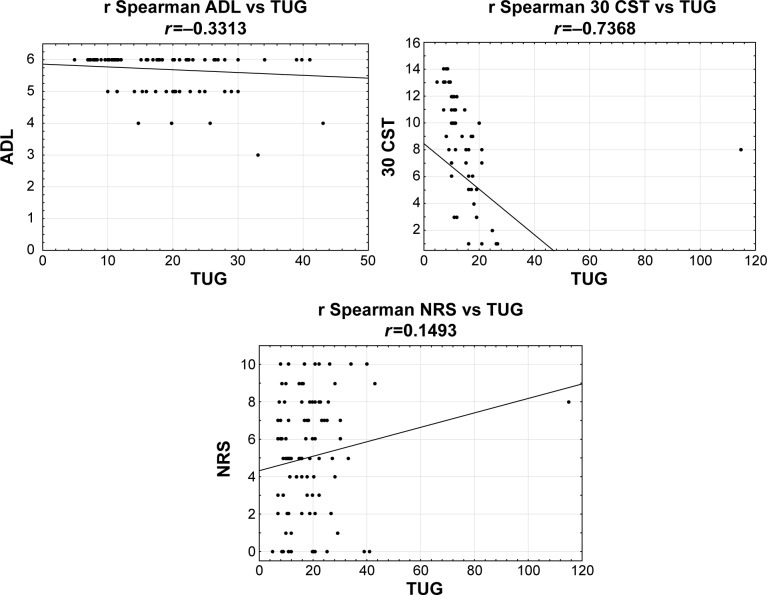
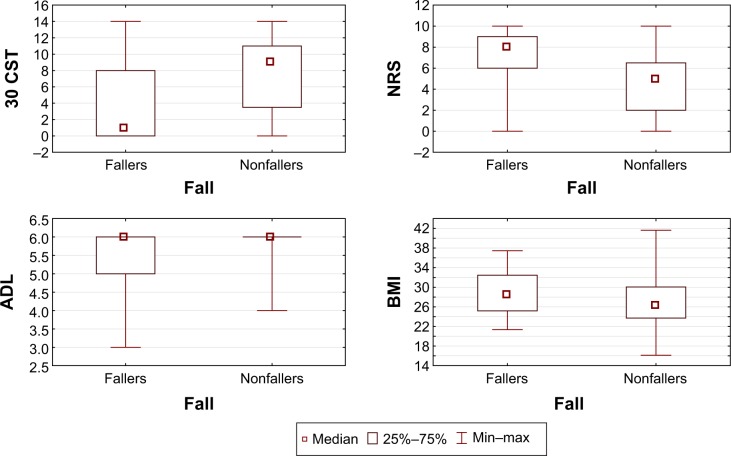
Results: The TUG test results were significantly better in younger OA patients (aged 60-69 years), as compared with their older peers (aged 70-79 years; P<0.01) and the oldest group (aged >80 years; P<0.001). Also, the 30 CST results were significantly higher in younger OA patients (P<0.05). Subjects older than 80 years had a significantly worse ADL score (P<0.05 and P<0.001). Pain complaints were reported significantly more frequently by women than men (P<0.05). A correlation between age and the TUG test score (r=0.412; P<0.0004) as well as between the TUG test and the 30 CST scores (r=0.7368; P=0.000) was detected. In the group with the TUG test score of <13.5 seconds, the 30 CST (P<0.0001) and ADL (P<0.003) results were significantly better. A comparison of fallers vs nonfallers revealed that the number of falls was significantly higher in the group of subjects who scored ≥13.5 when compared to <13.5 (P=0.003). Fallers significantly more often reported pain (P<0.0001), whereas nonfallers had significantly better 30 CST results (P=0.0003).
Conclusion: Elderly population with OA is at an elevated risk of falling, which increases with progressing age, pain, and muscle weakness. It seems prudent to identify individuals at a high risk of falling and to propose an adequate treatment for them.
Keywords: elderly; osteoarthritis; risk of falling.
Figures
References
-
- Górska-Zimmermann I. Osteoarthritis – a new look? Pol Arch Med Wewn. 2008;74-B:118–121.
-
- Arden N, Nevitt MC. Osteoarthritis: epidemiology. Best Pract Res Clin Rheumatol. 2006;20(1):3–25. - PubMed
-
- Muraki S, Akune T, Ishimoto Y, et al. Risk factors for falls in a longitudinal population-based cohort study of Japanese men and women: the ROAD study. Bone. 2013;52(1):516–523. - PubMed
-
- Stubbs B, Binnekade T, Eggermont L, Sepehry AA, Patchay S, Schofield P. Pain and the risk for falls in community-dwelling older adults: systematic review and meta-analysis. Arch Phys Med Rehabil. 2014;95(1):175–187. - PubMed
MeSH terms
LinkOut - more resources
Full Text Sources
Medical
