Review
. 2015 Aug 4:6:755.
doi: 10.3389/fmicb.2015.00755. eCollection 2015.

Beyond phage display: non-traditional applications of the filamentous bacteriophage as a vaccine carrier, therapeutic biologic, and bioconjugation scaffold

Affiliations
Review

Beyond phage display: non-traditional applications of the filamentous bacteriophage as a vaccine carrier, therapeutic biologic, and bioconjugation scaffold

Kevin A Henry et al. Front Microbiol. .

Abstract

For the past 25 years, phage display technology has been an invaluable tool for studies of protein-protein interactions. However, the inherent biological, biochemical, and biophysical properties of filamentous bacteriophage, as well as the ease of its genetic manipulation, also make it an attractive platform outside the traditional phage display canon. This review will focus on the unique properties of the filamentous bacteriophage and highlight its diverse applications in current research. Particular emphases are placed on: (i) the advantages of the phage as a vaccine carrier, including its high immunogenicity, relative antigenic simplicity and ability to activate a range of immune responses, (ii) the phage's potential as a prophylactic and therapeutic agent for infectious and chronic diseases, (iii) the regularity of the virion major coat protein lattice, which enables a variety of bioconjugation and surface chemistry applications, particularly in nanomaterials, and (iv) the phage's large population sizes and fast generation times, which make it an excellent model system for directed protein evolution. Despite their ubiquity in the biosphere, metagenomics work is just beginning to explore the ecology of filamentous and non-filamentous phage, and their role in the evolution of bacterial populations. Thus, the filamentous phage represents a robust, inexpensive, and versatile microorganism whose bioengineering applications continue to expand in new directions, although its limitations in some spheres impose obstacles to its widespread adoption and use.

Keywords: antimicrobial; bioconjugation; filamentous phage; therapeutic; vaccine.


Figures
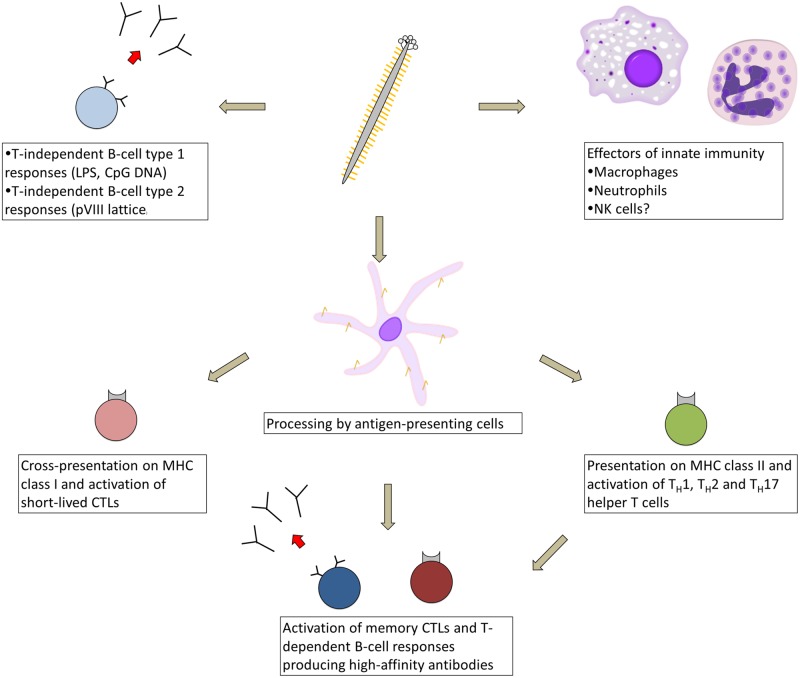
FIGURE 1
FIGURE 1
Types of immune responses elicited in response to immunization with filamentous bacteriophage. As a virus-like particle, the filamentous phage engages multiple arms of the immune system, beginning with cellular effectors of innate immunity (macrophages, neutrophils, and possibly natural killer cells), which are recruited to tumor sites by phage displaying tumor-targeting moieties. The phage likely activates T-cell independent antibody responses, either via phage-associated TLR ligands or cross-linking by the pVIII lattice. After processing by antigen-presenting cells, phage-derived peptides are presented on MHC class II and cross-presented on MHC class I, resulting in activation of short-lived CTLs and an array of helper T-cell types, which help prime memory CTL and high-affinity B-cell responses.
FIGURE 2
FIGURE 2
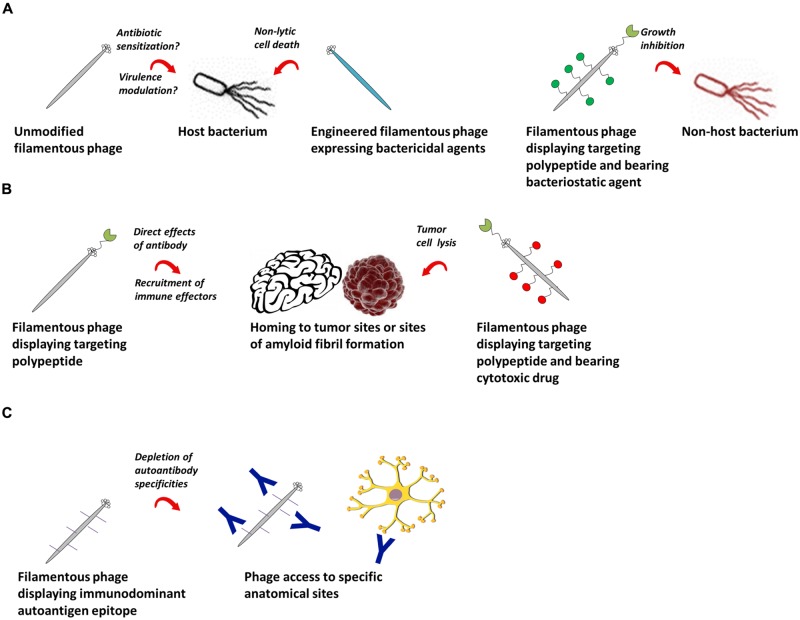
Potential therapeutic applications of filamentous bacteriophage. (A) Filamentous phage as a therapeutic against bacterial infections. Left: wild-type or engineered phage bearing genes encoding antibacterial agents can be used as therapeutics against their natural bacterial hosts. Right: filamentous phage displaying antibodies or polypeptides can target bacterial cells outside their natural species tropism. (B) Filamentous phage as a therapeutic in cancer and chronic diseases. Phage encoding targeting peptides home specifically to tumor or amyloid fibril sites, where they can have direct effects, recruit immune effector cells, or deliver conjugated cytotoxic drugs. (C) Filamentous phage as a therapeutic for autoantibody-mediated autoimmune conditions. Phage displaying immunodominant autoantigen epitopes can selectively deplete autoantibodies of defined specificities.
FIGURE 3
FIGURE 3
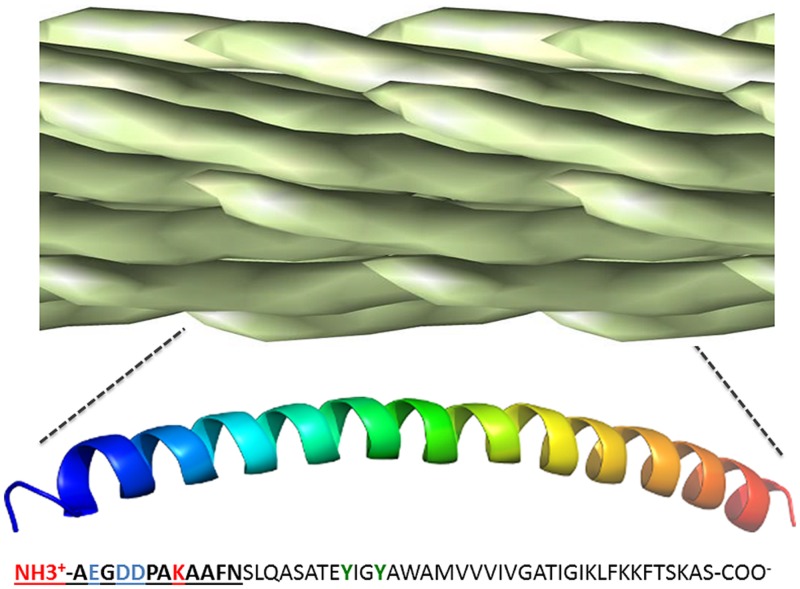
Chemically addressable groups of the filamentous bacteriophage major coat protein lattice. The filamentous phage virion is made up of ~2,500–4,000 overlapping copies of the 50-residue major coat protein, pVIII, arranged in a shingle-type lattice. Each monomer has an array of chemically addressable groups available for bioorthogonal conjugation, including two primary amine groups (shown in red), three carboxyl groups (show in blue) and two hydroxyl groups (show in green). The 12 N-terminal residues generally exposed to the immune system for antibody binding are in bold underline. Figure adapted from structural data of Marvin, 1990, freely available in PDB and SCOPe databases.

References

    1. Abbineni G., Modali S., Safiejko-Mroczka B., Petrenko V. A., Mao C. (2010). Evolutionary selection of new breast cancer cell-targeting peptides and phages with the cell-targeting peptides fully displayed on the major coat and their effects on actin dynamics during cell internalization. Mol. Pharm. 7 1629–1642. 10.1021/mp100052y - DOI - PMC - PubMed
    1. Abdennebi L., Couture L., Grebert D., Pajot E., Salesse R., Remy J. J. (1999). Generating FSH antagonists and agonists through immunization against FSH receptor N-terminal decapeptides. J. Mol. Endocrinol. 22 151–159. 10.1677/jme.0.0220151 - DOI - PubMed
    1. Alhamlan F. S., Ederer M. M., Brown C. J., Coats E. R., Crawford R. L. (2013). Metagenomics-based analysis of viral communities in dairy lagoon wastewater. J. Microbiol. Methods 92 183–188. 10.1016/j.mimet.2012.11.016 - DOI - PubMed
    1. Ashelford K. E., Day M. J., Fry J. C. (2003). Elevated abundance of bacteriophage infecting bacteria in soil. Appl. Environ. Microbiol. 69 285–289. 10.1128/AEM.69.1.285-289.2003 - DOI - PMC - PubMed
    1. Bahadir A. O., Balcioglu B. K., Uzyol K. S., Hatipoglu I., Sogut I., Basalp A., et al. (2011). Phage displayed HBV core antigen with immunogenic activity. Appl. Biochem. Biotechnol. 165 1437–1447. 10.1007/s12010-011-9365-1 - DOI - PubMed

LinkOut - more resources