


Evaluation of Ricinus communis L. for the Phytoremediation of Polluted Soil with Organochlorine Pesticides
- PMID: 26301249
- PMCID: PMC4537713
- DOI: 10.1155/2015/549863
Evaluation of Ricinus communis L. for the Phytoremediation of Polluted Soil with Organochlorine Pesticides
Abstract
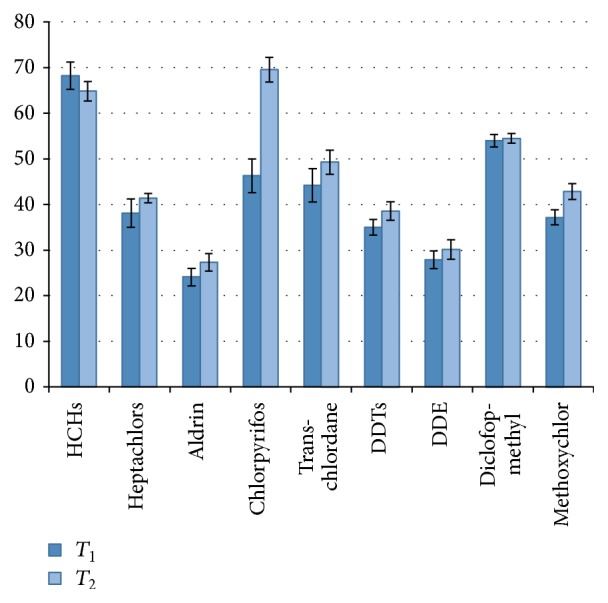
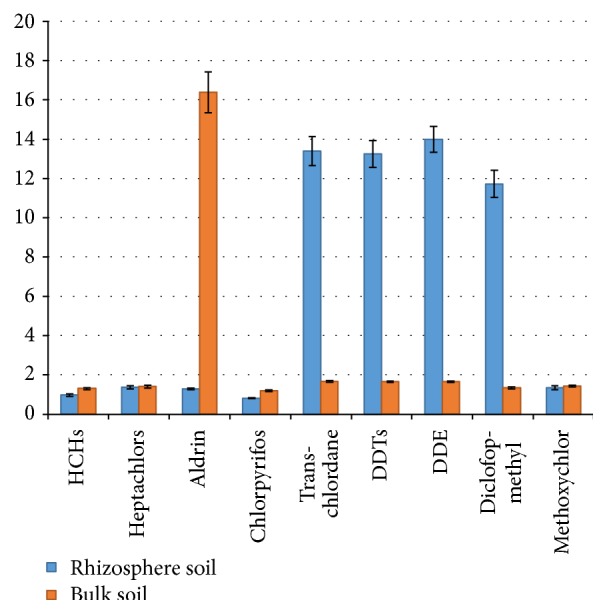
Phytoremediation is an attractive alternative to conventional treatments of soil due to advantages such as low cost, large application areas, and the possibility of in situ treatment. This study presents the assessment of phytoremediation processes conducted under controlled experimental conditions to evaluate the ability of Ricinus communis L., tropical plant species, to promote the degradation of 15 persistent organic pollutants (POPs), in a 66-day period. The contaminants tested were hexachlorocyclohexane (HCH), DDT, heptachlor, aldrin, and others. Measurements made in rhizosphere soil indicate that the roots of the studied species reduce the concentration of pesticides. Results obtained during this study indicated that the higher the hydrophobicity of the organic compound and its molecular interaction with soil or root matrix the greater its tendency to concentrate in root tissues and the research showed the following trend: HCHs < diclofop-methyl < chlorpyrifos < methoxychlor < heptachlor epoxide < endrin < o,p'-DDE < heptachlor < dieldrin < aldrin < o,p'-DDT < p,p'-DDT by increasing order of log K ow values. The experimental results confirm the importance of vegetation in removing pollutants, obtaining remediation from 25% to 70%, and demonstrated that Ricinus communis L. can be used for the phytoremediation of such compounds.
Figures
References
-
- United Nations Environment Programme (UNEP) Guidance on the Global Monitoring Plan for Persistent Organic Pollutants, Preliminary Version. Nairobi, Kenya: United Nations Environment Programme (UNEP); 2007.
-
- Environmental Protection Agency. The Foundation for Global Action on Persistent Organic Pollutants: A United State Perspective. 2002. http://www.epa.gov/
-
- Mcleod A. M., Paterson G., Drouillard K. G., Haffner G. D. Ecological factors contributing to variability of persistent organic pollutant bioaccumulation within forage fish communities of the Detroit River, Ontario, Canada. Environmental Toxicology and Chemistry. 2014;33(8):1825–1831. doi: 10.1002/etc.2606. - DOI - PubMed
-
- United Nations Environment Program UNEP. UNEP/POPS/CONF/4. UNEP; 2001. Final act of the conference of plenipotentiaries on the Stockholm convention on persistent organic pollutants.
-
- D'Amato C., Torres J. P. M., Malm O. DDT (Dichlorodiphenyltrichloroethane): toxicity and environmental contamnation—a review. Química Nova. 2002;25(6):995–1002. doi: 10.1590/s0100-40422002000600017. - DOI
Publication types
MeSH terms
Substances
LinkOut - more resources
Full Text Sources
Other Literature Sources
Miscellaneous
