


Vitamin D Status among Older Adults Residing in the Littoral and Andes Mountains in Ecuador
- PMID: 26301259
- PMCID: PMC4537767
- DOI: 10.1155/2015/545297
Vitamin D Status among Older Adults Residing in the Littoral and Andes Mountains in Ecuador
Abstract
Objectives: To estimate the prevalence of 25-hydroxyvitamin D (25(OH)D) deficiency and its determinants among older adults in Ecuador.
Methods: 25(OH)D deficiency and insufficiency prevalence rates were examined among participants in the National Survey of Health, Wellbeing, and Aging. Logistic regression models were used to evaluate demographic characteristics associated with 25(OH)D deficiency.
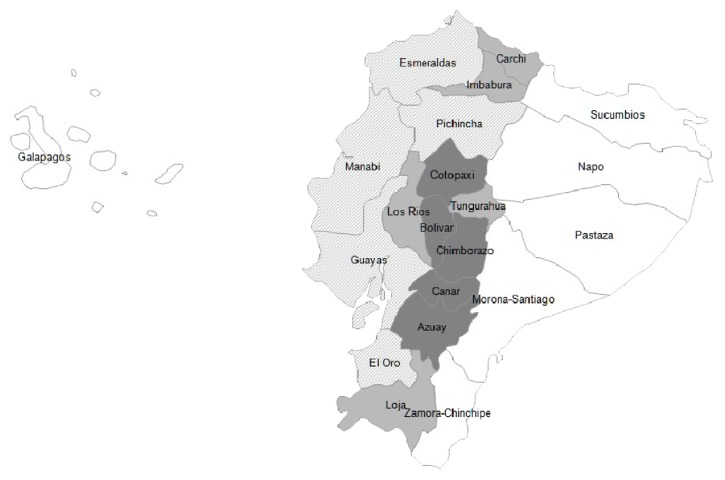
Results: Of 2,374 participants with a mean age of 71.0 (8.3) years, 25(OH)D insufficiency and deficiency were present in 67.8% (95% CI, 65.3-70.2) and 21.6% (95% CI, 19.5-23.7) of older adults in Ecuador, respectively. Women (OR, 3.19; 95% CI, 3.15-3.22), self-reported race as Indigenous (OR, 2.75; 95% CI, 2.70-2.80), and residents in rural (OR, 4.49; 95% CI, 4.40-4.58) and urban (OR, 2.74; 95% CI, 2.69-2.80) areas of the Andes Mountains region were variables significantly associated with 25(OH)D deficiency among older adults.
Conclusions: Despite abundant sunlight throughout the year in Ecuador, 25(OH)D deficiency was significantly prevalent among older women, Indigenous subjects, and subjects residing in the Andes Mountains region of the country. The present findings may assist public health authorities to implement policies of vitamin D supplementation among older adults at risk for this condition.
Figures
References
-
- Hirani V., Cumming R. G., Naganathan V., et al. Associations between serum 25-hydroxyvitamin D concentrations and multiple health conditions, physical performance measures, disability, and all-cause mortality: the concord health and ageing in men project. Journal of the American Geriatrics Society. 2014;62(3):417–425. doi: 10.1111/jgs.12693. - DOI - PubMed
MeSH terms
Substances
LinkOut - more resources
Full Text Sources
Other Literature Sources
Medical
