. 2016 Jan;209(1):307-18.
doi: 10.1111/nph.13584. Epub 2015 Aug 25.

Comparative genomics of Fusarium oxysporum f. sp. melonis reveals the secreted protein recognized by the Fom-2 resistance gene in melon

Affiliations

Comparative genomics of Fusarium oxysporum f. sp. melonis reveals the secreted protein recognized by the Fom-2 resistance gene in melon

Sarah Maria Schmidt et al. New Phytol. 2016 Jan.

Abstract

Development of resistant crops is the most effective way to control plant diseases to safeguard food and feed production. Disease resistance is commonly based on resistance genes, which generally mediate the recognition of small proteins secreted by invading pathogens. These proteins secreted by pathogens are called 'avirulence' proteins. Their identification is important for being able to assess the usefulness and durability of resistance genes in agricultural settings. We have used genome sequencing of a set of strains of the melon wilt fungus Fusarium oxysporum f. sp. melonis (Fom), bioinformatics-based genome comparison and genetic transformation of the fungus to identify AVRFOM2, the gene that encodes the avirulence protein recognized by the melon Fom-2 gene. Both an unbiased and a candidate gene approach identified a single candidate for the AVRFOM2 gene. Genetic complementation of AVRFOM2 in three different race 2 isolates resulted in resistance of Fom-2-harbouring melon cultivars. AvrFom2 is a small, secreted protein with two cysteine residues and weak similarity to secreted proteins of other fungi. The identification of AVRFOM2 will not only be helpful to select melon cultivars to avoid melon Fusarium wilt, but also to monitor how quickly a Fom population can adapt to deployment of Fom-2-containing cultivars in the field.

Keywords: AVRFOM2; Fusarium oxysporum f. sp. Melonis; comparative genomics; gene-for-gene interaction; melon Fom-2 resistance gene; virulence gene.


Figures

Fig. 1
Fig. 1
Fusarium oxysporum f. sp. melonis (Fom) isolates cluster according to vegetative compatibility groups (VCGs) and geographic location, but not according to race. The Illumina paired-end sequencing reads were mapped to the Fom004 genome using Burrows-Wheeler Aligner (version 0.7.4-r385 mem) (Li, 2013). Single-nucleotide polymorphisms were called using the Genome Analysis Toolkit (see the Materials and Methods section). The variant positions were used to construct a Randomized Axelerated Maximum Likelihood (version 7.7.8) (Stamatakis, 2006) tree using the GTRCAT model with 1000 bootstrap replicates. Branch length indicates nucleotide substitutions per site. Green boxes, race 0 isolates; blue boxes, race 1 isolates; yellow boxes, race 2 isolates. VCGs and geographic origin of the isolates are shown on the right.
Fig. 2
Fig. 2
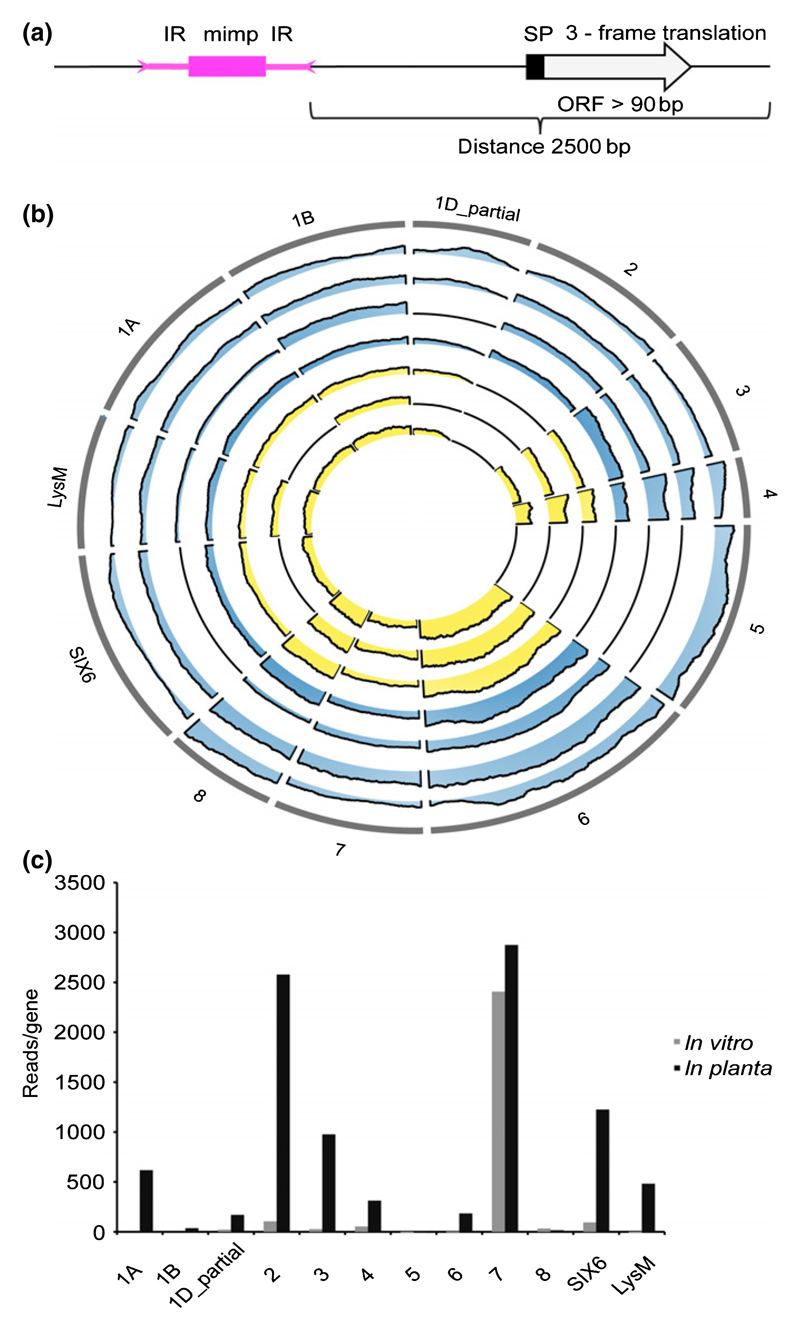
The predicted Fusarium oxysporum f. sp. melonis Fom001 effector 2 is present in all race 1 isolates and absent in all race 2 isolates. (a) Effector genes were predicted by searching the Fom001 genome for inverted repeats (IR) of the Miniature Impala (mimp) transposable elements. The sequence 2500 bp downstream of the mimp IR was translated in the three possible reading frames. Open reading frames (ORFs) > 90 bp were submitted to SignalP4.0 (Petersen et al., 2011) to identify N-terminal secretion peptides. (b) The 11 predicted effectors are shown as dark grey lines. The inner histograms show the read depth per base of the mapped genome sequencing reads per isolate (only correctly paired reads were included). Race 1 isolates are shown in blue, race 2 isolates in yellow (from outside to inside: Fom001, Fom005, Fom010, Fom016, Fom006, Fom009, Fom013). (c) We isolated and sequenced RNA from the roots of Fom001-infected melon seedlings and from in vitro grown Fom001. Bar graphs indicate the number of mapped RNA-seq reads for each gene.
Fig. 3
Fig. 3
Eleven Fusarium oxysporum f. sp. melonis Fom001 1 kb windows are present in all race 0 and race 1 isolates and absent in all race 2 isolates. Whole genome sequencing reads of all isolates were mapped against 1 kb windows of the Fom001 genome. Windows were considered present when > 20% of the window length was covered by sequencing reads and absent when < 20% of the gene length was covered. Windows either present in all race 0 isolates (green circle), present in all race 1 isolates (blue circle) or absent in all race 2 isolates (yellow circle) were intersected.
Fig. 4
Fig. 4
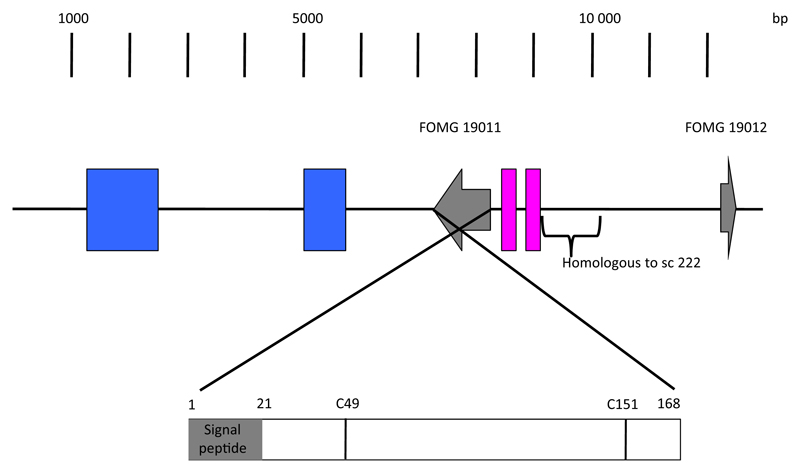
The AVRFOM2 locus and protein of Fusarium oxysporum f. sp. melonis isolate Fom001. Schematic representation of the supercontig 236 harbouring AVRFOM2 (FOXG_19011) of Fom001. Blue boxes indicate transposable elements. Pink boxes represent Miniature Impala (mimp) transposable elements. Contig size is indicated at the top.
Fig. 5
Fig. 5
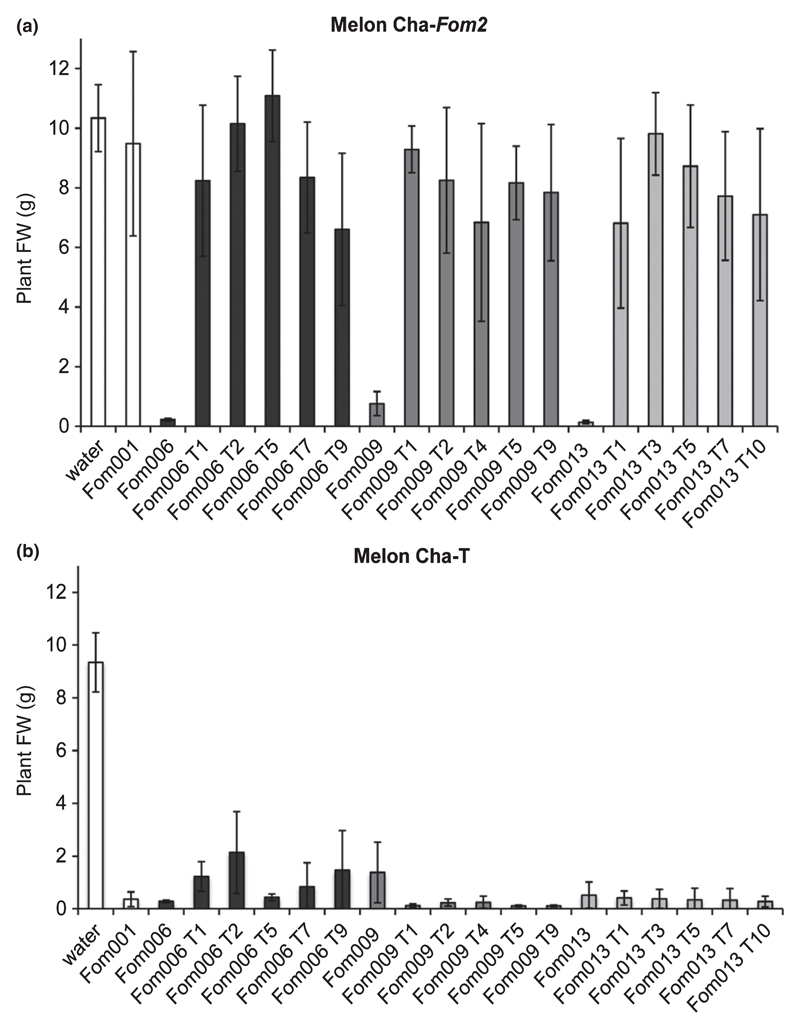
Genetic complementation of three different Fusarium oxysporum f. sp. melonis (Fom) race 2 isolates with AVRFOM2 results in Fom-2-mediated resistance of melon. We cloned AVRFOM2 with its own promoter (1 kb upstream of the start codon) and its own terminator (1 kb downstream of the stop codon) and ectopically inserted it in the genomes of three different race 2 isolates (Fom006, Fom009, Fom013) via Agrobacterium-mediated transformation. Ten-day-old melon seedlings with (Cha-Fom2) or without (Cha-T) the Fom-2 resistance gene were inoculated with conidia of five independent strains that were genetically complemented with AVRFOM2 for each isolate as well as with conidia of the wild-type race 2 strains and Fom001 (race 1). Twelve days after inoculation we determined the plant fresh weight (FW). (a) High plant FW of Cha-Fom-2 plants indicates resistance of the plant to the fungal infection. (b) Low FW of Cha-T plants indicates that the fungal strains are able to cause infection in the absence of Fom-2. Error bars indicate ± SD (n = 5 for water, Fom001, Fom006, Fom009, Fom013 or n = 8 for genetic complements). The experiment was repeated twice with similar results.

References

    1. Alvarez JM, Gonzalez-Torres R, Mallor C, Gomez-Guillamon ML. Potential sources of resistance to Fusarium wilt and powdery mildew in melons. HortScience. 2005;40:1657–1660.
    1. Anders S, Huber W. Differential expression analysis for sequence count data. Genome Biology. 2010;11:R106. - PMC - PubMed
    1. Appel DJ, Gordon TR. Relationships among pathogenic and nonpathogenic isolates of Fusarium oxysporum based on the partial sequence of the intergenic spacer region of the ribosomal DNA. Molecular Plant–Microbe Interactions. 1996;9:125–138. - PubMed
    1. Brotman Y, Normantovich M, Goldenberg Z, Zvirin Z, Kovalski I, Stovbun N, Doniger T, Bolger AM, Troadec C, Bendahmane A, et al. Dual resistance of melon to Fusarium oxysporum races 0 and 2 and to papaya ring-spot virus is controlled by a pair of head-to-head-oriented NB-LRR genes of unusual architecture. Molecular Plant. 2013;6:235–238. - PubMed
    1. Dangl J, Jones J. Plant pathogens and integrated defence responses to infection. Nature. 2001;411:826. - PubMed

Publication types

MeSH terms

LinkOut - more resources