


Epidemiological trends and future care needs for pelvic floor disorders
- PMID: 26308198
- PMCID: PMC5081686
- DOI: 10.1097/GCO.0000000000000200
Epidemiological trends and future care needs for pelvic floor disorders
Abstract
Purpose of review: We sought to provide a review of the recent literature regarding the prevalence and epidemiological trends in pelvic floor disorders (PFDs) including pelvic organ prolapse (POP), urinary incontinence and fecal incontinence. We also examined the current trends in surgical treatment for these disorders and discuss future care needs.
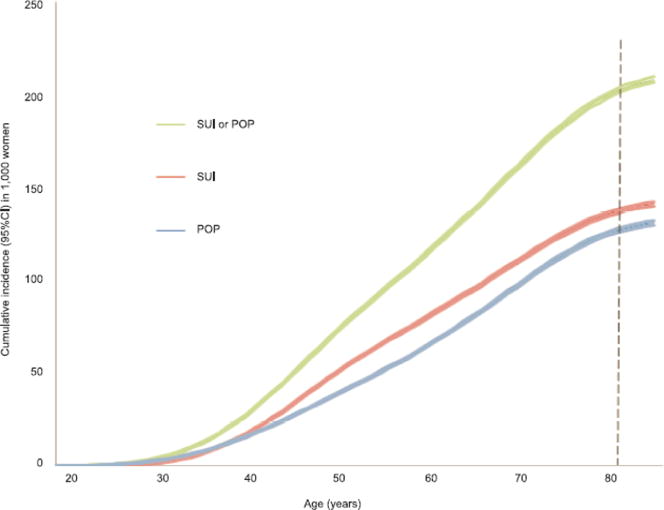
Recent findings: Approximately, one quarter of all women suffer from at least one or more PFDs. Urinary incontinence represents the most common PFD with an estimated prevalence of 15-17%, whereas fecal incontinence affects, approximately, 9% of adult women. POP is more difficult to assess with prevalence estimates ranging from 3 to 8%. Surgery for PFDs is common as 20% of women undergo stress urinary incontinence or POP surgery over their lifetime. As the aging population grows, the number of women with PFDs will increase substantially and the demand for care for these disorders will continue to grow through the year 2050.
Summary: PFDs are a significant public health issue and they negatively impact the lives of millions of adult women. The projected increase in the number of women affected by PFDs over the next 40 years will create increased demand for providers properly trained in Female Pelvic Medicine and Reconstructive Surgery.
Conflict of interest statement
None
Figures
References
-
- Wu JM, Vaughan CP, Goode PS, et al. Prevalence and trends of symptomatic pelvic floor disorders in U.S. women. Obstetrics and gynecology. 2014;123(1):141–8. Epub 2014/01/28. • This study used NHANES data to estimate prevalence and trends of PFDs from 2005 to 2010. Although there was no statistical trend, the significance of PFDs as a public health issue was further demonstrated, with one in four women reporting at least one disorder. - PMC - PubMed
-
- Gyhagen M, Akervall S, Milsom I. Clustering of pelvic floor disorders 20 years after one vaginal or one cesarean birth. International urogynecology journal. 2015 Epub 2015/02/25. - PubMed
-
- Coyne KS, Sexton CC, Bell JA, et al. The prevalence of lower urinary tract symptoms (LUTS) and overactive bladder (OAB) by racial/ethnic group and age: results from OAB-POLL. Neurourology and urodynamics. 2013;32(3):230–7. Epub 2012/08/01. - PubMed
-
- Coyne KS, Sexton CC, Vats V, et al. National community prevalence of overactive bladder in the United States stratified by sex and age. Urology. 2011;77(5):1081–7. Epub 2011/01/25. - PubMed
Publication types
MeSH terms
Grants and funding
LinkOut - more resources
Full Text Sources
Medical
Research Materials
