


Ultrafine and respirable particle exposure during vehicle fire suppression
- PMID: 26308547
- PMCID: PMC4606867
- DOI: 10.1039/c5em00233h
Ultrafine and respirable particle exposure during vehicle fire suppression
Abstract
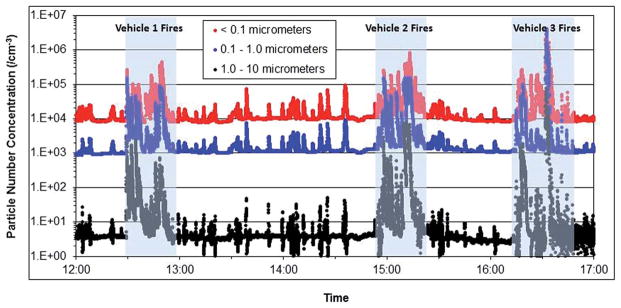
Vehicle fires are a common occurrence, yet few studies have reported exposures associated with burning vehicles. This article presents an assessment of firefighters' potential for ultrafine and respirable particle exposure during vehicle fire suppression training. Fires were initiated within the engine compartment and passenger cabins of three salvaged vehicles, with subsequent water suppression by fire crews. Firefighter exposures were monitored with an array of direct reading particle and air quality instruments. A flexible metallic duct and blower drew contaminants to the instrument array, positioned at a safe distance from the burning vehicles, with the duct inlet positioned at the nozzle operator's shoulder. The instruments measured the particle number, active surface area, respirable particle mass, photoelectric response, aerodynamic particle size distributions, and air quality parameters. Although vehicle fires were suppressed quickly (<10 minutes), firefighters may be exposed to short duration, high particle concentration episodes during fire suppression, which are orders of magnitude greater than the ambient background concentration. A maximum transient particle concentration of 1.21 × 10(7) particles per cm(3), 170 mg m(-3) respirable particle mass, 4700 μm(2) cm(-3) active surface area and 1400 (arbitrary units) in photoelectric response were attained throughout the series of six fires. Expressed as fifteen minute time-weighted averages, engine compartment fires averaged 5.4 × 10(4) particles per cm(3), 0.36 mg m(-3) respirable particle mass, 92 μm(2) cm(-3) active particle surface area and 29 (arbitrary units) in photoelectric response. Similarly, passenger cabin fires averaged 2.04 × 10(5) particles per cm(3), 2.7 mg m(-3) respirable particle mass, 320 μm(2) cm(-3) active particle surface area, and 34 (arbitrary units) in photoelectric response. Passenger cabin fires were a greater potential source of exposure than engine compartment fires. The wind direction and the relative position of the fire crew to the stationary burning vehicle played a primary role in fire crews' potential for exposure. We recommend that firefighters wear self-contained breathing apparatus during all phases of the vehicle fire response to significantly reduce their potential for particulate, vapor, and gaseous exposures.
Figures



References
-
- United States Fire Administration, National Fire Data Center. Fire in the United States 2003–2007. (15) 2009 Oct; http://www.usfa.fema.gov/downloads/pdf/statistics/fa_325.pdf.
-
- United States Fire Administration, National Fire Data Center. Highway Vehicle Fires (2008–2010) Topical Fire report Series. 2013 Jan;13(11) http://www.usfa.fema.gov/downloads/pdf/statistics/v13i11.pdf.
-
- Wichmann H, Lorenz W, Bahadir M. Release of PCDD/F and PAH during vehicle fires in traffic tunnels. Chemosphere. 1995;31(2):2755–2766.
-
- Lönnermark A, Blomqvist P. Emissions from an automobile fire. Chemosphere. 2006;62:1043–1056. - PubMed
-
- Okamoto K, Watanebe N, Hagimoto Y, Chigira T, Masano R, Miura H, Ochiai S, Satoh H, Tamura Y, Hayano K, Maeda Y, Suzuki J. Burning behavior of sedan passenger cars. Fire Saf J. 2009;44:301–310.
Publication types
MeSH terms
Substances
Grants and funding
LinkOut - more resources
Full Text Sources
Other Literature Sources
Medical
