


Treatment of hemorrhoids: A coloproctologist's view
- PMID: 26309351
- PMCID: PMC4541377
- DOI: 10.3748/wjg.v21.i31.9245
Treatment of hemorrhoids: A coloproctologist's view
Abstract
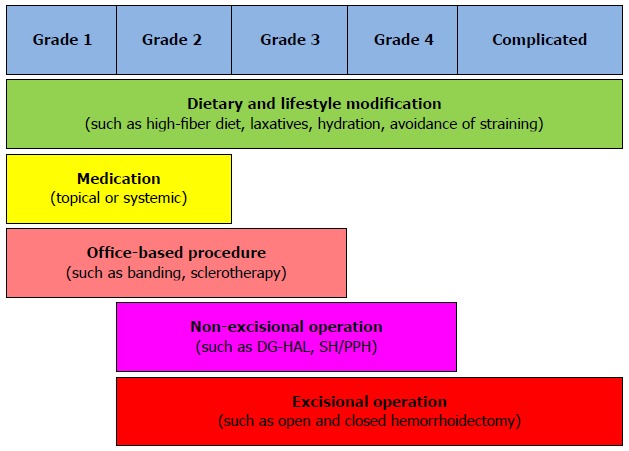
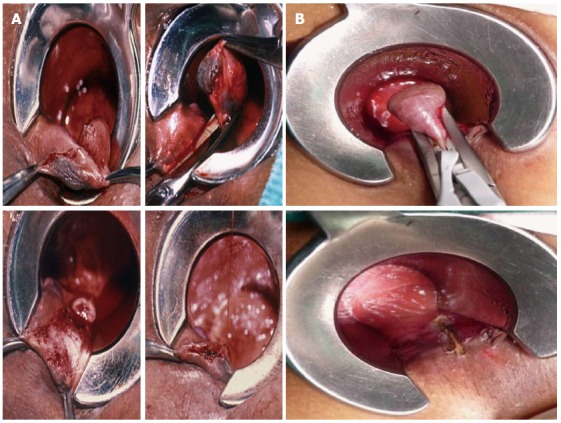
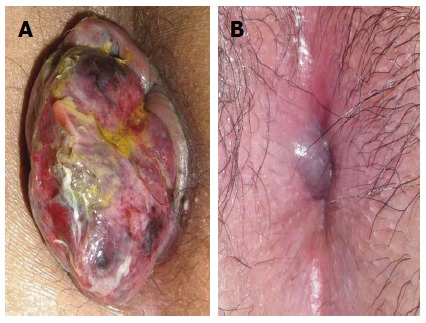
Hemorrhoids is recognized as one of the most common medical conditions in general population. It is clinically characterized by painless rectal bleeding during defecation with or without prolapsing anal tissue. Generally, hemorrhoids can be divided into two types: internal hemorrhoid and external hemorrhoid. External hemorrhoid usually requires no specific treatment unless it becomes acutely thrombosed or causes patients discomfort. Meanwhile, low-graded internal hemorrhoids can be effectively treated with medication and non-operative measures (such as rubber band ligation and injection sclerotherapy). Surgery is indicated for high-graded internal hemorrhoids, or when non-operative approaches have failed, or complications have occurred. Although excisional hemorrhoidectomy remains the mainstay operation for advanced hemorrhoids and complicated hemorrhoids, several minimally invasive operations (including Ligasure hemorrhoidectomy, doppler-guided hemorrhoidal artery ligation and stapled hemorrhoidopexy) have been introduced into surgical practices in order to avoid post-hemorrhiodectomy pain. This article deals with some fundamental knowledge and current treatment of hemorrhoids in a view of a coloproctologist - which includes the management of hemorrhoids in complicated situations such as hemorrhoids in pregnancy, hemorrhoids in immunocompromised patients, hemorrhoids in patients with cirrhosis or portal hypertension, hemorrhoids in patients having antithrombotic agents, and acutely thrombosed or strangulated hemorrhoids. Future perspectives in the treatment of hemorrhoids are also discussed.
Keywords: Complication; Hemorrhoids; Outcome; Pathophysiology; Treatment.
Figures
References
Publication types
MeSH terms
LinkOut - more resources
Full Text Sources
Other Literature Sources
Medical
