


Potential Reparative Role of Resident Adult Renal Stem/Progenitor Cells in Acute Kidney Injury
- PMID: 26309808
- PMCID: PMC4509615
- DOI: 10.1089/biores.2015.0011
Potential Reparative Role of Resident Adult Renal Stem/Progenitor Cells in Acute Kidney Injury
Abstract
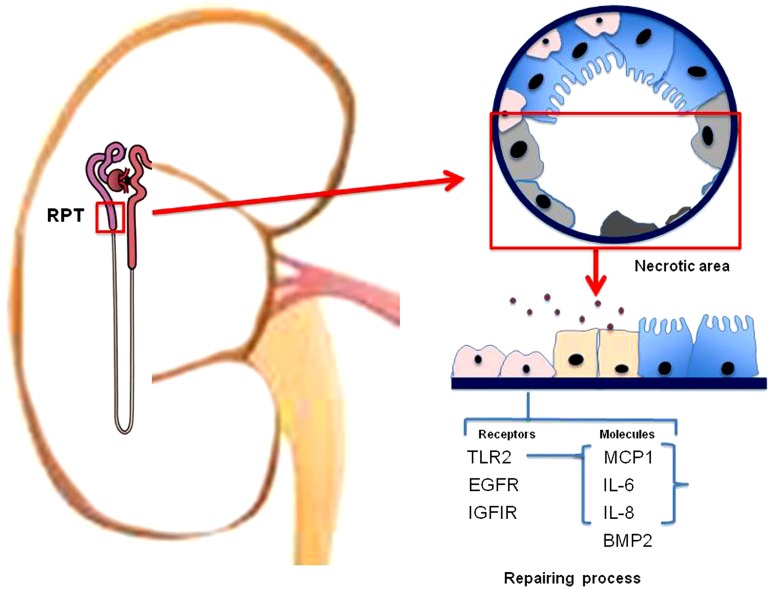
Human kidney is particularly susceptible to ischemia and toxins with consequential tubular necrosis and activation of inflammatory processes. This process can lead to the acute renal injury, and even if the kidney has a great capacity for regeneration after tubular damage, in several circumstances, the normal renal repair program may not be sufficient to achieve a successful regeneration. Resident adult renal stem/progenitor cells could participate in this repair process and have the potentiality to enhance the renal regenerative mechanism. This could be achieved both directly, by means of their capacity to differentiate and integrate into the renal tissues, and by means of paracrine factors able to induce or improve the renal repair or regeneration. Recent genetic fate-tracing studies indicated that tubular damage is instead repaired by proliferative duplication of epithelial cells, acquiring a transient progenitor phenotype and by fate-restricted clonal cell progeny emerging from different nephron segments. In this review, we discuss about the properties and the reparative characteristics of high regenerative CD133(+)/CD24(+) cells, with a view to a future application of these cells for the treatment of acute renal injury.
Keywords: acute kidney injury; regenerative medicine; renal progenitor cells; toll-like receptors.
Figures
References
-
- Lameire NH, Bagga A, Cruz D, et al. . Acute kidney injury: an increasing global concern. Lancet. 2013;382:170–179 - PubMed
-
- Nash K, Hafeez A, Hou S. Hospital-acquired renal insufficiency. Am J Kidney Dis. 2002;39:930–936 - PubMed
-
- Lieberthal W, Nigam SK. Acute renal failure. II. Experimental models of acute renal failure: imperfect but indispensable. Am J Physiol Renal Physiol. 2000;278:F1–F12 - PubMed
-
- Thadhani R, Pascual M, Bonventre JV. Acute renal failure. N Engl J Med. 1996;334:1448–1460 - PubMed
-
- Bonventre JV. Dedifferentiation and proliferation of surviving epithelial cells in acute renal failure. J Am Soc Nephrol. 2003;14 Suppl 1:S55–S61 - PubMed
Publication types
LinkOut - more resources
Full Text Sources
Other Literature Sources
Research Materials
