


Targeted Assessment for Prevention of Healthcare-Associated Infections: A New Prioritization Metric
- PMID: 26310913
- PMCID: PMC4658253
- DOI: 10.1017/ice.2015.201
Targeted Assessment for Prevention of Healthcare-Associated Infections: A New Prioritization Metric
Abstract
Objective: To develop a method for calculating the number of healthcare-associated infections (HAIs) that must be prevented to reach a HAI reduction goal and identifying and prioritizing healthcare facilities where the largest reductions can be achieved.
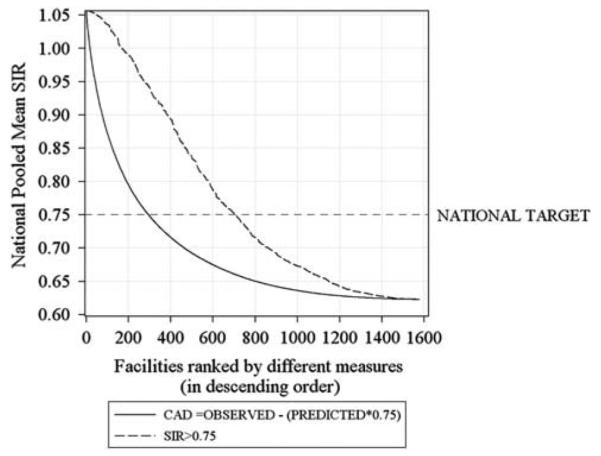
Setting: Acute care hospitals that report HAI data to the Centers for Disease Control and Prevention's National Healthcare Safety Network. METHODS :The cumulative attributable difference (CAD) is calculated by subtracting a numerical prevention target from an observed number of HAIs. The prevention target is the product of the predicted number of HAIs and a standardized infection ratio goal, which represents a HAI reduction goal. The CAD is a numeric value that if positive is the number of infections to prevent to reach the HAI reduction goal. We calculated the CAD for catheter-associated urinary tract infections for each of the 3,639 hospitals that reported such data to National Healthcare Safety Network in 2013 and ranked the hospitals by their CAD values in descending order.
Results: Of 1,578 hospitals with positive CAD values, preventing 10,040 catheter-associated urinary tract infections at 293 hospitals (19%) with the highest CAD would enable achievement of the national 25% catheter-associated urinary tract infection reduction goal.
Conclusion: The CAD is a new metric that facilitates ranking of facilities, and locations within facilities, to prioritize HAI prevention efforts where the greatest impact can be achieved toward a HAI reduction goal.
Figures
Comment in
-
Cumulative Attributable Difference: An Infection Metric That Reflects a Value System.Infect Control Hosp Epidemiol. 2015 Dec;36(12):1385-7. doi: 10.1017/ice.2015.231. Epub 2015 Nov 23. Infect Control Hosp Epidemiol. 2015. PMID: 26415745 No abstract available.
-
Reply to Jones et al.Infect Control Hosp Epidemiol. 2015 Dec;36(12):1477-8. doi: 10.1017/ice.2015.232. Infect Control Hosp Epidemiol. 2015. PMID: 26592429 Free PMC article. No abstract available.
References
-
- Marchetti A, Rossiter R. Economic burden of healthcare-associated infection in US acute care hospitals–societal perspective. J Med Econ. 2013;16:1399–1404. - PubMed
-
- Scott RD. The direct medical costs of healthcare-associated infections in U.S. hospitals and the benefits of prevention, 2009. Centers for Disease Control and Prevention. website. http://www.cdc.gov/HAI/pdfs/hai/Scott_CostPaper.pdf. Published March 2009. Accessed July 2014.
-
- The National Action Plan to Prevent Health Care-Associated Infections Road Map to Elimination. US Department of Health and Human Services. website. http://www.health.gov/hai/prevent_hai.asp#hai_plan. Accessed December 2014.
-
- Centers for Disease Control and Prevention Winnable Battles. http://www.cdc.gov/winnablebattles/. Accessed November 2014.
Publication types
MeSH terms
Grants and funding
LinkOut - more resources
Full Text Sources
Other Literature Sources
Miscellaneous
