


A simple risk stratification model that predicts 1-year postoperative mortality rate in patients with solid-organ cancer
- PMID: 26311149
- PMCID: PMC4673995
- DOI: 10.1002/cam4.518
A simple risk stratification model that predicts 1-year postoperative mortality rate in patients with solid-organ cancer
Abstract
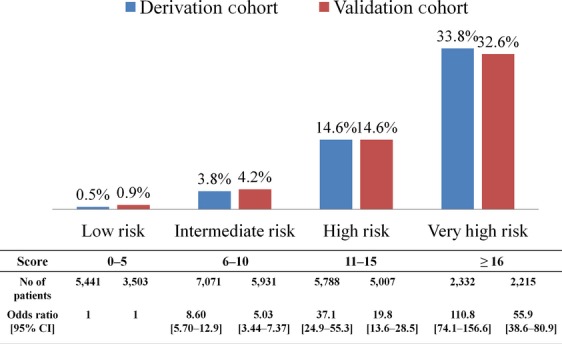
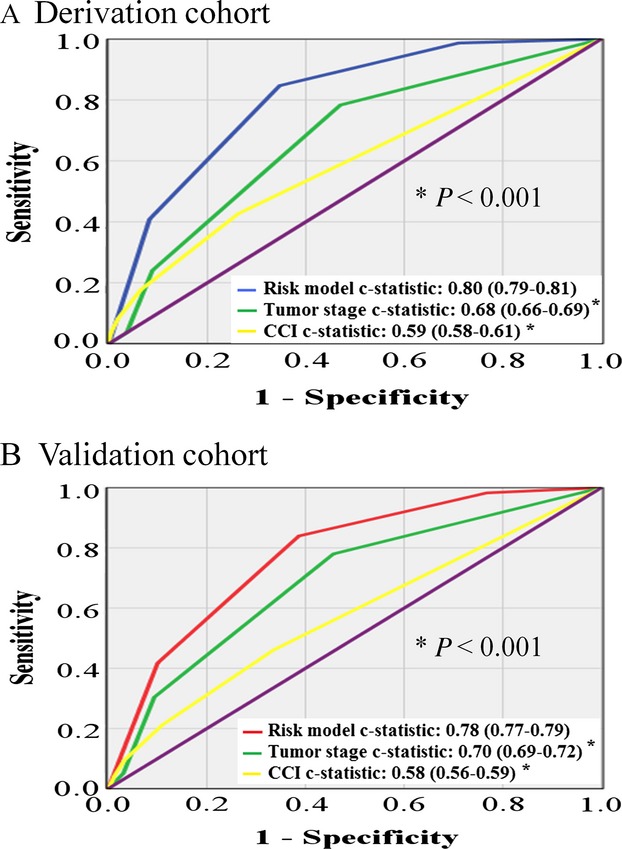
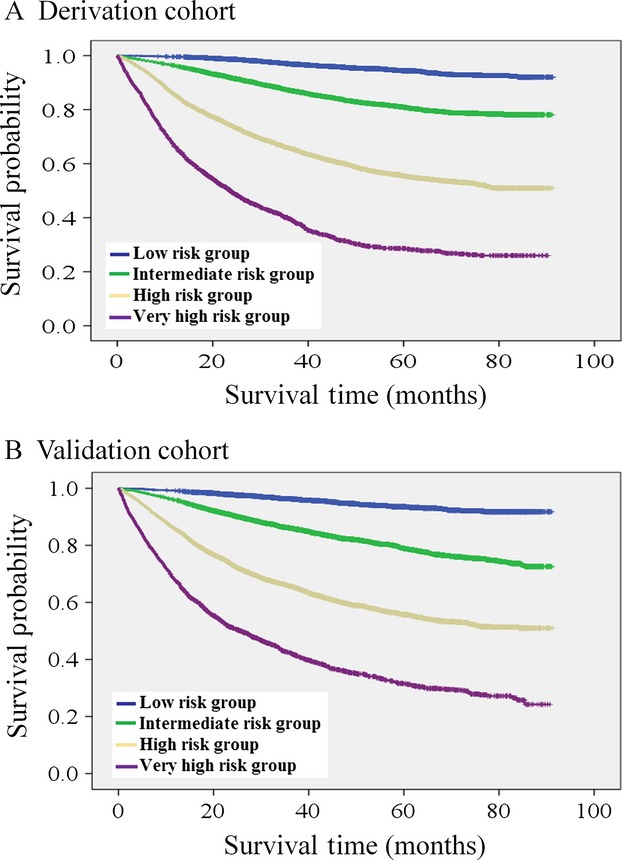
This study aimed to construct a scoring system developed exclusively from the preoperative data that predicts 1-year postoperative mortality in patients with solid cancers. A total of 20,632 patients who had a curative resection for solid-organ cancers between 2007 and 2012 at Chang Gung Memorial Hospital Linkou Medical Center were included in the derivation cohort. Multivariate logistic regression analysis was performed to develop a risk model that predicts 1-year postoperative mortality. Patients were then stratified into four risk groups (low-, intermediate-, high-, and very high-risk) according to the total score (0-43) form mortality risk analysis. An independent cohort of 16,656 patients who underwent curative cancer surgeries at three other hospitals during the same study period (validation cohort) was enrolled to verify the risk model. Age, gender, cancer site, history of previous cancer, tumor stage, Charlson comorbidity index, American Society of Anesthesiologist score, admission type, and Eastern Cooperative Oncology Group performance status were independently predictive of 1-year postoperative mortality. The 1-year postoperative mortality rates were 0.5%, 3.8%, 14.6%, and 33.8%, respectively, among the four risk groups in the derivation cohort (c-statistic, 0.80), compared with 0.9%, 4.2%, 14.6%, and 32.6%, respectively, in the validation cohort (c-statistic, 0.78). The risk stratification model also demonstrated good discrimination of long-term survival outcome of the four-tier risk groups (P < 0.01 for both cohorts). The risk stratification model not only predicts 1-year postoperative mortality but also differentiates long-term survival outcome between the risk groups.
Keywords: Postoperative mortality; prognostic score; risk model; solid cancer; validation.
© 2015 The Authors. Cancer Medicine published by John Wiley & Sons Ltd.
Figures
References
-
- Greenblatt DY, Kelly KJ, Rajamanickam V, Wan Y, Hanson T, Rettammel R, et al. Preoperative factors predict perioperative morbidity and mortality after pancreaticoduodenectomy. Ann. Surg. Oncol. 2011;18:2126–2135. - PubMed
-
- Are C, Afuh C, Ravipati L, Sasson A, Ullrich F. Smith L. Preoperative normogram to predict risk of preoperative mortality following pancreatic resections for malignancy. J. Gastrointest. Surg. 2009;13:2152–2162. - PubMed
-
- Peters TT, van Dijk BA, Roodenburg JL, van der Laan BF. Halmos GB. Relation between age comorbidity, and complications in patients undergoing major surgery for head and neck cancer. Ann. Surg. Oncol. 2014;21:963–970. - PubMed
-
- Haga Y, Wada Y, Takeuchi H, Kimura O, Furuya T, Sameshima H, et al. Estimation of physiologic ability and surgical stress (E-PASS) for a surgical audit in elective digestive surgery. Surgery. 2004;135:586–594. - PubMed
Publication types
MeSH terms
LinkOut - more resources
Full Text Sources
Other Literature Sources
