


Association Between Visuospatial Ability and Vestibular Function in the Baltimore Longitudinal Study of Aging
- PMID: 26311169
- PMCID: PMC4883683
- DOI: 10.1111/jgs.13609
Association Between Visuospatial Ability and Vestibular Function in the Baltimore Longitudinal Study of Aging
Abstract
Objectives: To investigate the relationship between vestibular loss associated with aging and age-related decline in visuospatial function.
Design: Cross-sectional analysis within a prospective cohort study.
Setting: Baltimore Longitudinal Study of Aging (BLSA).
Participants: Community-dwelling BLSA participants with a mean age of 72 (range 26-91) (N = 183).
Measurements: Vestibular function was measured using vestibular-evoked myogenic potentials. Visuospatial cognitive tests included Card Rotations, Purdue Pegboard, Benton Visual Retention Test, and Trail-Making Test Parts A and B. Tests of executive function, memory, and attention were also considered.
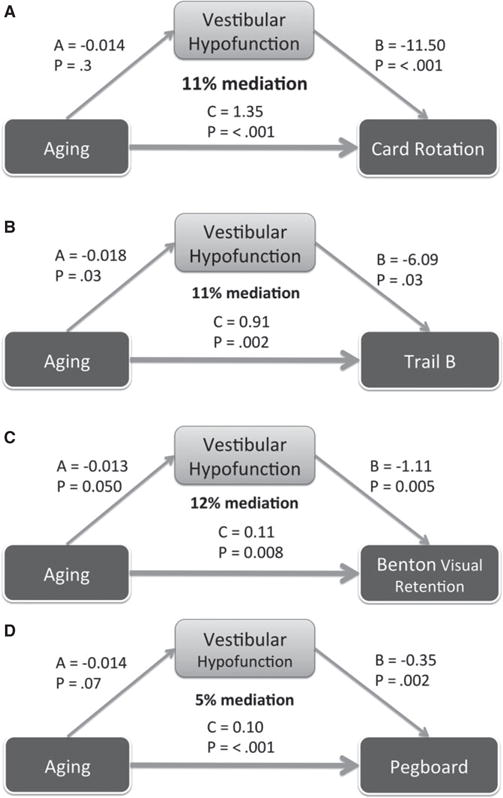
Results: Participants underwent vestibular and cognitive function testing. In multiple linear regression analyses, poorer vestibular function was associated with poorer performance on Card Rotations (P = .001), Purdue Pegboard (P = .005), Benton Visual Retention Test (P = 0.008), and Trail-Making Test Part B (P = .04). Performance on tests of executive function and verbal memory were not significantly associated with vestibular function. Exploratory factor analyses in a subgroup of participants who underwent all cognitive tests identified three latent cognitive abilities: visuospatial ability, verbal memory, and working memory and attention. Vestibular loss was significantly associated with lower visuospatial and working memory and attention factor scores.
Conclusion: Significant consistent associations between vestibular function and tests of visuospatial ability were observed in a sample of community-dwelling adults. Impairment in visuospatial skills is often one of the first signs of dementia and Alzheimer's disease. Further longitudinal studies are needed to evaluate whether the relationship between vestibular function and visuospatial ability is causal.
Keywords: aging; cognition; vestibular function; visuospatial ability.
© 2015, Copyright the Authors Journal compilation © 2015, The American Geriatrics Society.
Conflict of interest statement
Figures
References
-
- Peterka RJ, Black FO. Age-related changes in human posture control: Sensory organization tests. J Vestib Res. 1990;1:73–85. - PubMed
-
- Welgampola MS, Colebatch JG. Vestibulocollic reflexes: Normal values and the effect of age. Clin Neurophysiol. 2001;112:1971–1979. - PubMed
-
- Baloh RW, Enrietto J, Jacobson KM, et al. Age-related changes in vestibular function: A longitudinal study. Ann N Y Acad Sci. 2001;942:210–219. - PubMed
-
- Agrawal Y, Carey JP, Della Santina CC, et al. Disorders of balance and vestibular function in US adults: Data from the National Health and Nutrition Examination Survey, 2001–2004. Arch Intern Med. 2009;169:938–944. - PubMed
-
- Agrawal Y, Davalos-Bichara M, Zuniga MG, et al. Head impulse test abnormalities and influence on gait speed and falls in older individuals. Otol Neurotol. 2013;34:1729–1735. - PubMed
Publication types
MeSH terms
Grants and funding
LinkOut - more resources
Full Text Sources
Other Literature Sources
Medical
