


Revisiting the taxonomical classification of Porcine Circovirus type 2 (PCV2): still a real challenge
- PMID: 26311322
- PMCID: PMC4551364
- DOI: 10.1186/s12985-015-0361-x
Revisiting the taxonomical classification of Porcine Circovirus type 2 (PCV2): still a real challenge
Abstract
Background: PCV2 has emerged as one of the most devastating viral infections of swine farming, causing a relevant economic impact due to direct losses and control strategies expenses. Epidemiological and experimental studies have evidenced that genetic diversity is potentially affecting the virulence of PVC2. The growing number of PCV2 complete genomes and partial sequences available at GenBank questioned the accepted PCV2 classification.
Methods: Nine hundred seventy five PCV2 complete genomes and 1,270 ORF2 sequences available from GenBank were subjected to recombination, PASC and phylogenetic analyses and results were used for comparison with previous classification scheme.
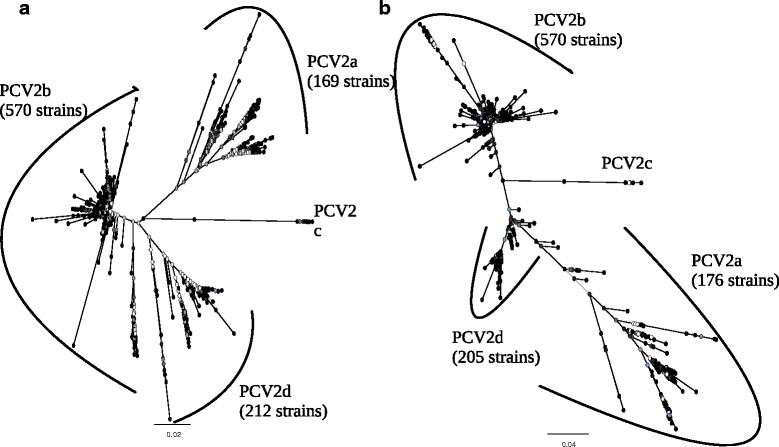
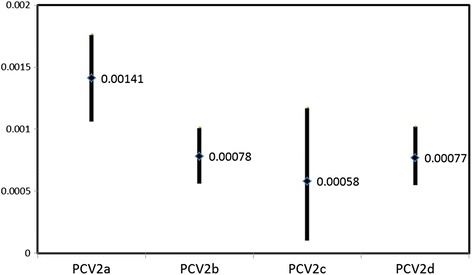
Results: The outcome of these analyses favors the recognition of four genotypes on the basis of ORF2 sequences, namely PCV2a, PCV2b, PCV2c and PCV2d-mPCV2b. To deal with the difficulty of founding an unambiguous classification and accounting the impossibility to define a p-distance cut-off, a set of reference sequences that could be used in further phylogenetic studies for PCV2 genotyping was established. Being aware that extensive phylogenetic analyses are time-consuming and often impracticable during routine diagnostic activity, ORF2 nucleotide positions adequately conserved in the reference sequences were identified and reported to allow a quick genotype differentiation.
Conclusions: Globally, the present work provides an updated scenario of PCV2 genotypes distribution and, based on the limits of the previous classification criteria, proposes new rapid and effective schemes for differentiating the four defined PCV2 genotypes.
Figures

References
-
- Clark EG. Post-weaning multisystemic wasting syndrome. Proc West Can Assoc Swine Pract. 1996;21:19–20.
-
- Harding JC. Postweaning multisystemic wasting syndrome: preliminary epidemiology and clinical findings. Proc West Can Assoc Swine Pract. 1996;21:2.
Publication types
MeSH terms
Substances
LinkOut - more resources
Full Text Sources
Other Literature Sources
