


Revisiting the incremental effects of context on word processing: Evidence from single-word event-related brain potentials
- PMID: 26311477
- PMCID: PMC4596793
- DOI: 10.1111/psyp.12515
Revisiting the incremental effects of context on word processing: Evidence from single-word event-related brain potentials
Abstract
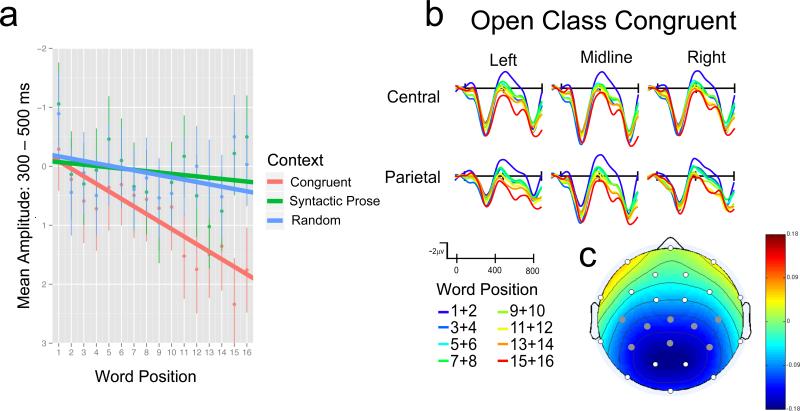
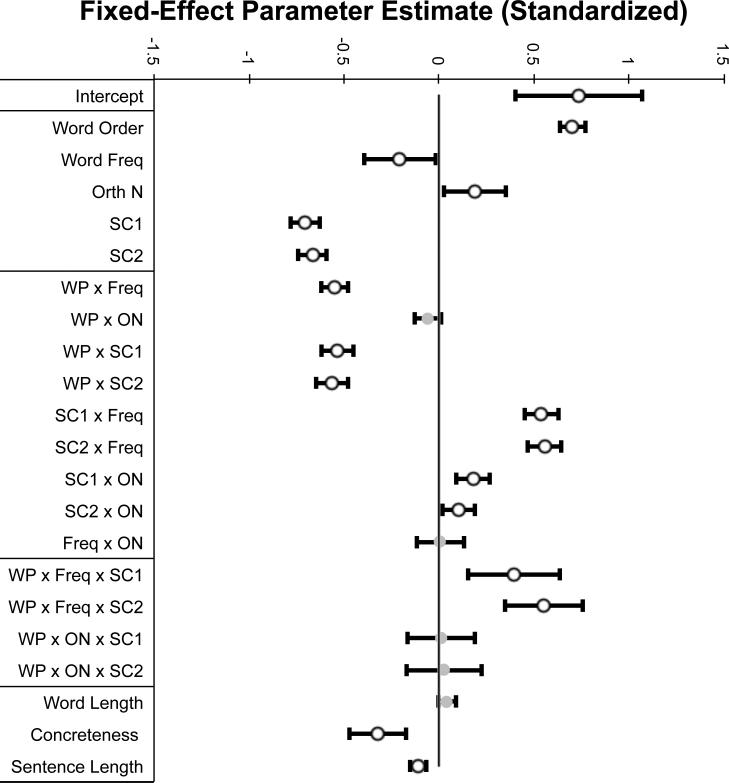
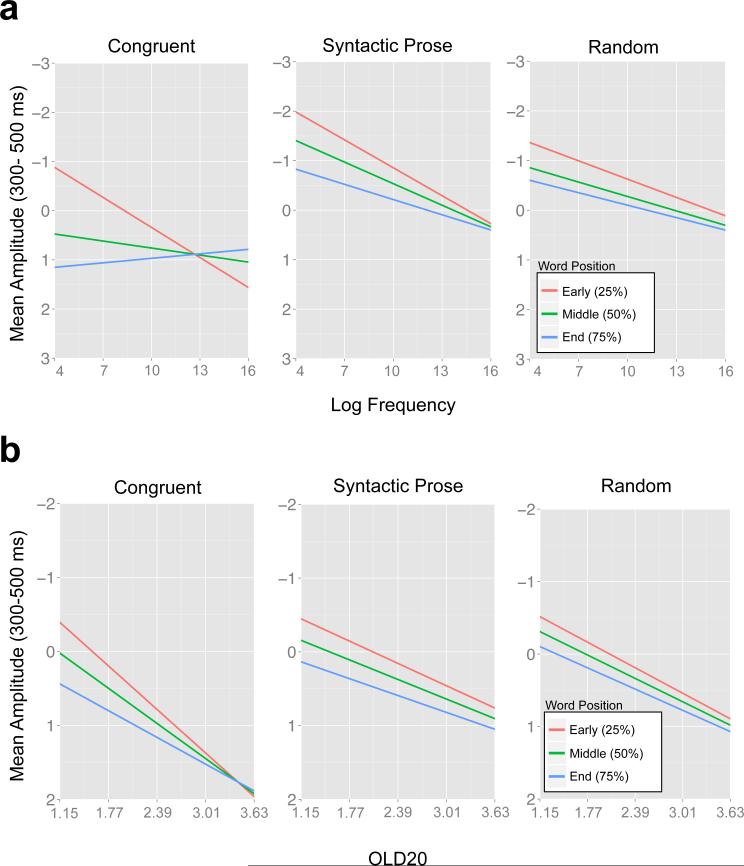
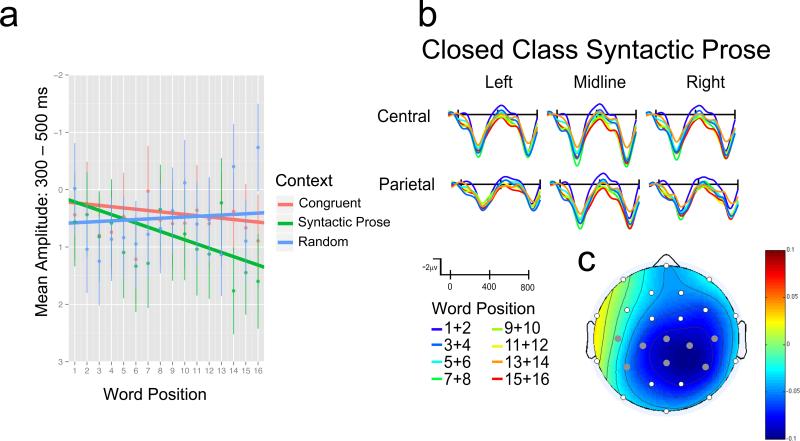
The amplitude of the N400-an event-related potential (ERP) component linked to meaning processing and initial access to semantic memory-is inversely related to the incremental buildup of semantic context over the course of a sentence. We revisited the nature and scope of this incremental context effect, adopting a word-level linear mixed-effects modeling approach, with the goal of probing the continuous and incremental effects of semantic and syntactic context on multiple aspects of lexical processing during sentence comprehension (i.e., effects of word frequency and orthographic neighborhood). First, we replicated the classic word-position effect at the single-word level: Open-class words showed reductions in N400 amplitude with increasing word position in semantically congruent sentences only. Importantly, we found that accruing sentence context had separable influences on the effects of frequency and neighborhood on the N400. Word frequency effects were reduced with accumulating semantic context. However, orthographic neighborhood was unaffected by accumulating context, showing robust effects on the N400 across all words, even within congruent sentences. Additionally, we found that N400 amplitudes to closed-class words were reduced with incrementally constraining syntactic context in sentences that provided only syntactic constraints. Taken together, our findings indicate that modeling word-level variability in ERPs reveals mechanisms by which different sources of information simultaneously contribute to the unfolding neural dynamics of comprehension.
Keywords: Event-related potentials (ERPs); Lexical processing; Linear mixed-effects model; N400; Sentence comprehension.
© 2015 Society for Psychophysiological Research.
Figures
References
-
- Aarts E, Verhage M, Veenvliet JV, Dolan CV, van der Sluis S. A solution to dependency: Using multilevel analysis to accommodate nested data. Nature Neuroscience. 2014;17:491–496. http://dx.doi.org/10.1038/nn.3648. - DOI - PubMed
-
- Ahmadi M, Quiroga RQ. Automatic denoising of single-trial evoked potentials. NeuroImage. 2013;66:672–680. http://dx.doi.org/10.1016/j.neuroimage.2012.10.062. - DOI - PubMed
-
- Altmann GT, Kamide Y. The real-time mediation of visual attention by language and world knowledge: Linking anticipatory (and other) eye movements to linguistic processing. Journal of Memory and Language. 2007;57:502–518. http://dx.doi.org/10.1016/j.jml.2006.12.004. - DOI
-
- Baayen RH, Davidson DJ, Bates DM. Mixed-effects modeling with crossed random effects for subjects and items. Journal of Memory and Language. 2008;59:390–412. http://dx.doi.org/10.1016/j.jml.2007.12.005. - DOI
-
- Balota DA, Yap MJ, Hutchison KA, Cortese MJ, Kessler B, Loftis B, Treiman R. The English lexicon project. Behavior Research Methods. 2007;39:445–459. http://dx.doi.org/10.3758/BF03193014. - DOI - PubMed
Publication types
MeSH terms
Grants and funding
LinkOut - more resources
Full Text Sources
Other Literature Sources
