. 2015 Aug 26;35(34):11911-20.
doi: 10.1523/JNEUROSCI.0591-15.2015.

Detection of p75NTR Trimers: Implications for Receptor Stoichiometry and Activation

Affiliations

Detection of p75NTR Trimers: Implications for Receptor Stoichiometry and Activation

Agustin Anastasia et al. J Neurosci. .

Abstract

The p75 neurotrophin receptor (p75(NTR)) is a multifunctional receptor that participates in many critical processes in the nervous system, ranging from apoptosis to synaptic plasticity and morphological events. It is a member of the tumor necrosis factor receptor (TNFR) superfamily, whose members undergo trimeric oligomerization. Interestingly, p75(NTR) interacts with dimeric ligands (i.e., proneurotrophins or mature neurotrophins), but several of the intracellular adaptors that mediate p75(NTR) signaling are trimeric (i.e., TNFR-associated factor 6 or TRAF6). Consequently, the active receptor signaling unit remains uncertain. To identify the functional receptor complex, we evaluated its oligomerization in vitro and in mice brain tissues using a combination of biochemical techniques. We found that the most abundant homotypic arrangement for p75(NTR) is a trimer and that monomers and trimers coexist at the cell surface. Interestingly, trimers are not required for ligand-independent or ligand-dependent p75(NTR) activation in a growth cone retraction functional assay. However, monomers are capable of inducing acute morphological effects in neurons. We propose that p75(NTR) activation is regulated by its oligomerization status and its levels of expression. These results indicate that the oligomeric state of p75(NTR) confers differential responses and offers an explanation for the diverse and contradictory actions of this receptor in the nervous system.

Significance statement: The p75 neurotrophin receptor (p75(NTR)) regulates a wide range of cellular functions, including apoptosis, neuronal processes remodeling, and synaptic plasticity. The goal of our work was to inquire whether oligomers of the receptor are required for function. Here we report that p75(NTR) predominantly assembles as a trimer, similar to other tumor necrosis factor receptors. Interestingly, monomers and trimers coexist at the cell surface, but trimers are not required for p75(NTR) activation in a functional assay. However, monomers are capable of inducing acute morphological effects in neurons. Identification of the oligomerization state of p75(NTR) begins to provide insights to the mechanisms of signal initiation of this noncatalytic receptor, as well as to develop therapeutic interventions to diminish its activity.

Keywords: TNF receptor; p75NTR; proNGF; signaling unit; stoichiometry; trimerization.


Figures

Figure 1.
Figure 1.
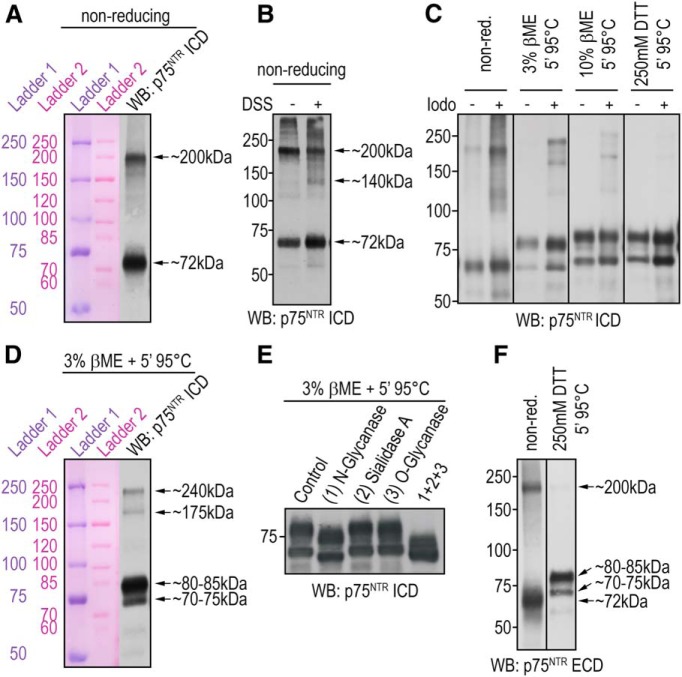
The most abundant p75NTR oligomer is a trimer. Expression of p75NTR in transfected HEK293 cells detected by nonreducing (non-red.) or reducing SDS-PAGE using antibodies specific for the ICD (AD) or ECD (F) of p75NTR. Iodoacetamide was used in the lysis buffer to inhibit disulfide bond formation during cell lysis, and its inclusion enhanced p75NTR detection. A, In nonreducing conditions, p75NTR migrated as a ∼72 kDa monomer and a ∼200 kDa oligomer, suggesting trimerization of the receptor. B, In nonreducing conditions, chemical crosslinking allowed the detection of p75NTR species consistent with dimers resolved at ∼140 kDa (∼2 times the molecular mass of the ∼72 kDa monomer in this condition). C, Reducing conditions shifted the molecular weight of the monomer to ∼80–85 kDa, and a second band of ∼70–75 kDa was detected. The 250 mm DTT and 5 min at 95°C reduced the oligomers to monomers. D, After the addition of βME and 5 min at 95°C, p75NTR oligomers were detected at ∼240 kDa and ∼175 kDa, strongly suggesting a trimer and dimer, respectively (∼2 or 3 times the molecular mass of the ∼80–85 kDa monomer in this condition). E, Identification of the ∼80–85 kDa and the ∼70–75 kDa p75NTR-positive bands found in reducing conditions. p75NTR has one asparagine-linked glycosylation in the first cysteine-rich domain and several O-linked glycosylations in the ECD juxtamembrane region. Therefore, we tested whether the bands correspond to differentially glycosylated isoforms. Lysates from p75NTR-transfected HEK293 cells were deglycosylated with N-glycanase, sialidase A, O-glycanase, or with the three enzymes together. N-glycanase reduced the molecular mass of both bands, suggesting that both are N-linked glycosylated. Neither sialidase A nor O-glycanase affected p75NTR molecular mass. However, sequential deglycosylation using the three enzymes together shifted the molecular weights as follows: (1) the higher band shifted more than with N-glycanase alone and started to collapse on top of the lower band, confirming that this isoform is N- and O-linked glycosylated; and (2) the lower band was resolved at the same molecular mass as after the N-glycanase, suggesting that this isoform is only N-linked glycosylated but is missing O-linked oligosaccharides. Overall, the molecular mass shifts were partial after deglycosylation. This may be due to iodoacetamide affecting the enzymatic activity and/or on the partial reducing efficacy of βME in the experimental conditions used, which may only incompletely unfold the ECD and consequently partially expose the oligosaccharides for enzymatic removal. F, Antibodies specific for the p75NTR ECD displayed the same pattern of bands as the ICD antibody in nonreducing and DTT reducing conditions.
Figure 2.
Figure 2.
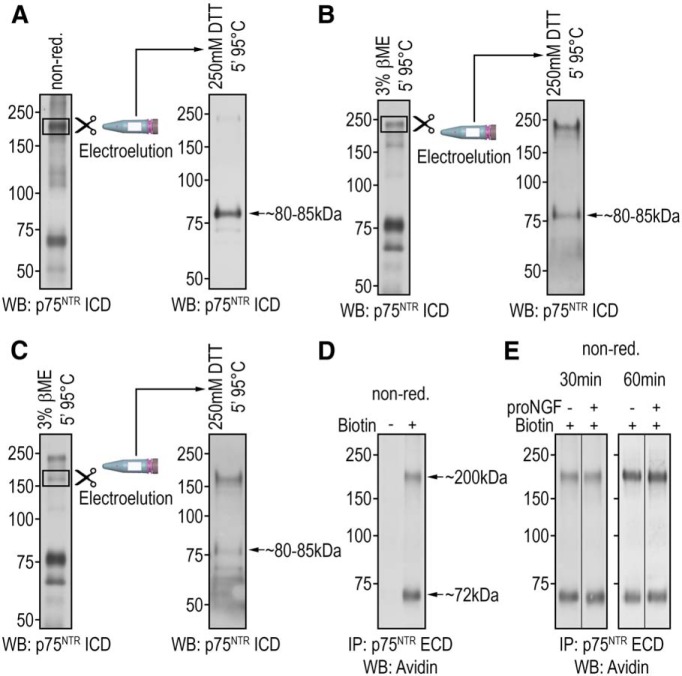
p75NTR oligomers are formed by full-length monomers, and p75NTR monomers and trimers coexist at the plasma membrane. A, Electroelution of the ∼200 kDa complex found in nonreducing conditions, followed by DTT reduction of the resolubilized protein, showed that the oligomers are formed by monomers of full-length p75NTR (∼80–85 kDa). B, Electroelution of the ∼240 kDa p75NTR oligomer observed in the 3% βME + 5 min at 95°C condition. The resolubilized protein was further reduced with DTT and showed that the oligomer is formed by monomers of full-length p75NTR (∼80–85 kDa). C, Electroelution of the ∼175 kDa form observed in the 3% βME + 5 min at 95°C. The resolubilized protein was further reduced with DTT, and this showed that the oligomer is formed by monomers of full-length p75NTR (∼80–85 kDa). D, p75NTR oligomerization at the plasma membrane was studied in transfected and surface-biotinylated HEK293 cells (Biotin+). Monomers and trimers coexist at the cell surface. Biotin−, Transfected but not biotinylated cells. E, Administration of 50 ng/ml of proNGF for 30 or 60 min did not affect the p75NTR monomer/trimer ratio at the cell surface in transfected HEK293 cells.
Figure 3.
Figure 3.
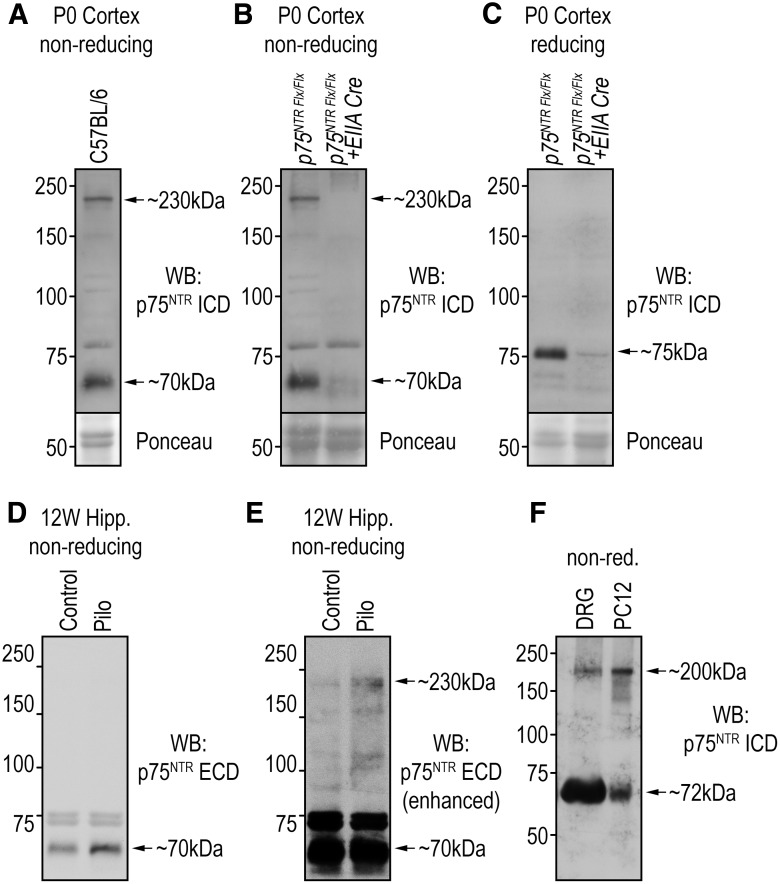
p75NTR monomers and trimers are present in the mouse brain, DRGs in culture, and in PC12 cells. A–C, Endogenous p75NTR oligomerization was studied in postnatal day 0 (P0) mouse cortical lysates. A, Nonreducing SDS-PAGE of C57BL/6 cortical lysates showed that p75NTR monomers are resolved at ∼70 kDa, whereas oligomers appeared at ∼230 kDa, strongly supporting trimerization of the receptor. B, C, p75NTRflx/flx conditional mice were used to study the specificity of the bands. B, Recombination of the conditional alleles with Cre under the control of EIIa promoter results in loss of ∼70 kDa and ∼230 kDa p75NTR bands observed in nonreducing conditions. C, βME reduced the high molecular mass oligomers and shifted the molecular weight of the monomers to ∼75 kDa. Ponceau red staining was used as the loading control. D, E, Endogenous p75NTR oligomerization in the adult brain was studied in 12-week-old (12W) mouse hippocampal lysates, after loading 150 μg/lane in the SDS-PAGE, and using pilocarpine-induced seizures (Pilo) to increase p75NTR endogenous levels. D, Representative blot detecting p75NTR by regular ECL. E, The same blot shown in D developed using enhanced ECL signal was necessary to detect the ∼230 kDa oligomers. F, p75NTR oligomerization in DRG neurons in culture and in PC12 pheochromocytoma cells.
Figure 4.
Figure 4.
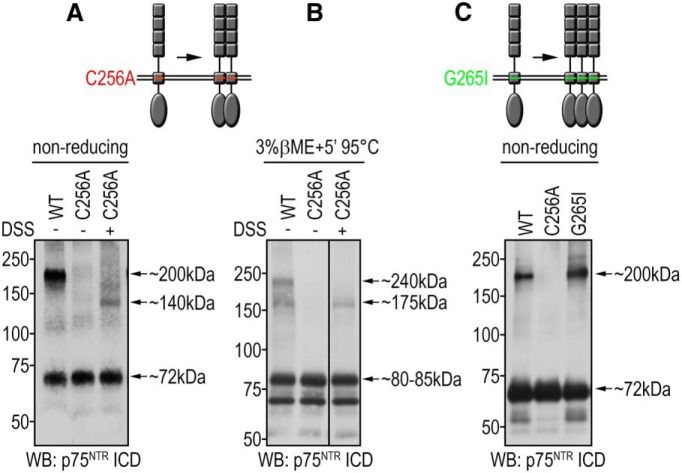
The cysteine 256 in the transmembrane domain is required for trimerization. Representative images of nonreducing and reducing (3% βME and 5 min at 95°C) SDS-PAGE displaying HEK293 cells transfected with p75NTR point mutations. A graphic representation of p75NTR mutations and the oligomers found for each one are displayed on top of each image. Wild-type p75NTR is shown as “WT” (in nonreducing conditions, monomers run at ∼72 kDa and trimers at ∼200 kDa; in reducing conditions, monomers run at ∼80–85 kDa, dimers at ∼175 kDa, and trimers at ∼240 kDa). A, B, Mutation of the cysteine 256 in the transmembrane domain of human p75NTR to alanine (C256A) abrogated trimerization. The third lane of both images displays C256A-p75NTR-transfected HEK293 cells followed by chemical crosslinking with disuccinimidyl suberate (DSS). A, In nonreducing conditions, chemical crosslinking allowed the detection of C256A-p75NTR dimers at ∼140 kDa (∼2 times the molecular mass of the ∼72 kDa monomer in this condition). B, In reducing conditions, the chemical crosslinking revealed C256A-p75NTR dimers at ∼175 kDa (∼2 times the molecular mass of the ∼80–85 kDa monomer in this condition). C, Mutation of the glycine 265 in the transmembrane domain to isoleucine (G265I) did not affect trimerization of p75NTR.
Figure 5.
Figure 5.
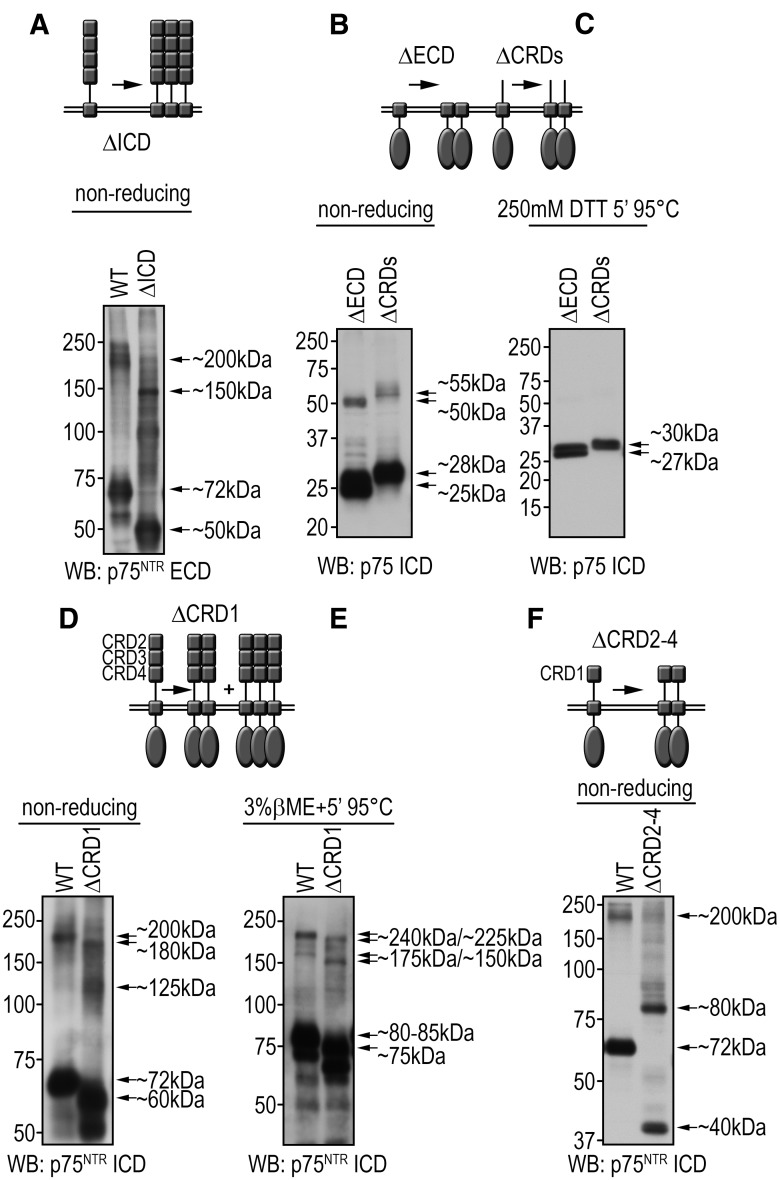
The cysteine-rich domains are required for trimerization. Representative images of nonreducing and reducing (3% βME and 5 min at 95°C) SDS-PAGE displaying HEK293 cells transfected with p75NTR deletion mutants. A graphic representation of p75NTR deletions and the oligomers found for each one are displayed on top of each image. Wild-type p75NTR is shown as “WT” (in nonreducing conditions, monomers run at ∼72 kDa and trimers at ∼200 kDa; in reducing conditions, monomers run at ∼80–85 kDa, dimers at ∼175 kDa, and trimers at ∼240 kDa). A, Deletion of the intracellular domain (ΔICD) did not affect trimerization (ΔICD monomer: ∼50 kDa; ΔICD trimer: ∼150 kDa). B, C, Deletion of the extracellular domain (ΔECD) or the four cysteine-rich domains (ΔCRDs) prevented trimerization, but dimers were detected. B, In nonreducing conditions, ΔECD monomers were detected at ∼25 kDa, ΔECD dimers at ∼50 kDa, ΔCRDs monomers at ∼28 kDa, and ΔCRDs dimers at ∼55 kDa. C, In reducing conditions, ΔECD monomers were detected at ∼27 kDa and ΔCRDs monomers at ∼30 kDa. D, E, Deletion of the cysteine-rich domain 1 (ΔCRD1) partially prevented trimerization and increased the proportion of dimers. D, In nonreducing conditions, ΔCRD1 monomers were detected at ∼60 kDa, dimers at ∼125 kDa, and trimers at ∼180 kDa. E, In reducing conditions, ΔCRD1 monomers were detected at ∼75 kDa, dimers at ∼150 kDa, and trimers at ∼225 kDa. F, Deletion of the cysteine-rich domains 2–4 (ΔCRD2–4) prevented trimerization, but dimers were still detected (ΔCRD2–4 monomer: ∼40 kDa, ΔCRD2–4 dimer: ∼80 kDa).
Figure 6.
Figure 6.
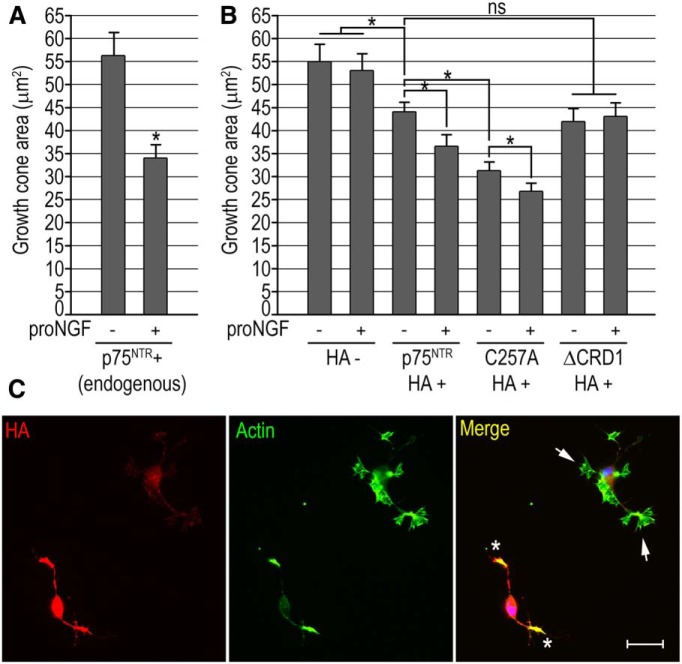
p75NTR trimerization is not required for proNGF-induced growth cone retraction. A, E17-dissociated hippocampal neurons were treated with proNGF (20 ng/ml) for 30 min, fixed, and stained for p75NTR and actin. ProNGF induced growth cone retraction in endogenously p75NTR-expressing hippocampal neurons. Quantification of growth cone area (μm2) was performed to determine growth cone retraction. Error bars indicate mean ± SEM. B, E17-dissociated hippocampal neurons were transfected with rat wild-type p75NTR-HA, C257A-HA, or ΔCRD1-HA constructs. At DIV3, cultures were treated with proNGF for 30 min, fixed, and stained for HA and actin. Quantification of growth cone area (μm2) to assess growth cone retraction in transfected p75NTR-HA, C257A-HA, or ΔCRD1-HA-positive neurons, and HA-negative (HA−) neurons of the same cultures. Error bars indicate mean ± SEM. Statistical comparisons were made by Kruskal–Wallis nonparametric analysis of the variance test. n = 3 independent experiments; at least 2 coverslips per experiment per condition were analyzed. *p < 0.05. ns, Nonsignificant. C, Representative image of a p75NTR-HA-positive and a p75NTR-HA-negative neuron after proNGF treatment. Arrows indicate expanded growth cones. * indicates retracted growth cones. Scale bar, 20 μm.

References

    1. Anastasia A, Deinhardt K, Chao MV, Will NE, Irmady K, Lee FS, Hempstead BL, Bracken C. Val66Met polymorphism of BDNF alters prodomain structure to induce neuronal growth cone retraction. Nat Commun. 2013;4:2490. doi: 10.1038/ncomms3490. - DOI - PMC - PubMed
    1. Baldwin AN, Shooter EM. Zone mapping of the binding domain of the rat low affinity nerve growth factor receptor by the introduction of novel N-glycosylation sites. J Biol Chem. 1995;270:4594–4602. doi: 10.1074/jbc.270.9.4594. - DOI - PubMed
    1. Barker PA. A p75(NTR) pivoting paradigm propels perspicacity. Neuron. 2009;62:3–5. doi: 10.1016/j.neuron.2009.04.005. - DOI - PubMed
    1. Bhakar AL, Howell JL, Paul CE, Salehi AH, Becker EB, Said F, Bonni A, Barker PA. Apoptosis induced by p75NTR overexpression requires Jun kinase-dependent phosphorylation of Bad. J Neurosci. 2003;23:11373–11381. - PMC - PubMed
    1. Bogenmann E, Thomas PS, Li Q, Kim J, Yang LT, Pierchala B, Kaartinen V. Generation of mice with a conditional allele for the p75(NTR) neurotrophin receptor gene. Genesis. 2011;49:862–869. doi: 10.1002/dvg.20747. - DOI - PMC - PubMed

Publication types

MeSH terms

Substances