. 2015 Jul;4(7):374-85.
doi: 10.1002/psp4.48. Epub 2015 Jun 30.

Integrated Simulation Framework for Toxicity, Dose Intensity, Disease Progression, and Cost Effectiveness for Castration-Resistant Prostate Cancer Treatment With Eribulin

Affiliations

Integrated Simulation Framework for Toxicity, Dose Intensity, Disease Progression, and Cost Effectiveness for Castration-Resistant Prostate Cancer Treatment With Eribulin

J G C van Hasselt et al. CPT Pharmacometrics Syst Pharmacol. 2015 Jul.

Abstract

Quantitative model-based analyses are helpful to support decision-making in drug development. In oncology, disease progression/clinical outcome (DPCO) models have been used for early predictions of clinical outcome, but most of such approaches did not include adverse events or dose intensity. In addition, cost-effectiveness evaluations of investigational compounds are becoming increasingly important. Here, we developed an integrated model-based framework including relevant treatment effects for patients with castration-resistant prostate cancer treated with the anticancer agent eribulin. The framework included (i) a DPCO model relating prostate-specific antigen (PSA) dynamics to survival; (ii) models for adverse events including dose-limiting neutropenia and other graded toxicities; (iii) a model for Eastern Cooperative Oncology Group (ECOG) performance score; (iv) a model for dropout; (v) the consideration of cost effectiveness. The model allowed simulation of realistic treatment courses. Subsequently, simulations evaluating alternative treatment protocols or patient characteristics were performed in order to derive inferences on expected efficacy and cost effectiveness.


Figures
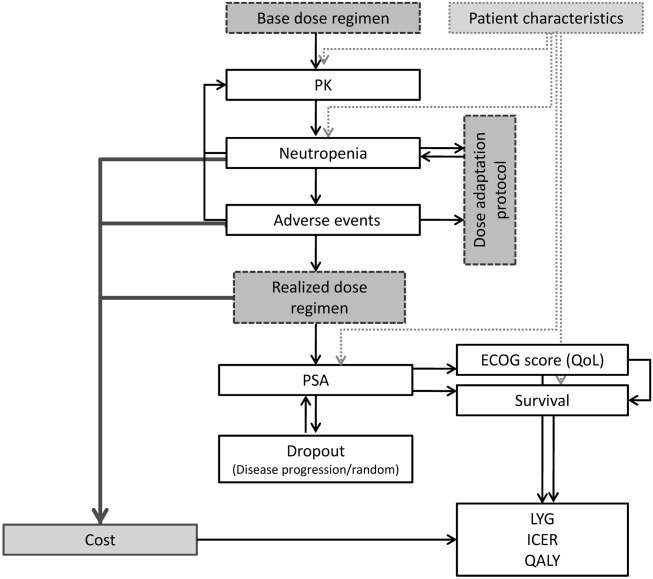
Figure 1
Figure 1
Schematic representation of the integrated simulation framework that was developed. PSA, prostate-specific antigen; LYG, life years gained; ICER, incremental cost-effectiveness ratio; QALY, quality-adjusted life years; PK, pharmacokinetics.
Figure 2
Figure 2
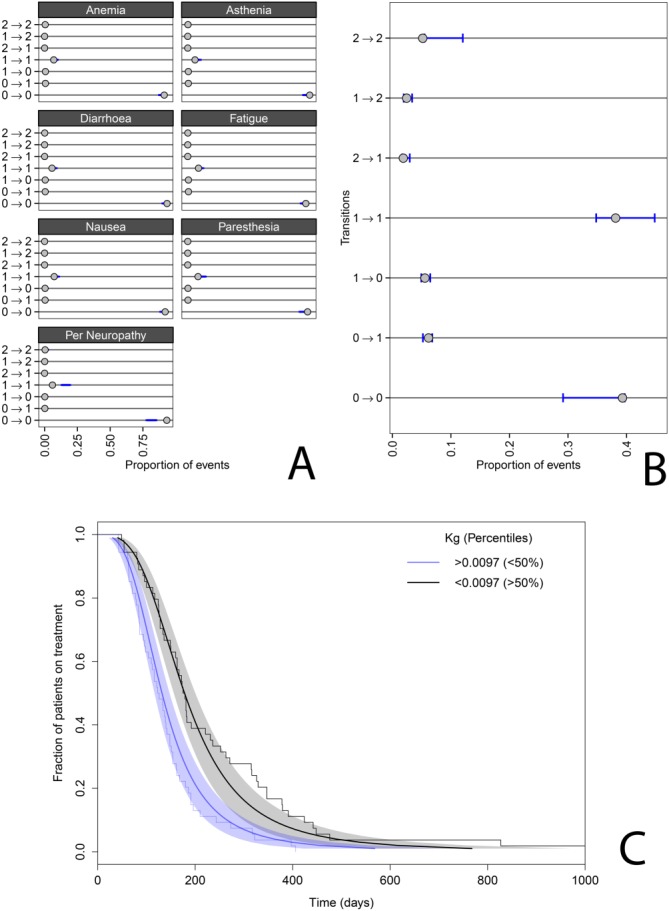
(A) Model predictions (95% prediction intervals) and observed incidence of transitions for the Markov-transition models for the other adverse events model and (B) ECOG performance score model. (C) Dropout model simulated median (thick solid lines) and 95% confidence intervals (areas) and observed (thin solid lines), stratified by patients above (blue) and below (gray) the median estimate for the PSA growth rate (KG).
Figure 3
Figure 3
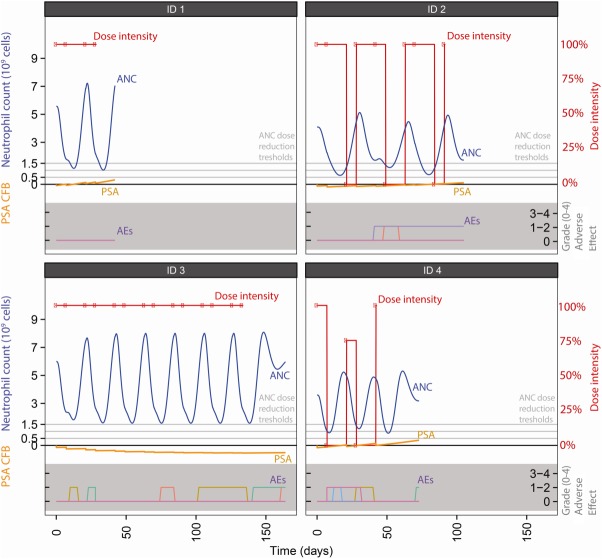
Typical simulated time courses for dose reductions (red symbols and lines), neutrophils (dashed line), PSA (dotted orange line) and other adverse events (colored lines in bottom gray area) in four simulated patients. Neutropenia dose reductions thresholds are at 1.5*109 (predose threshold), 1.0*109 (grade 3), and 0.5*109 (grade 4) cells/L.
Figure 4
Figure 4
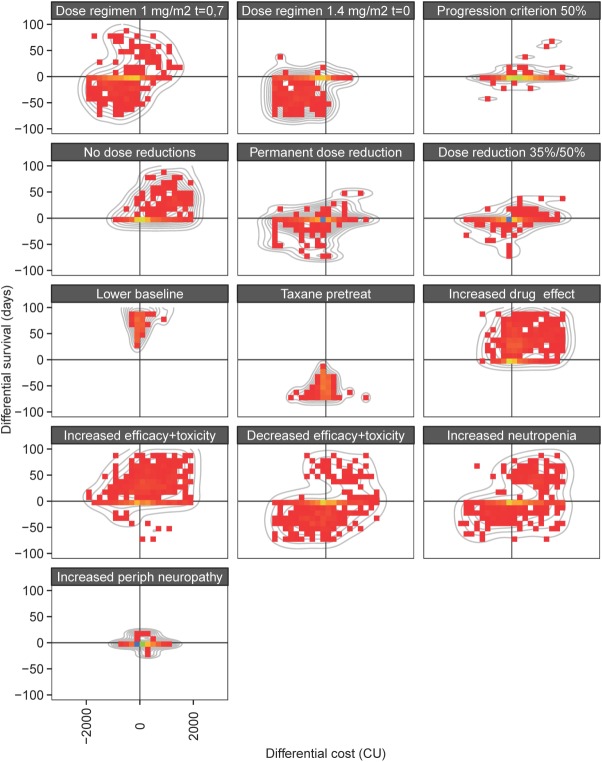
Distribution of difference in cost (CU) vs. effect (overall survival, days) for the different simulation scenarios vs. the base scenario. The color intensity represents the relative density of cost-effectiveness pairs across individuals. The gray lines represent 2D density smoothers.

References

    1. Bruno R, Mercier F. Claret L. Model-based drug development in oncology: what's next? Clin. Pharmacol. Ther. 2013;93:303–305. - PubMed
    1. Sheiner L. Wakefield J. Population modelling in drug development. Stat. Methods Med. Res. 1999;8:183–193. - PubMed
    1. Van Hasselt JGC, et al. The status of pharmacometrics in pregnancy: highlights from the 3(rd) American Conference on Pharmacometrics. Br. J. Clin. Pharmacol. 2012;74:932–939. - PMC - PubMed
    1. Sharma MR, Maitland ML. Ratain MJ. Models of excellence: improving oncology drug development. Clin. Pharmacol. Ther. 2012;92:548–550. - PMC - PubMed
    1. Keizer RJ, Zandvliet AS, Beijnen JH, Schellens JHM. Huitema ADR. Two-stage model-based design of cancer phase I dose escalation trials: evaluation using the phase I program of barasertib (AZD1152) Invest. New Drugs. 2012;30:1519–1530. - PMC - PubMed