. 2015 Aug 27;10(8):e0136581.
doi: 10.1371/journal.pone.0136581. eCollection 2015.

Social Costs of Iron Deficiency Anemia in 6-59-Month-Old Children in India

Affiliations

Social Costs of Iron Deficiency Anemia in 6-59-Month-Old Children in India

Rafael Plessow et al. PLoS One. .

Abstract

Introduction: Inadequate nutrition has a severe impact on health in India. According to the WHO, iron deficiency is the single most important nutritional risk factor in India, accounting for more than 3% of all disability-adjusted life years (DALYs) lost. We estimate the social costs of iron deficiency anemia (IDA) in 6-59-month-old children in India in terms of intangible costs and production losses.

Materials and methods: We build a health economic model estimating the life-time costs of a birth cohort suffering from IDA between the ages of 6 and 59 months. The model is stratified by 2 age groups (6-23 and 24-59-months), 2 geographical areas (urban and rural), 10 socio-economic strata and 3 degrees of severity of IDA (mild, moderate and severe). Prevalence of anemia is calculated with the last available National Family Health Survey. Information on the health consequences of IDA is extracted from the literature.

Results: IDA prevalence is 49.5% in 6-23-month-old and 39.9% in 24-58-month-old children. Children living in poor households in rural areas are particularly affected but prevalence is high even in wealthy urban households. The estimated yearly costs of IDA in 6-59-month-old children amount to intangible costs of 8.3 m DALYs and production losses of 24,001 m USD, equal to 1.3% of gross domestic product. Previous calculations have considerably underestimated the intangible costs of IDA as the improved WHO methodology leads to a threefold increase of DALYs due to IDA.

Conclusion: Despite years of iron supplementation programs and substantial economic growth, IDA remains a crucial public health issue in India and an obstacle to the economic advancement of the poor. Young children are especially vulnerable due to the irreversible effects of IDA on cognitive development. Our research may contribute to the design of new effective interventions aiming to reduce IDA in early childhood.


Conflict of interest statement

Competing Interests: The authors have the following interests. The study was supported by the Nestlé Research Center. KE and SW have received speaker honorarium and conference travel grants from Nestlé Nutrition Institute. Rafael Plessow, Beatrice Brunner, Christina Tzogiou, Klaus Eichler, Urs Brügger and Simon Wieser are employed by Winterthur Institute of Health Economics. The Winterthur Institute of Health Economics is an institute at the Zurich University of Applied Sciences, a publicly funded Swiss University. There are no patents, products in development or marketed products to declare. This does not alter the authors' adherence to all the PLOS ONE policies on sharing data and materials, as detailed online in the guide for authors.

Figures

Fig 1
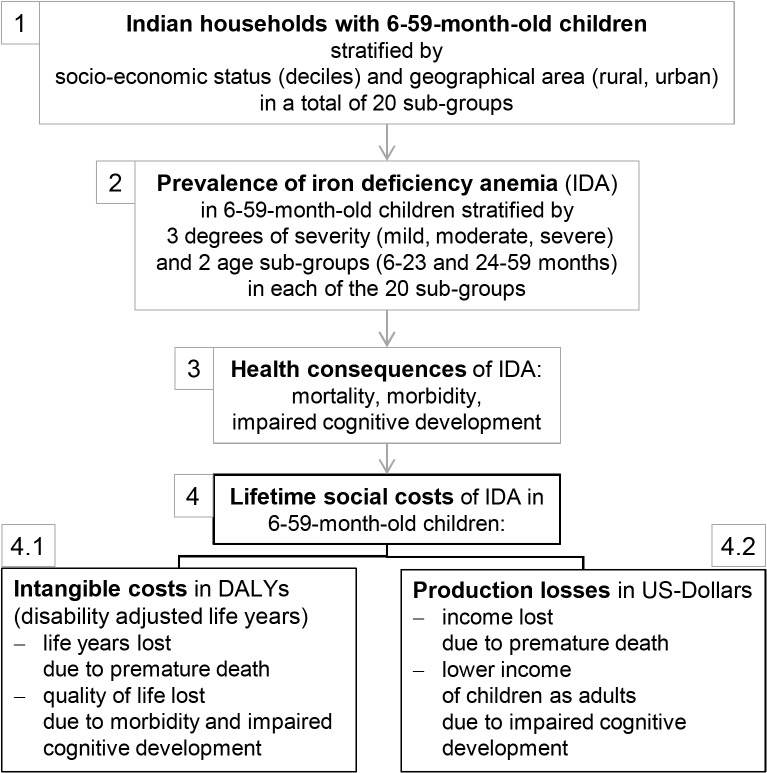
Fig 1. Overview of health economic model of social costs of IDA.
Adapted from Wieser, Plessow [9].
Fig 2
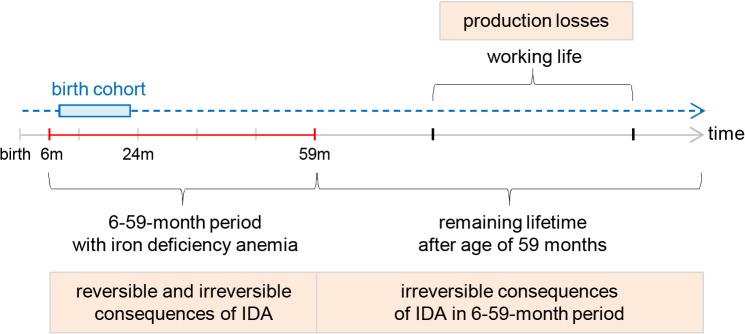
Fig 2. Temporary and permanent consequences of IDA in a birth cohort.
The model estimates present value of the lifetime costs of iron deficiency anemia (IDA) in a birth cohort affected by IDA from 6 to 59 months of age. These costs include the irreversible effects of IDA on cognitive development, leading to lower incomes and lower quality of life in adult life.
Fig 3
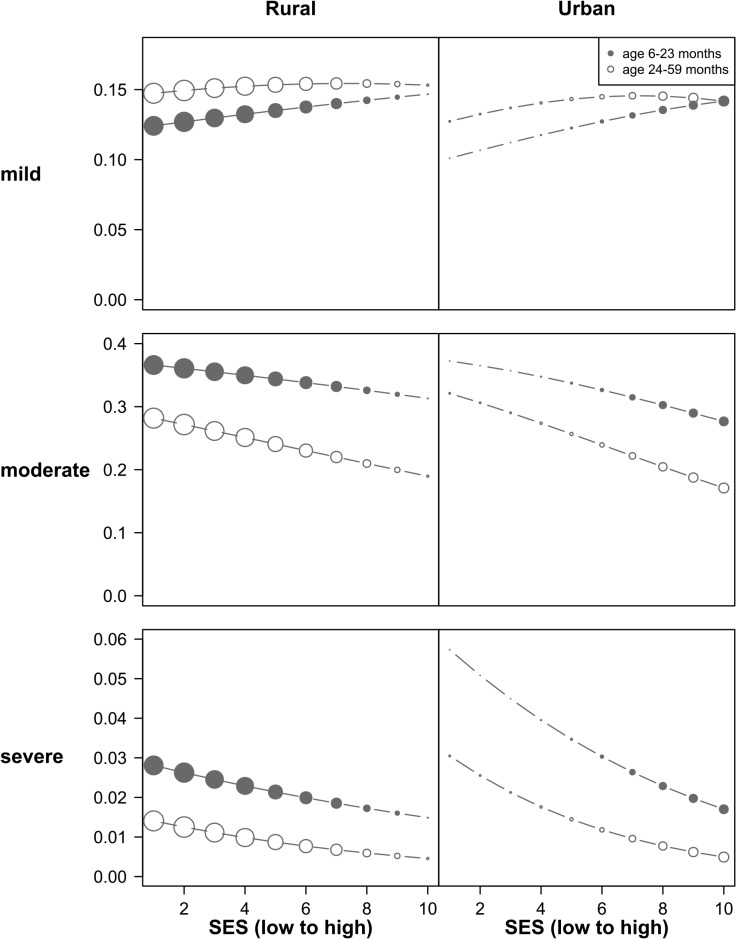
Fig 3. Prevalence of IDA by severity, age-group, SES and area of residence.
Source: Own calculation based on NFHS-3 survey [10]. Mild IDA (Hb g/l 100–110); moderate IDA (Hb g/l 70–100); severe IDA (Hb g/l <70), size of bubbles corresponds to relative size of the population of the sub-group.
Fig 4
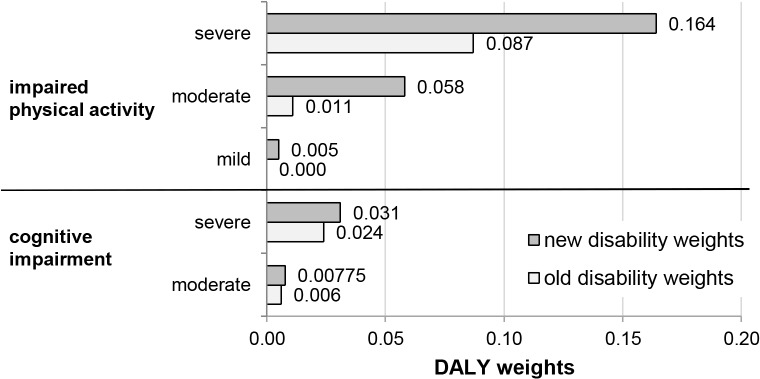
Fig 4. Old and new disability weights.
Disability weights according to GBD 1996 methodology [19] and GBD 2010 methodology [18] and adaptations according to Stein et al. [29].
Fig 5
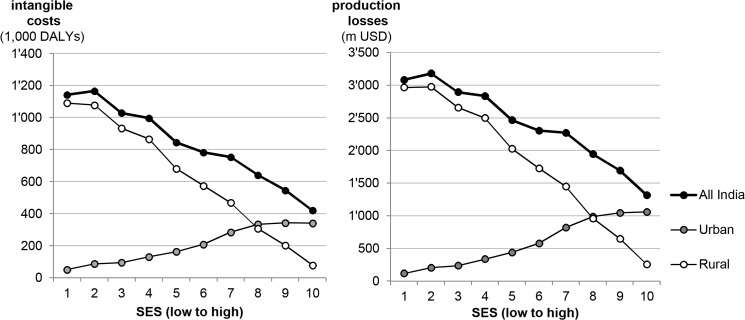
Fig 5. Intangible costs and production losses due to IDA by SES.
Distribution of costs across SES. Households are split into deciles of equal size for the whole country.
Fig 6
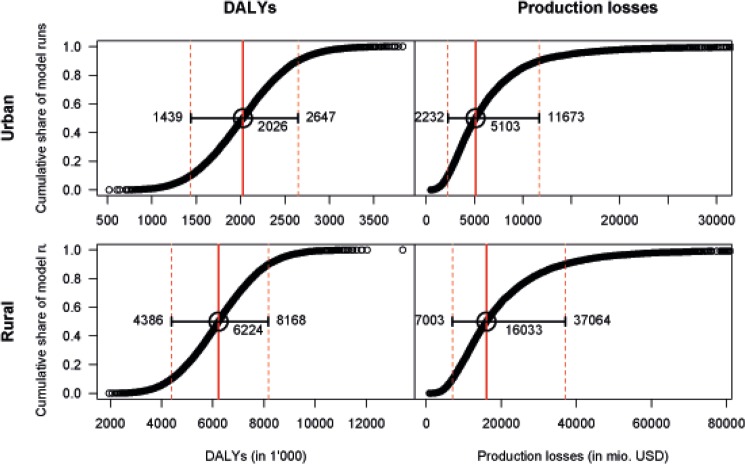
Fig 6. Multivariate sensitivity analysis by type of social cost and area of residence.
Distribution of ordered results from 10,000 model runs with input parameters varying randomly according to predefined distributions. The curves show the share of all model runs that resulted in costs of a given size or lower. The solid vertical line shows the median result of all model runs. The dashed lines mark the values between which 80% of all model runs lay.
Fig 7
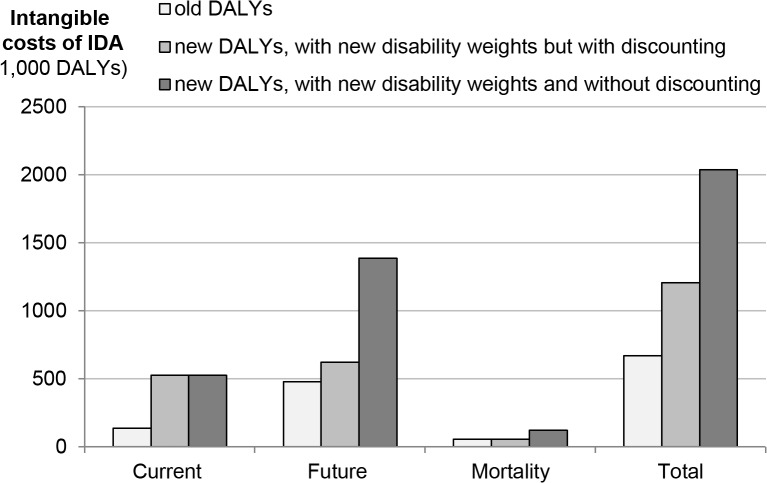
Fig 7. Comparison of DALY calculation rules for urban India.

References

    1. Institue for Health Metrics and Evaluation. GBD profile: India 2013 [21. July 2015]. Available from: http://www.healthdata.org/results/country-profiles.
    1. Sachdev HP, Gera T. Preventing childhood anemia in India: iron supplementation and beyond. Eur J Clin Nutr. 2013;67(5):475–80. 10.1038/ejcn.2012.212 - DOI - PubMed
    1. Lozoff B, Jimenez E, Smith JB. Double burden of iron deficiency in infancy and low socioeconomic status. A longitudinal analysis of cognitive test scores to age 19 years. Arch Pediatr Adolesc Med. 2006;160(11):1108–13. - PMC - PubMed
    1. Black RE, Victora CG, Walker SP, Bhutta ZA, Christian P, de Onis M, et al. Maternal and child undernutrition and overweight in low-income and middle-income countries. Lancet. 2013;382(9890):427–51. 10.1016/S0140-6736(13)60937-X - DOI - PubMed
    1. Government of India. Census of India 2011 [23 July 2014]. Available from: http://www.censusindia.gov.in/.

Publication types

LinkOut - more resources