


Association of Change of Anthropometric Measurements With Incident Type 2 Diabetes Mellitus: A Pooled Analysis of the Prospective Population-Based CARLA and SHIP Cohort Studies
- PMID: 26313783
- PMCID: PMC4602920
- DOI: 10.1097/MD.0000000000001394
Association of Change of Anthropometric Measurements With Incident Type 2 Diabetes Mellitus: A Pooled Analysis of the Prospective Population-Based CARLA and SHIP Cohort Studies
Abstract
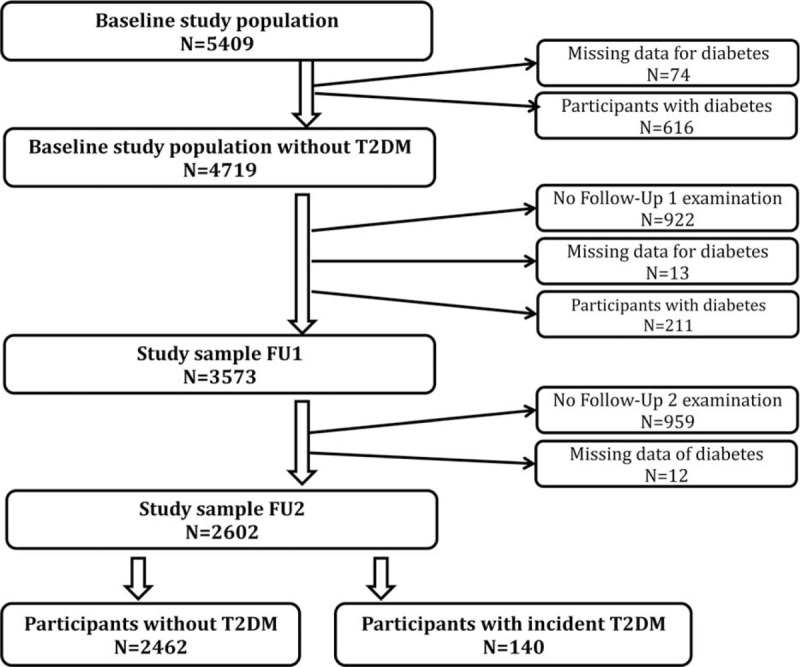
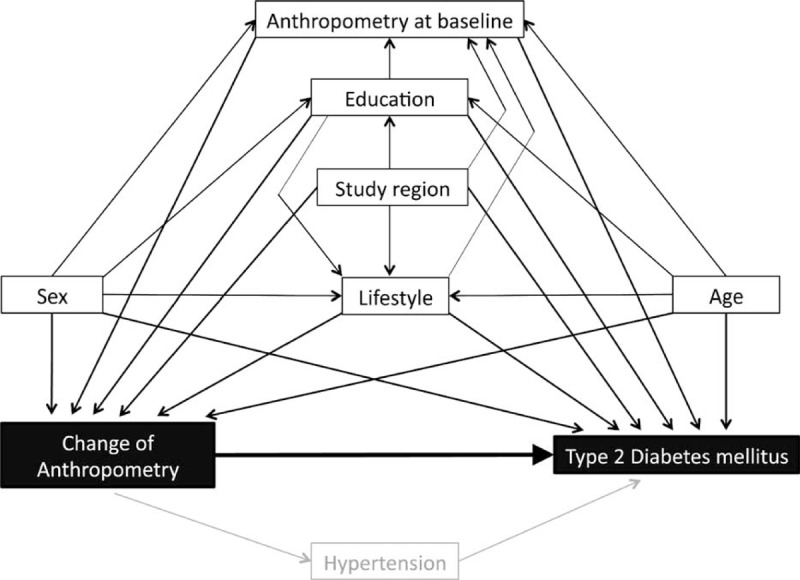
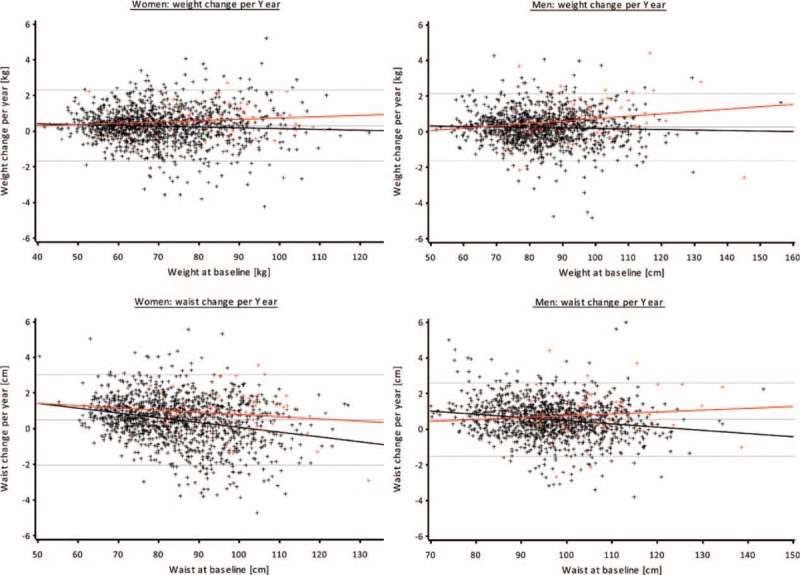
Our objective was to investigate the association of change of anthropometric measurements and the incidence of type 2 diabetes mellitus (T2DM) within a pooled sample of 2 population-based cohorts.A final sample of 1324 women and 1278 men aged 31 to 83 years from 2 prospective cohorts in Germany, the CARLA (Cardiovascular Disease - Living and Ageing in Halle) and the SHIP study (Study of Health in Pomerania), were pooled. The association of change of body weight and waist circumference (WC) with incidence of T2DM was assessed by calculating sex-specific hazard ratios (HRs). We investigated the absolute change of markers of obesity as well as change relative to the baseline value and estimated crude and adjusted HRs. Furthermore, we conducted the analyses stratified by obesity status and age (<60 vs ≥60 years) at baseline.Associations were found for both change of body weight and WC and incidence of T2DM in the crude and adjusted analyses. In the stratified study sample, those participants with a body mass index of <30 kg/m at baseline showed considerably lower HRs compared with obese women and men for both weight and WC. In the age-stratified analysis, we still found associations between change of weight and WC and incident T2DM with only marginal differences between the age groups.Our study showed associations of change of weight and WC as markers of obesity with incidence of T2DM. Keeping a healthy and primarily stable weight should be the goal for preventing the development of T2DM.
Conflict of interest statement
The authors report no conflicts of interest.
Figures
References
-
- Danaei G, Finucane MM, Lu Y, et al. National, regional, and global trends in fasting plasma glucose and diabetes prevalence since 1980: systematic analysis of health examination surveys and epidemiological studies with 370 country-years and 2.7 million participants. Lancet 2011; 378:31–40. - PubMed
-
- Burke JP, Williams K, Gaskill SP, et al. Rapid rise in the incidence of type 2 diabetes from 1987 to 1996: results from the San Antonio Heart Study. Arch Intern Med 1999; 159:1450–1456. - PubMed
-
- Geiss LS, Wang J, Cheng YJ, et al. Prevalence and incidence trends for diagnosed diabetes among adults aged 20 to 79 years, United States, 1980-2012. JAMA 2014; 312:1218–1226. - PubMed
-
- Weinstein AR, Sesso HD, Lee IM, et al. Relationship of physical activity vs body mass index with type 2 diabetes in women. JAMA 2004; 292:1188–1194. - PubMed
Publication types
MeSH terms
LinkOut - more resources
Full Text Sources
Medical
