


Heat Shock Protein 90 Inhibitor Decreases Collagen Synthesis of Keloid Fibroblasts and Attenuates the Extracellular Matrix on the Keloid Spheroid Model
- PMID: 26313837
- PMCID: PMC4556118
- DOI: 10.1097/PRS.0000000000001538
Heat Shock Protein 90 Inhibitor Decreases Collagen Synthesis of Keloid Fibroblasts and Attenuates the Extracellular Matrix on the Keloid Spheroid Model
Abstract
Background: The 90-kDa heat-shock protein (heat-shock protein 90) is an abundant cytosolic chaperone, and inhibition of heat-shock protein 90 by 17-allylamino-17-demethoxygeldanamycin (17-AAG) compromises transforming growth factor (TGF)-β-mediated transcriptional responses by enhancing TGF-β receptor I and II degradation, thus preventing Smad2/3 activation. In this study, the authors evaluated whether heat-shock protein 90 regulates TGF-β signaling in the pathogenesis and treatment of keloids.
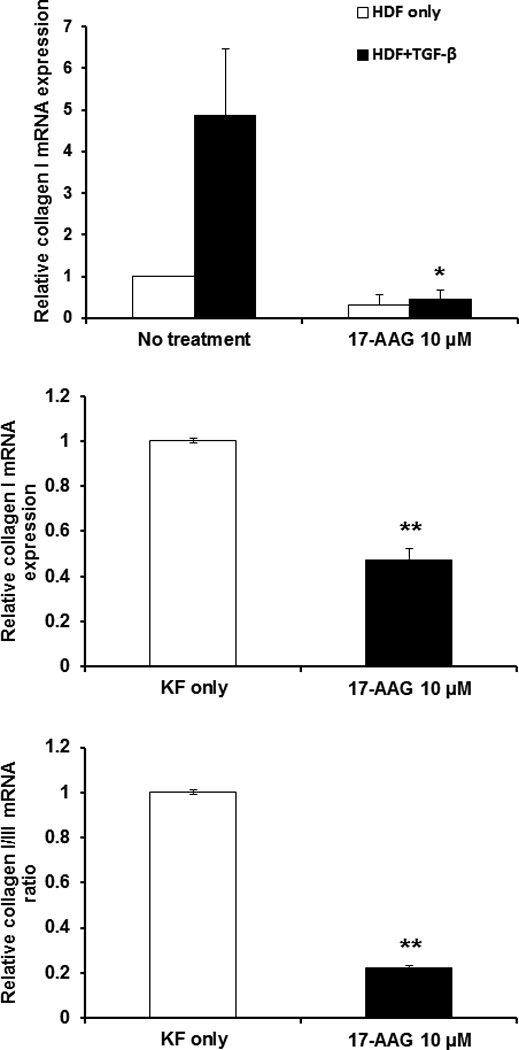
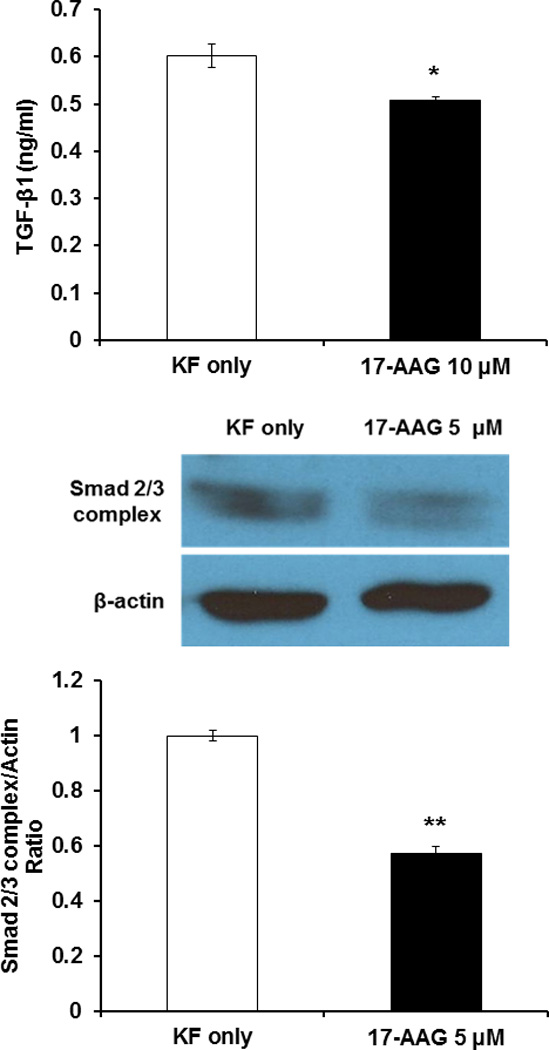
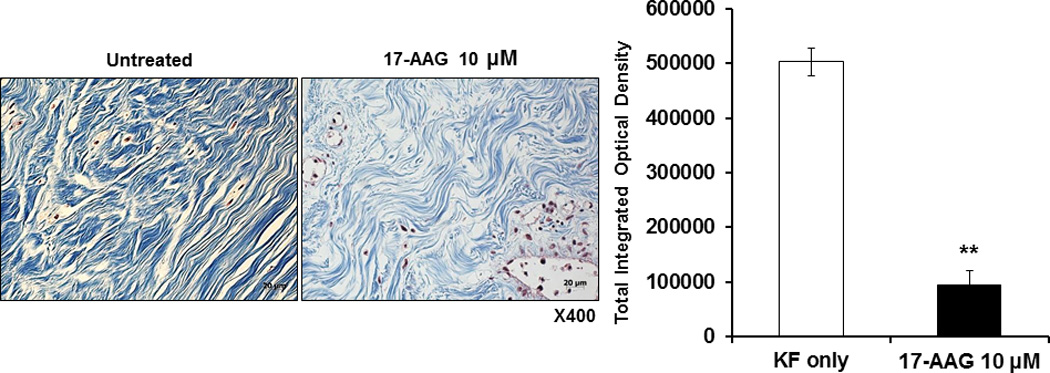
Methods: Keloid fibroblasts were treated with 17-AAG (10 μM), and mRNA levels of collagen types I and III were determined by real-time reverse- transcriptase polymerase chain reaction. Also, secreted TGF-β1 was assessed by enzyme-linked immunosorbent assay. The effect of 17-AAG on protein levels of Smad2/3 complex was determined by Western blot analysis. In addition, in 17-AAG-treated keloid spheroids, the collagen deposition and expression of major extracellular matrix proteins were investigated by means of Masson trichrome staining and immunohistochemistry.
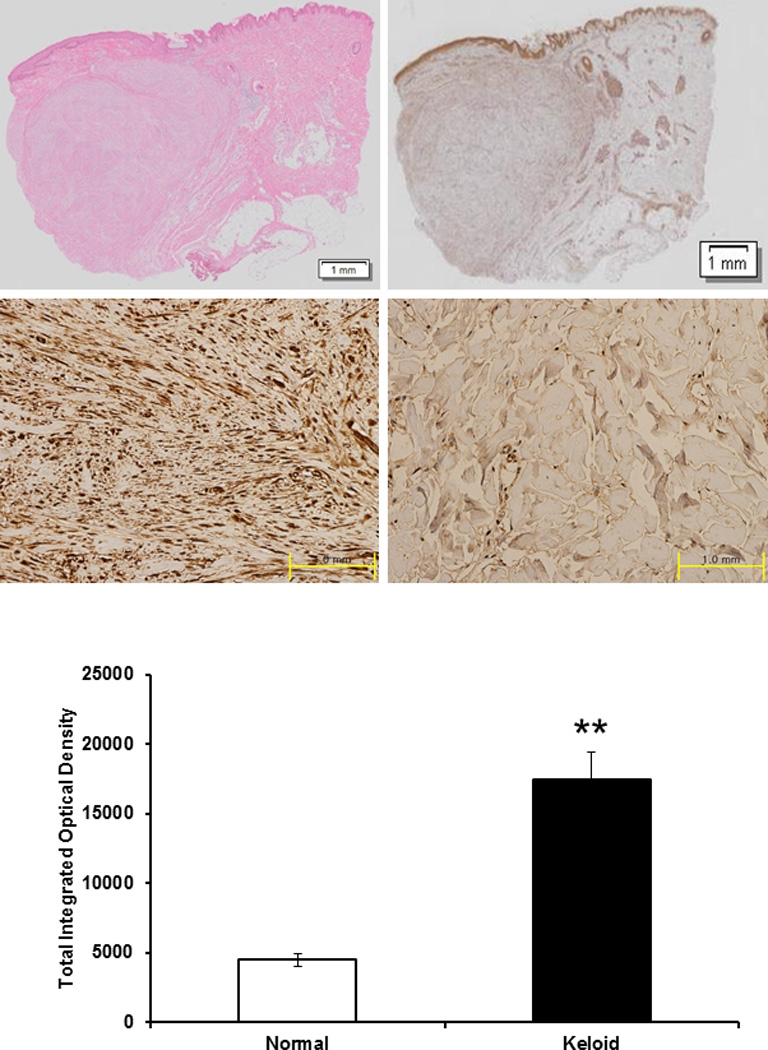
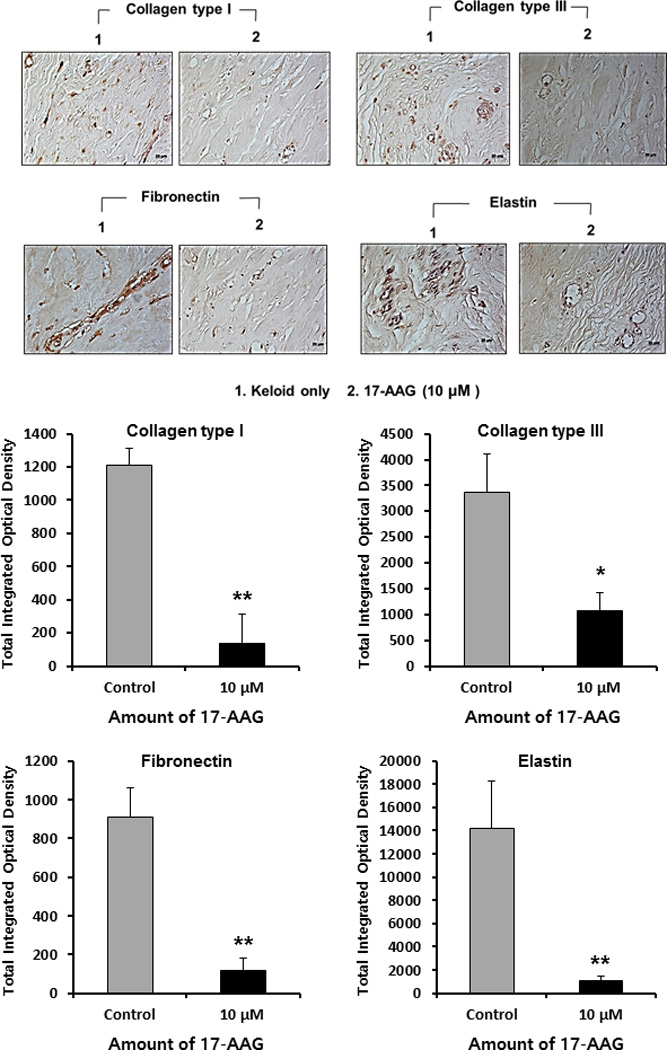
Results: The authors found that heat-shock protein 90 is overexpressed in human keloid tissue compared with adjacent normal tissue, and 17-AAG decreased mRNA levels of type I collagen, secreted TGF-ß1, and Smad2/3 complex protein expression in keloid fibroblasts. Masson trichrome staining revealed that collagen deposition was decreased in 17-AAG-treated keloid spheroids, and immunohistochemical analysis showed that expression of collagen types I and III, elastin, and fibronectin was markedly decreased in 17-AAG-treated keloid spheroids.
Conclusion: These results suggest that the antifibrotic action of heat-shock protein 90 inhibitors such as 17-AAG may have therapeutic effects on keloids.
Figures
Comment in
-
Heat Shock Protein 90 Inhibitor Decreases Collagen Synthesis of Keloid Fibroblasts and Attenuates the Extracellular Matrix on the Keloid Spheroid Model.Plast Reconstr Surg. 2016 Apr;137(4):759e-760e. doi: 10.1097/PRS.0000000000002039. Plast Reconstr Surg. 2016. PMID: 26752358 No abstract available.
References
-
- Burd A, Huang L. Hypertrophic response and keloid diathesis: two very different forms of scar. Plast Reconstr Surg. 2005;116:150e–157e. - PubMed
-
- Atiyeh BS, Costagliola M, Hayek SN. Keloid or hypertrophic scar: the controversy: review of the literature. Ann Plast Surg. 2005;54:676–680. - PubMed
-
- Al-Attar A, Mess S, Thomassen JM, Kauffman CL, Davison SP. Keloid pathogenesis and treatment. Plast Reconstr Surg. 2006;117:286–300. - PubMed
Publication types
MeSH terms
Substances
Grants and funding
LinkOut - more resources
Full Text Sources
Other Literature Sources
