


Improving Health-Related Quality of Life among People Living with HIV: Results from an Impact Evaluation of a Food Assistance Program in Uganda
- PMID: 26313908
- PMCID: PMC4552093
- DOI: 10.1371/journal.pone.0135879
Improving Health-Related Quality of Life among People Living with HIV: Results from an Impact Evaluation of a Food Assistance Program in Uganda
Abstract
Introduction: Widespread food insecurity in Africa continues to compromise an effective response to the AIDS epidemic. Health-related quality of life (HRQoL) is a comprehensive indicator of physical, mental, and social well-being that is associated with food insecurity and increasingly used to assess the well-being of people living with HIV/AIDS (PLHIV). We examined the impact of a food assistance intervention, previously shown to have reduced household food insecurity and improved nutritional status, on HRQoL of PLHIV.
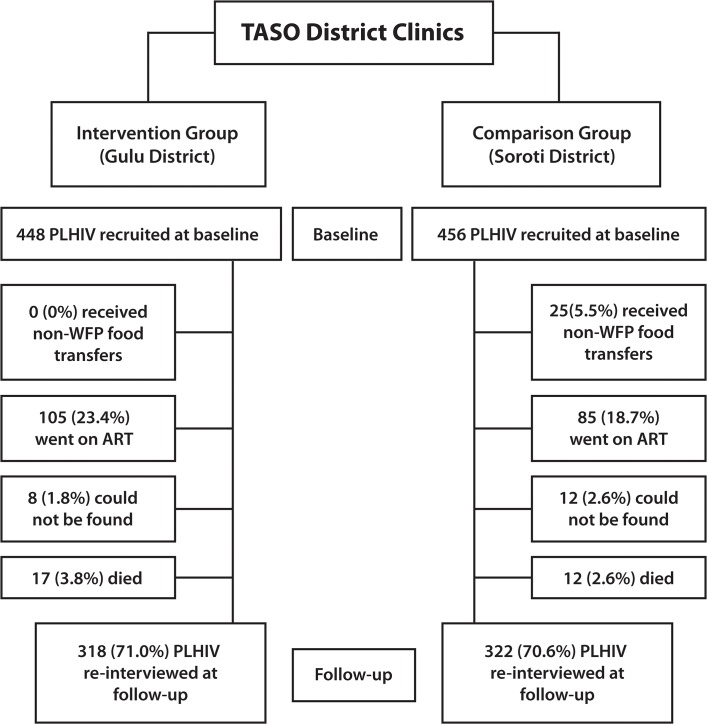
Methods: We capitalized on an existing intervention targeting antiretroviral therapy (ART)- naïve PLHIV in Uganda, and conducted a prospective impact evaluation including a treatment and a comparison group. Data analyzed included 640 participants from two districts (318 in the intervention district) interviewed in both clinic and household settings at baseline and again approximately one year later. The main outcomes considered were physical and mental health dimensions of HRQoL, and other outcomes included self- and healthcare provider-reported symptoms. We utilized difference-in-difference propensity score matching methodologies to infer causality and examine program impacts.
Results: Over 12 months, food assistance significantly increased physical health scores (PHS) by 2.85 (P < .01) or approximately 0.35 SD, and reduced substantially the number of self- and healthcare provider-reported HIV-related symptoms by 3.83 and 2.68, respectively (P < .01). There was no significant impact, however, on mental health scores (MHS).
Conclusions: This study demonstrates the potential importance for HRQoL of including food assistance programming as part of the standard of care for PLHIV in areas of widespread food insecurity.
Conflict of interest statement
Figures
References
-
- Bukusuba J, Kikafunda JK, Whitehead RG (2007) Food secruity status in households of people living with HIV/AIDS (PLWHA) in a Ugandan urban setting. Br J Nutr 98: 211–217. - PubMed
-
- Kirkpatrick SI, Tarasuk V (2008) Food insecurity is associated with nutrient inadequacies among Canadian adults and adolescents. J Nutr 138: 604–612. - PubMed
-
- Lee JS, Frongillo EA Jr (2001) Nutritional and health consequences are associated with food insecurity among US elderly persons. J Nutr 131: 1503–1509. - PubMed
-
- Stuff JE, Casey PH, Szeto KL, Gossett JM, Robbins JM, et al. (2004) Household food insecurity is associated with adult health status. J Nutr 134: 2330–2335. - PubMed
Publication types
MeSH terms
LinkOut - more resources
Full Text Sources
Other Literature Sources
Medical
