


Magnetic resonance elastography for staging liver fibrosis in non-alcoholic fatty liver disease: a diagnostic accuracy systematic review and individual participant data pooled analysis
- PMID: 26314479
- PMCID: PMC5051267
- DOI: 10.1007/s00330-015-3949-z
Magnetic resonance elastography for staging liver fibrosis in non-alcoholic fatty liver disease: a diagnostic accuracy systematic review and individual participant data pooled analysis
Abstract
Objectives: We conducted an individual participant data (IPD) pooled analysis on diagnostic accuracy of MRE to detect fibrosis stage in patients with non-alcoholic fatty liver disease (NAFLD).
Methods: Through a systematic literature search, we identified studies of MRE (at 60-62.5 Hz) for staging fibrosis in patients with NAFLD, using liver biopsy as gold standard, and contacted study authors for IPD. Through pooled analysis, we calculated the cluster-adjusted AUROC, sensitivity and specificity of MRE for any (≥stage 1), significant (≥stage 2) and advanced (≥stage 3) fibrosis and cirrhosis (stage 4).
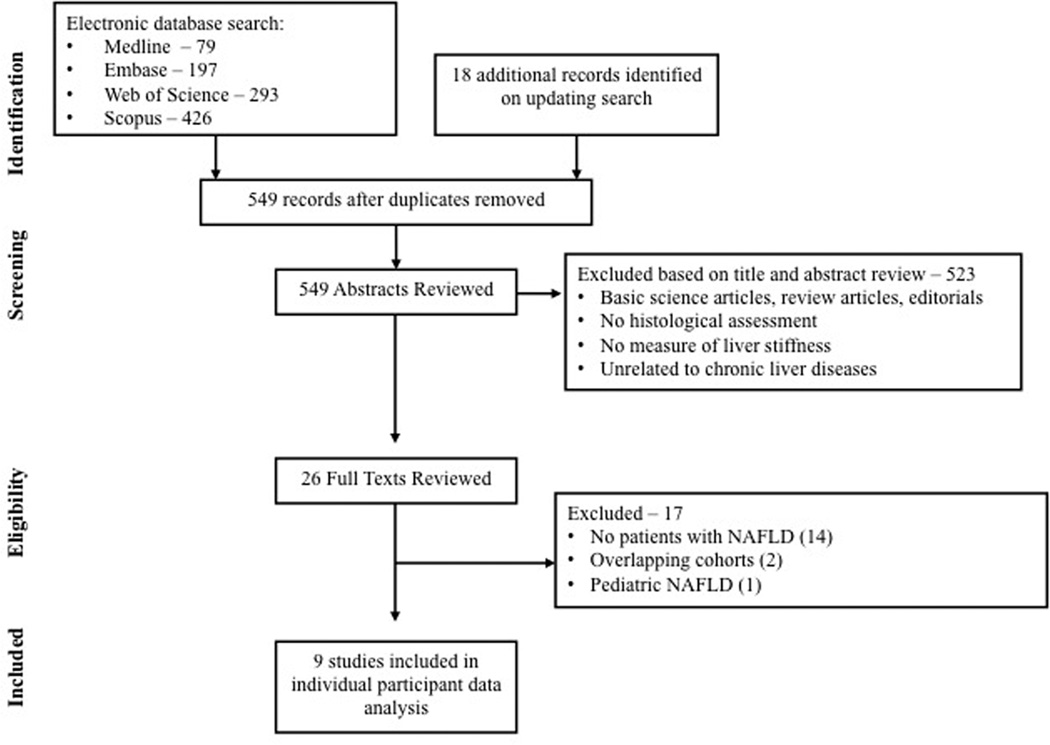
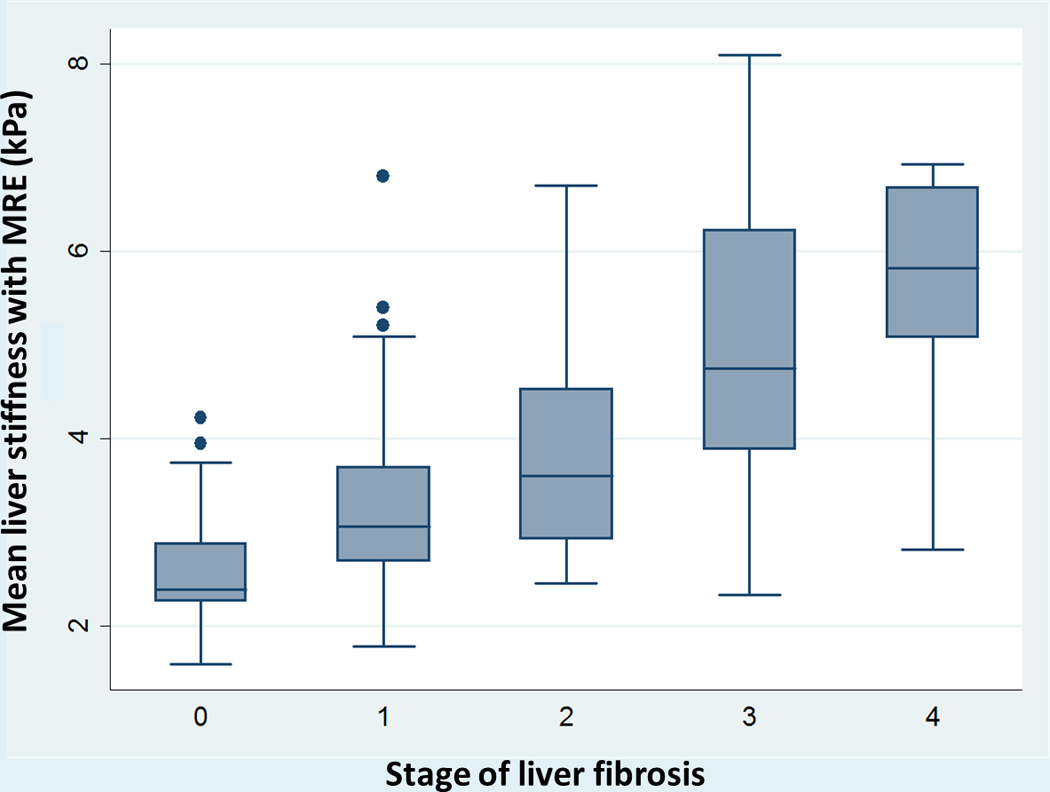
Results: We included nine studies with 232 patients with NAFLD (mean age, 51 ± 13 years; 37.5% males; mean BMI, 33.5 ± 6.7 kg/m(2); interval between MRE and biopsy <1 year, 98.3%). Fibrosis stage distribution (stage 0/1/2/3/4) was 33.6, 32.3, 10.8, 12.9 and 10.4%, respectively. Mean AUROC (and 95% CIs) for diagnosis of any, significant or advanced fibrosis and cirrhosis was 0.86 (0.82-0.90), 0.87 (0.82-0.93), 0.90 (0.84-0.94) and 0.91 (0.76-0.95), respectively. Similar diagnostic performance was observed in stratified analysis based on sex, obesity and degree of inflammation.
Conclusions: MRE has high diagnostic accuracy for detection of fibrosis in NAFLD, independent of BMI and degree of inflammation.
Key points: • MRE has high diagnostic accuracy for detection of fibrosis in NAFLD. • BMI does not significantly affect accuracy of MRE in NAFLD. • Inflammation had no significant influence on MRE performance in NAFLD for fibrosis.
Keywords: Biomarker; Cirrhosis; Diagnostic performance; Elastography; Fibrosis.
Conflict of interest statement
This research has been reviewed by the Mayo Clinic Conflict of Interest Review Board and is being conducted in compliance with Mayo Clinic Conflict of Interest policies. None of the other authors have any disclosures.
Figures
References
-
- Vernon G, Baranova A, Younossi ZM. Systematic review: the epidemiology and natural history of non-alcoholic fatty liver disease and non-alcoholic steatohepatitis in adults. Aliment Pharmacol Ther. 2011;34:274–285. - PubMed
-
- Chalasani N, Younossi Z, Lavine JE, et al. The diagnosis and management of non-alcoholic fatty liver disease: practice guideline by the American Gastroenterological Association, American Association for the Study of Liver Diseases, and American College of Gastroenterology. Gastroenterology. 2012;142:1592–1609. - PubMed
-
- Loomba R, Sanyal AJ. The global NAFLD epidemic. Nat Rev Gastroenterol Hepatol. 2013;10:686–690. - PubMed
-
- Bravo AA, Sheth SG, Chopra S. Liver biopsy. N Engl J Med. 2001;344:495–500. - PubMed
Publication types
MeSH terms
Grants and funding
LinkOut - more resources
Full Text Sources
Other Literature Sources
Medical
