. 2016 Feb 15;138(4):881-90.
doi: 10.1002/ijc.29825. Epub 2015 Sep 8.

The distribution of BRAF gene fusions in solid tumors and response to targeted therapy

Affiliations

The distribution of BRAF gene fusions in solid tumors and response to targeted therapy

Jeffrey S Ross et al. Int J Cancer. .

Abstract

Although the BRAF V600E base substitution is an approved target for the BRAF inhibitors in melanoma, BRAF gene fusions have not been investigated as anticancer drug targets. In our study, a wide variety of tumors underwent comprehensive genomic profiling for hundreds of known cancer genes using the FoundationOne™ or FoundationOne Heme™ comprehensive genomic profiling assays. BRAF fusions involving the intact in-frame BRAF kinase domain were observed in 55 (0.3%) of 20,573 tumors, across 12 distinct tumor types, including 20 novel BRAF fusions. These comprised 29 unique 5' fusion partners, of which 31% (9) were known and 69% (20) were novel. BRAF fusions included 3% (14/531) of melanomas; 2% (15/701) of gliomas; 1.0% (3/294) of thyroid cancers; 0.3% (3/1,062) pancreatic carcinomas; 0.2% (8/4,013) nonsmall-cell lung cancers and 0.2% (4/2,154) of colorectal cancers, and were enriched in pilocytic (30%) vs. nonpilocytic gliomas (1%; p < 0.0001), Spitzoid (75%) vs. nonSpitzoid melanomas (1%; p = 0.0001), acinar (67%) vs. nonacinar pancreatic cancers (<1%; p < 0.0001) and papillary (3%) vs. nonpapillary thyroid cancers (0%; p < 0.03). Clinical responses to trametinib and sorafenib are presented. In conclusion, BRAF fusions are rare driver alterations in a wide variety of malignant neoplasms, but enriched in Spitzoid melanoma, pilocytic astrocytomas, pancreatic acinar and papillary thyroid cancers.

Keywords: BRAF fusions; NGS; Sptizoid melanoma; cancer; comprehensive genomic profiling; pancreatic acinar carcinoma; pilocytic astrocytoma; solid tumors; targeted therapy.


Figures

Figure 1
Figure 1
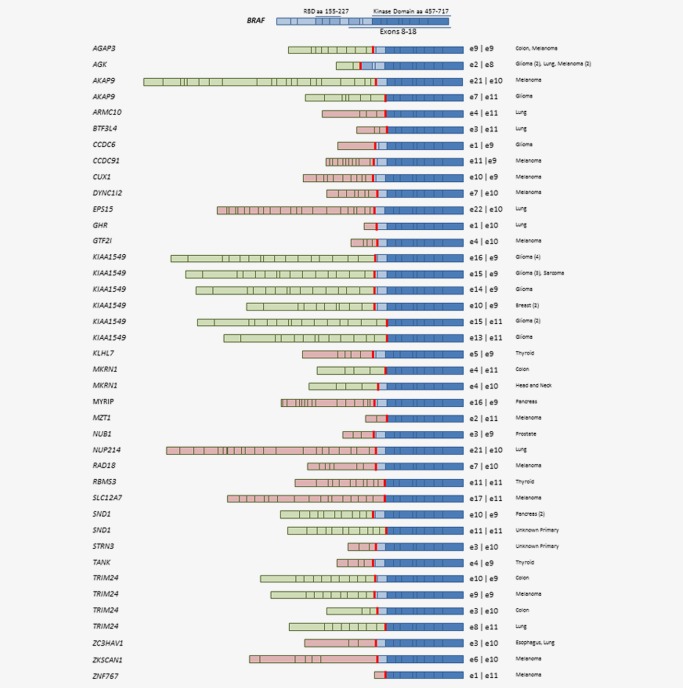
Structure of 55 BRAF fusions discovered from 20,573 solid tumors detected by comprehensive genomic profiling. Novel fusions were in pink, and known fusions were in green.
Figure 2
Figure 2
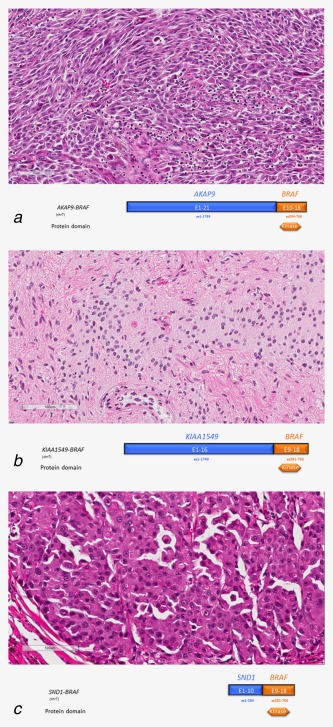
BRAF fusions in a variety of solid tumors. (a) (Case 32) Spitzoid metastatic malignant melanoma in a 60‐year‐old Caucasian female. Note the diffuse distribution of so‐called spindle or elongate cells and mixed with scattered round epithelioid cells with abundant pink cytoplasm and tumor‐infiltrating lymphocytes. Lymph node and cutaneous metastases present at the time of sequencing. The tumor features a fusion of AKAP9 (exons 1–21)–BRAF (exons 10–18) (hematoxylin and eosin 100×). (b) (Case 15) A pilocytic astrocytoma partially resected from the parietal lobe in an 8‐year‐old male with a KIAA1549 (exons 1–16)–BRAF (exons 9–18) fusion. Image shows a well‐differentiated low‐grade astrocytoma with widely separated oval to elongate tumor cell nuclei associated with tangles of eosinophilic fibrils (rosenthal fibers) in the lower right (hematoxylin and eosin 100×). (c) (Case 45) Pulmonary metastasis from a primary pancreatic acinar carcinoma in a 67‐year‐old Caucasian man. Sequencing revealed a rearrangement consistent with an inversion on chromosome 7, juxtaposing the 5′ region of SND1 to the complete kinase domain of BRAF, resulting in the generation of a predicted in‐frame SND1 (exons 1–10)–BRAF (exons 9–18) fusion protein (Hematoxylin and eosin X 100). In an expanded study of 44 pancreatic acinar carcinomas, we identified recurrent rearrangements involving BRAF and RAF1 (CRAF) in 23% of the tumors. The image shows solid nests of polygonal neoplastic cells with granular eosinophilic cytoplasm (hematoxylin and eosin 100×).
Figure 3
Figure 3
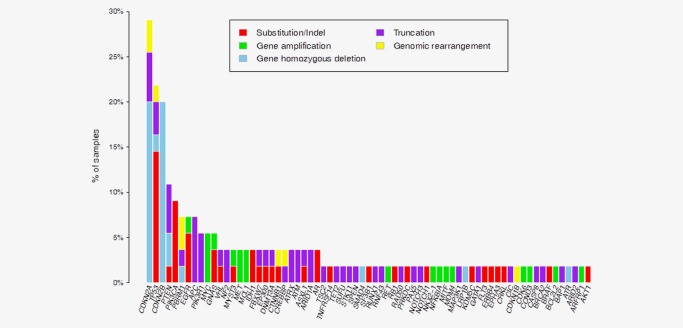
Distribution plot of additional genomic alterations identified in the targeted genes of the sequencing panel in 55 cases of BRAF fusion associated solid tumors.
Figure 4
Figure 4
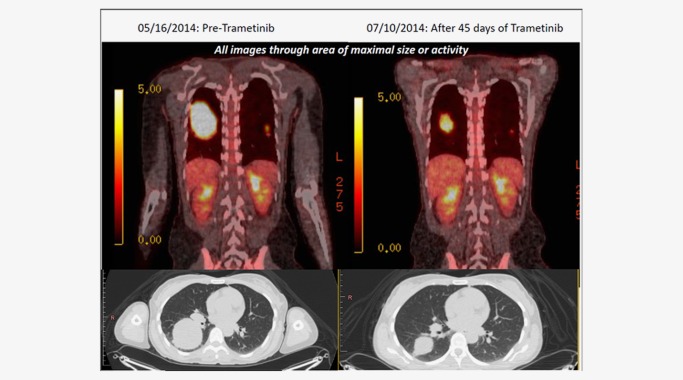
Fused PET/CT imaging results of trametinib therapy in a metastatic Spitzoid melanoma (Case 38) from a 46‐year‐old Caucasian woman that featured a ZKSCAN1‐BRAF fusion (ZKSCAN1 exons 1–5–BRAF exons 10–18) and responded to the MEK inhibitor trametinib. Subcutaneous tumor nodules exhibited overt clinical responses within 14 days of therapy, and her dominant bulky right lung metastases showed significant response by Day 45 such that she subsequently underwent robotic‐assisted lobectomy. The patient is currently alive with stable disease at 6 months post‐thoracic surgery.
Figure 5
Figure 5
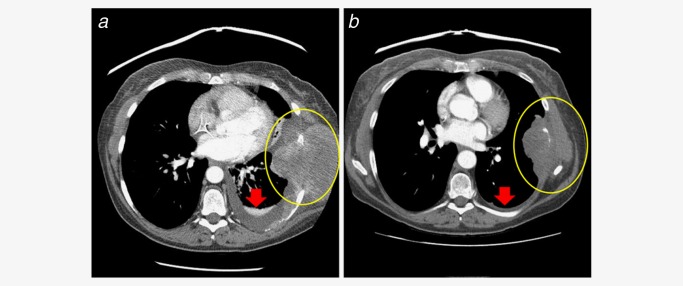
A malignant spindle cell tumor (Case 50) of the chest wall treated as a soft tissue sarcoma that featured a KIAA1549‐BRAF fusion (KIAA1549 exons 1–15–BRAF exons 9–18) showing pre‐ and post‐treatment CT scan images featuring tumor response to treatment with bevacizumab, temsirolimus and sorafenib.39 [Permission to re‐publish this figure provided by the publisher]. [Color figure can be viewed in the online issue, which is available at wileyonlinelibrary.com.]

References

    1. Davies H, Bignell GR, Cox C, et al. Mutations of the BRAF gene in human cancer. Nature 2002;417:949–54. - PubMed
    1. El‐Osta H, Falchook G, Tsimberidou A, et al. BRAF mutations in advanced cancers: clinical characteristics and outcomes. PLoS One 2011;6:e25806 - PMC - PubMed
    1. Pakneshan S, Salajegheh A, Smith RA, et al. Clinicopathological relevance of BRAF mutations in human cancer. Pathology 2013;45:346–56. - PubMed
    1. Vultur A, Villanueva J, Herlyn M. Targeting BRAF in advanced melanoma: a first step toward manageable disease. Clin Cancer Res 2011;17:1658–63. - PMC - PubMed
    1. Cantwell‐Dorris ER, O'Leary JJ, Sheils OM. BRAF(V600E): implications for carcinogenesis and molecular therapy. Mol Cancer Ther 2011;10:385–94. - PubMed

MeSH terms