


CAVEOLIN-1 expression in brain metastasis from lung cancer predicts worse outcome and radioresistance, irrespective of tumor histotype
- PMID: 26315660
- PMCID: PMC4745751
- DOI: 10.18632/oncotarget.4988
CAVEOLIN-1 expression in brain metastasis from lung cancer predicts worse outcome and radioresistance, irrespective of tumor histotype
Abstract
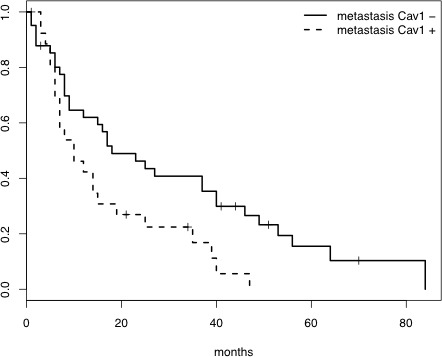
Brain metastases develop in one-third of patients with non-small-cell lung cancer and are associated with a dismal prognosis, irrespective of surgery or chemo-radiotherapy. Pathological markers for predicting outcomes after surgical resection and radiotherapy responsiveness are still lacking. Caveolin 1 has been associated with chemo- and radioresistance in various tumors, including non-small-cell lung cancer. Here, caveolin 1 expression was assessed in a series of 69 brain metastases from non-small-cell lung cancer and matched primary tumors to determine its role in predicting survival and radiotherapy responsiveness. Only caveolin 1 expression in brain metastasis was associated with poor prognosis and an increased risk of death (log rank test, p = 0.015). Moreover, in the younger patients (median age of <54 years), caveolin 1 expression neutralized the favorable effect of young age on survival compared with the older patients. Among the radiotherapy-treated patients, an increased risk of death was detected in the group with caveolin 1-positive brain metastasis (14 out of 22 patients, HR=6.839, 95% CI 1.849 to 25.301, Wald test p = 0.004). Overall, caveolin 1 expression in brain metastasis from non-small-cell lung cancer is independently predictive of worse outcome and radioresistance and could become an additional tool for personalized therapy in the critical subset of brain-metastatic non-small-cell lung cancer patients.
Keywords: brain metastasis; caveolin 1; non-small-cell lung cancer; radiotherapy.
Conflict of interest statement
The authors declare that they have no conflicts of interest.
Figures

References
-
- Barnholtz-Sloan JS, Sloan AE, Davis FG, Vigneau FD, Lai P, Sawaya RE. Incidence proportions of brain metastases in patients diagnosed (1973 to 2001) in the Metropolitan Detroit Cancer Surveillance System. J Clin Oncol. 2004;22:2865–2872. - PubMed
-
- Besse B, Adjei A, Baas P, Meldgaard P, Nicolson M, Paz-Ares L, Reck M, Smit EF, Syrigos K, Stahel R, Felip E, Peters S, Panel M. 2nd ESMO Consensus Conference on Lung Cancer: non-small-cell lung cancer first-line/second and further lines of treatment in advanced disease. Ann Oncol. 2014;25:1475–1484. - PubMed
-
- Baykara M, Kurt G, Buyukberber S, Demirci U, Ceviker N, Algin E, Coskun U, Aykol S, Emmez H, Ozet A, Benekli M. Management of brain metastases from non-small cell lung cancer. J Cancer Res Ther. 2014;10:915–921. - PubMed
-
- Soffietti R, Ruda R, Trevisan E. Brain metastases: current management and new developments. Curr Opin Oncol. 2008;20:676–684. - PubMed
-
- Sperduto PW, Kased N, Roberge D, Xu Z, Shanley R, Luo X, Sneed PK, Chao ST, Weil RJ, Suh J, Bhatt A, Jensen AW, Brown PD, Shih HA, Kirkpatrick J, Gaspar LE, et al. Summary report on the graded prognostic assessment: an accurate and facile diagnosis-specific tool to estimate survival for patients with brain metastases. J Clin Oncol. 2012;30:419–425. - PMC - PubMed
Publication types
MeSH terms
Substances
LinkOut - more resources
Full Text Sources
Other Literature Sources
Medical
