


Prognostic Significance of Premature Atrial Complexes Burden in Prediction of Long-Term Outcome
- PMID: 26316525
- PMCID: PMC4599506
- DOI: 10.1161/JAHA.115.002192
Prognostic Significance of Premature Atrial Complexes Burden in Prediction of Long-Term Outcome
Abstract
Background: The prognostic significance of premature atrial complex (PAC) burden is not fully elucidated. We aimed to investigate the relationship between the burden of PACs and long-term outcome.
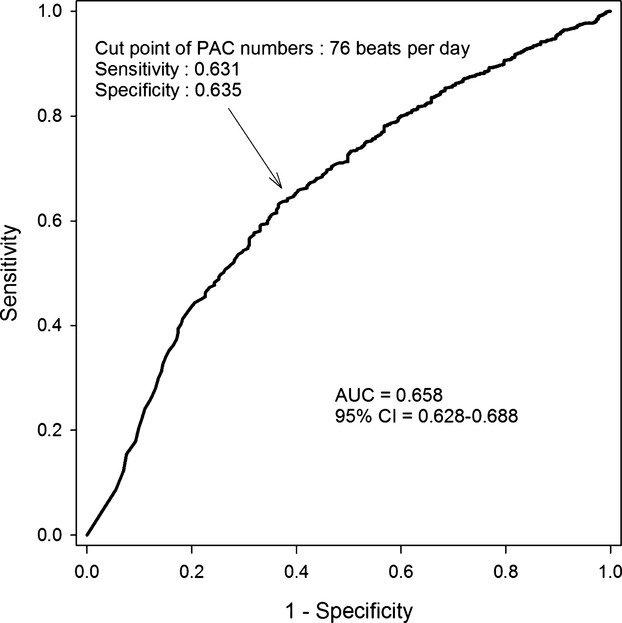
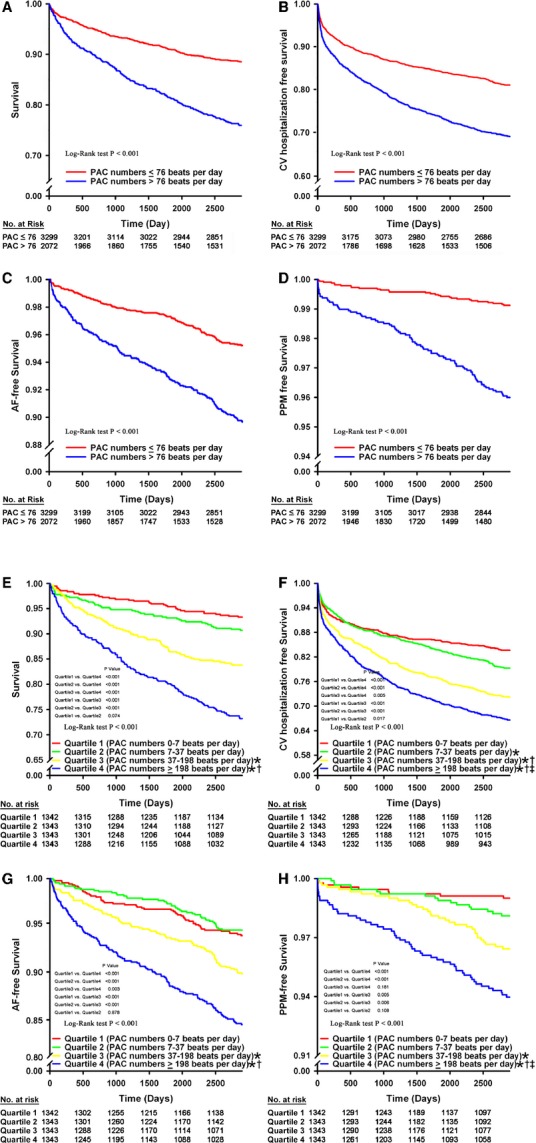
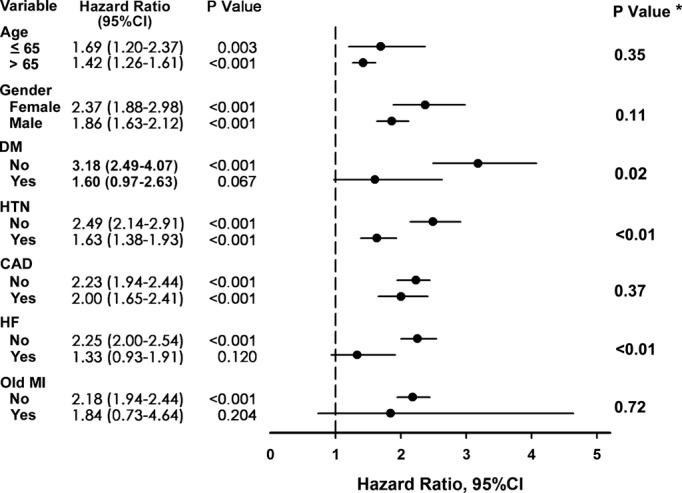
Methods and results: We investigated the clinical characteristics of 5371 consecutive patients without atrial fibrillation (AF) or a permanent pacemaker (PPM) at baseline who underwent 24-hour electrocardiography monitoring between January 1, 2002, and December 31, 2004. Clinical event data were retrieved from the Bureau of National Health Insurance of Taiwan. During a mean follow-up duration of 10±1 years, there were 1209 deaths, 1166 cardiovascular-related hospitalizations, 3104 hospitalizations for any reason, 418 cases of new-onset AF, and 132 PPM implantations. The optimal cut-off of PAC burden for predicting mortality was 76 beats per day, with a sensitivity of 63.1% and a specificity of 63.5%. In multivariate analysis, a PAC burden >76 beats per day was an independent predictor of mortality (hazard ratio: 1.384, 95% CI: 1.230 to 1.558), cardiovascular hospitalization (hazard ratio: 1.284, 95% CI: 1.137 to 1.451), new-onset AF (hazard ratio: 1.757, 95% CI: 1.427 to 2.163), and PPM implantation (hazard ratio: 2.821, 95% CI: 1.898 to 4.192). Patients with frequent PAC had increased risk of mortality attributable to myocardial infarction, heart failure, and sudden cardiac death. Frequent PACs increased risk of PPM implantation owing to sick sinus syndrome, high-degree atrioventricular block, and/or AF.
Conclusions: The burden of PACs is independently associated with mortality, cardiovascular hospitalization, new-onset AF, and PPM implantation in the long term.
Keywords: atrial fibrillation; permanent pacemaker; premature atrial complex; sick sinus syndrome.
© 2015 The Authors. Published on behalf of the American Heart Association, Inc., by Wiley Blackwell.
Figures
References
-
- Binici Z, Intzilakis T, Nielsen OW, Kober L, Sajadieh A. Excessive supraventricular ectopic activity and increased risk of atrial fibrillation and stroke. Circulation. 2010;121:1904–1911. - PubMed
-
- Conen D, Adam M, Roche F, Barthelemy JC, Felber Dietrich D, Imboden M, Kunzli N, von Eckardstein A, Regenass S, Hornemann T, Rochat T, Gaspoz JM, Probst-Hensch N, Carballo D. Premature atrial contractions in the general population: frequency and risk factors. Circulation. 2012;126:2302–2308. - PubMed
-
- Chong BH, Pong V, Lam KF, Liu S, Zuo ML, Lau YF, Lau CP, Tse HF, Siu CW. Frequent premature atrial complexes predict new occurrence of atrial fibrillation and adverse cardiovascular events. Europace. 2012;14:942–947. - PubMed
-
- Healey JS, Connolly SJ, Gold MR, Israel CW, Van Gelder IC, Capucci A, Lau CP, Fain E, Yang S, Bailleul C, Morillo CA, Carlson M, Themeles E, Kaufman ES, Hohnloser SH Investigators A. Subclinical atrial fibrillation and the risk of stroke. N Engl J Med. 2012;366:120–129. - PubMed
-
- Ofoma U, He F, Shaffer ML, Naccarelli GV, Liao D. Premature cardiac contractions and risk of incident ischemic stroke. J Am Heart Assoc. 2012;1:e002519. doi: 10.1161/JAHA.112.002519. - DOI - PMC - PubMed
Publication types
MeSH terms
LinkOut - more resources
Full Text Sources
Medical
Molecular Biology Databases
