Randomized Controlled Trial
. 2015 Aug 17:10:1335-49.
doi: 10.2147/CIA.S87732. eCollection 2015.

Does multicomponent physical exercise with simultaneous cognitive training boost cognitive performance in older adults? A 6-month randomized controlled trial with a 1-year follow-up

Affiliations
Randomized Controlled Trial

Does multicomponent physical exercise with simultaneous cognitive training boost cognitive performance in older adults? A 6-month randomized controlled trial with a 1-year follow-up

Patrick Eggenberger et al. Clin Interv Aging. .

Abstract

Background: Cognitive impairment is a health problem that concerns almost every second elderly person. Physical and cognitive training have differential positive effects on cognition, but have been rarely applied in combination. This study evaluates synergistic effects of multicomponent physical exercise complemented with novel simultaneous cognitive training on cognition in older adults. We hypothesized that simultaneous cognitive-physical components would add training specific cognitive benefits compared to exclusively physical training.

Methods: Seniors, older than 70 years, without cognitive impairment, were randomly assigned to either: 1) virtual reality video game dancing (DANCE), 2) treadmill walking with simultaneous verbal memory training (MEMORY), or 3) treadmill walking (PHYS). Each program was complemented with strength and balance exercises. Two 1-hour training sessions per week over 6 months were applied. Cognitive performance was assessed at baseline, after 3 and 6 months, and at 1-year follow-up. Multiple regression analyses with planned comparisons were calculated.

Results: Eighty-nine participants were randomized to the three groups initially, 71 completed the training, while 47 were available at 1-year follow-up. Advantages of the simultaneous cognitive-physical programs were found in two dimensions of executive function. "Shifting attention" showed a time×intervention interaction in favor of DANCE/MEMORY versus PHYS (F[2, 68] =1.95, trend P=0.075, r=0.17); and "working memory" showed a time×intervention interaction in favor of DANCE versus MEMORY (F[1, 136] =2.71, trend P=0.051, R (2)=0.006). Performance improvements in executive functions, long-term visual memory (episodic memory), and processing speed were maintained at follow-up in all groups.

Conclusion: Particular executive functions benefit from simultaneous cognitive-physical training compared to exclusively physical multicomponent training. Cognitive-physical training programs may counteract widespread cognitive impairments in the elderly.

Keywords: cognitive impairment; dance; elderly; executive function; transfer; video game.


Figures
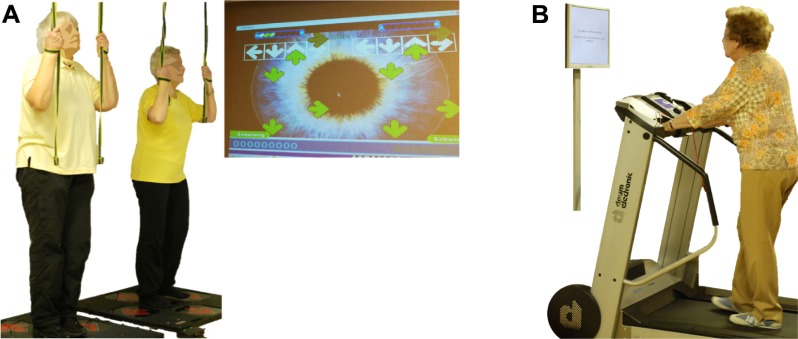
Figure 1
Figure 1
Simultaneous cognitive–physical training components: video game dancing (A) and treadmill memory training (B). In (A) two participants perform steps on a pressure sensitive platform to the rhythm of the music. Step timing and direction is cued with arrows on a screen. In (B) a participant is walking on a treadmill while performing verbal memory exercises presented on a computer screen.
Figure 2
Figure 2
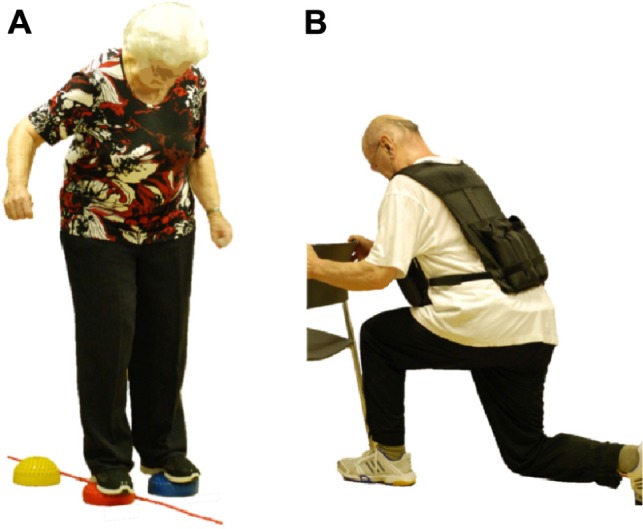
Examples of complementary balance (A) and strength (B) exercises. Notes: The participant in (A) tries to maintain balance while stepping from one object to the next (objects are soft rubber “stones” and a skipping rope) and (B) shows a participant performing split leg squats wearing a weight vest.
Figure 3
Figure 3
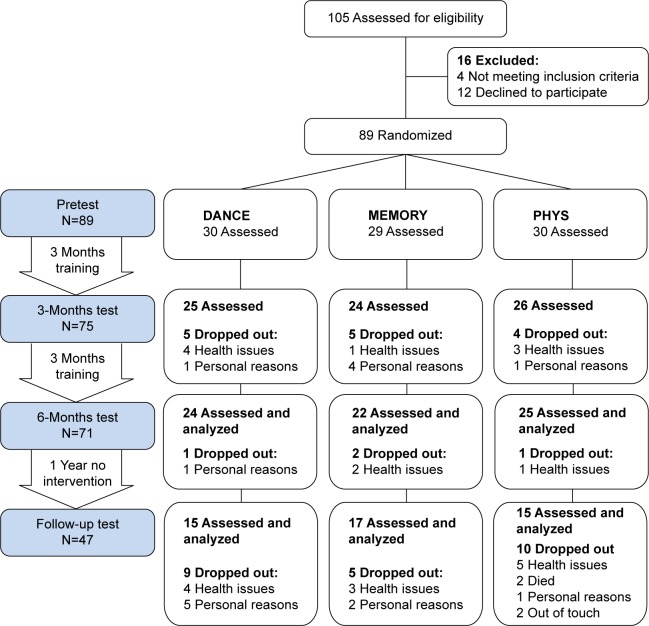
Trial design and participants’ flow. Notes: Participants were randomly assigned to one of two simultaneous cognitive–physical training groups (DANCE and MEMORY) or an exclusively physical multicomponent training group (PHYS) and were trained over 6 months twice weekly for 1 hour. Nine cognitive tests were assessed at pretest, 3-months test, and 6-months test. Four tests were repeated at 1-year follow-up. Abbreviations: DANCE, virtual reality video game dancing; MEMORY, treadmill walking with simultaneous verbal memory training; PHYS, treadmill walking.
Figure 4
Figure 4
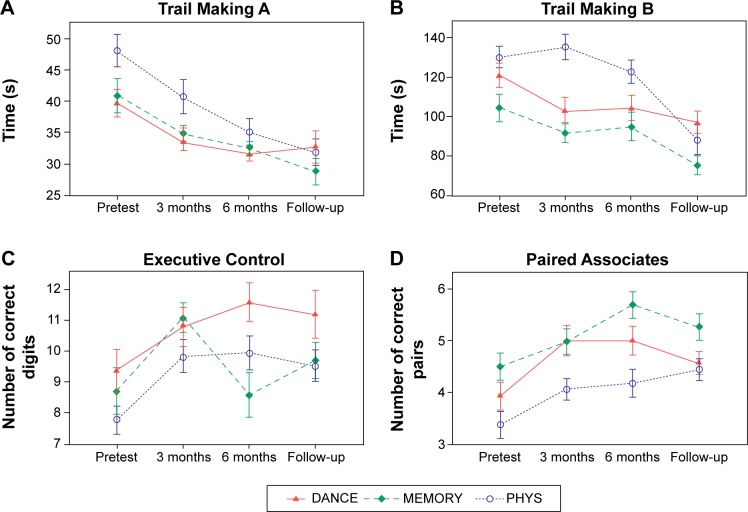
Cognitive performance developments in the four tests that included a 1-year follow-up measurement. Notes: Significant overall improvements were shown in all tests over the 6-months training period (graphs AD all P<0.05, one tailed). In Trail Making B (graph B), only the two groups with a cognitive training component (DANCE and MEMORY) improved from pretest to 3-months test (trend P=0.075, one tailed). In Executive Control (graph C), different time courses of adaptation between DANCE and MEMORY were found (trend P=0.051, one tailed). From 6-months test to 1-year follow-up test Trail Making B improved significantly (graph B, P=0.015), while performance was maintained in the three other tests (graphs A, C, and D). Error bars indicate ± standard error of the mean. Abbreviations: DANCE, virtual reality video game dancing; MEMORY, treadmill walking with simultaneous verbal memory training; PHYS, treadmill walking.
Figure 5
Figure 5
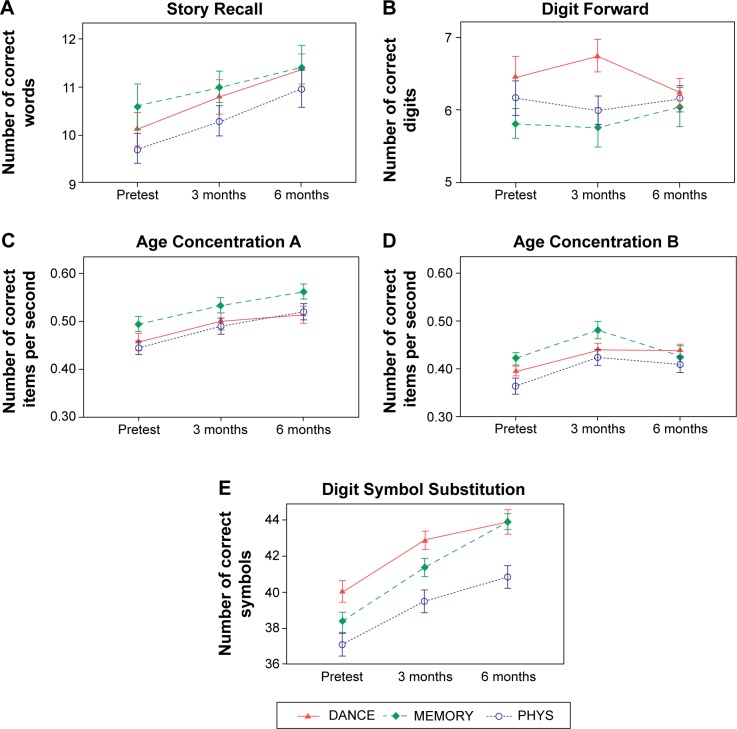
Cognitive performance developments in the five tests that did not include a 1-year follow-up measurement. Notes: Significant overall improvements were shown in the tests in graphs (A, C, D, and E) (all P<0.05, one tailed) over the 6-months training period. No improvement was found in Digit Forward (graph B). Error bars indicate ± standard error of the mean. Abbreviations: DANCE, virtual reality video game dancing; MEMORY, treadmill walking with simultaneous verbal memory training; PHYS, treadmill walking.
Figure 6
Figure 6
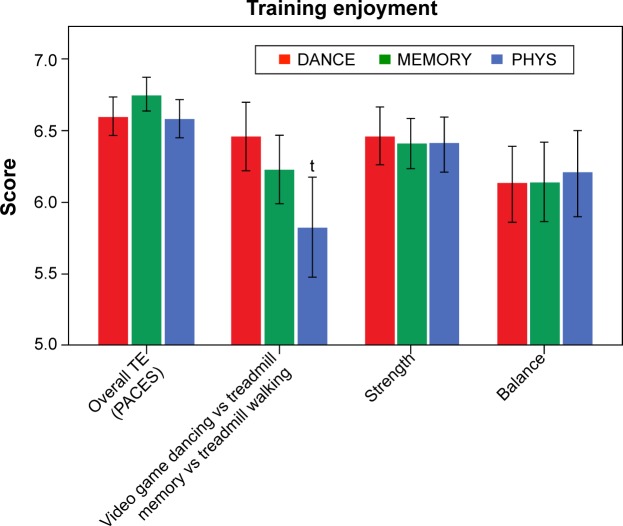
Comparison of training enjoyment in the three interventions. Notes: No group differences were shown for overall training enjoyment (PACES), strength, and balance training (all P>0.05). The two cognitive–physical training components (video game dancing and treadmill memory) tended to be enjoyed more than treadmill walking (trend P=0.069, one tailed). Scores system is from one to seven points (least to maximal enjoyment), tP<0.10 trend, error bars indicate ± standard error of the mean. Abbreviations: PACES, Physical Activity Enjoyment Scale; TE, training enjoyment; DANCE, virtual reality video game dancing; MEMORY, treadmill walking with simultaneous verbal memory training; PHYS, treadmill walking.

Similar articles

Cited by

References

    1. Scafato E, Gandin C, Galluzzo L, et al. PR.E.A. Working Group (Italian PRoject on Epidemiology of Alzheimer’s disease) Prevalence of aging-associated cognitive decline in an Italian elderly population: results from cross-sectional phase of Italian PRoject on Epidemiology of Alzheimer’s disease (IPREA) Aging Clin Exp Res. 2010;22(5–6):440–449. - PubMed
    1. Williams KN, Kemper S. Interventions to reduce cognitive decline in aging. J Psychosoc Nurs Ment Health Serv. 2010;48(5):42–51. - PMC - PubMed
    1. Erickson KI, Weinstein AM, Lopez OL. Physical activity, brain plasticity, and Alzheimer’s disease. Arch Med Res. 2012;43(8):615–621. - PMC - PubMed
    1. Lautenschlager NT, Cox K, Cyarto EV. The influence of exercise on brain aging and dementia. Biochim Biophys Acta. 2012;1822(3):474–481. - PubMed
    1. Gregory MA, Gill DP, Petrella RJ. Brain health and exercise in older adults. Curr Sports Med Rep. 2013;12(4):256–271. - PubMed

Publication types