


Modified Medical Research Council scale vs Baseline Dyspnea Index to evaluate dyspnea in chronic obstructive pulmonary disease
- PMID: 26316740
- PMCID: PMC4547644
- DOI: 10.2147/COPD.S82408
Modified Medical Research Council scale vs Baseline Dyspnea Index to evaluate dyspnea in chronic obstructive pulmonary disease
Abstract
Background: Assessment of dyspnea in COPD patients relies in clinical practice on the modified Medical Research Council (mMRC) scale, whereas the Baseline Dyspnea Index (BDI) is mainly used in clinical trials. Little is known on the correspondence between the two methods.
Methods: Cross-sectional analysis was carried out on data from the French COPD cohort Initiatives BPCO. Dyspnea was assessed by the mMRC scale and the BDI. Spirometry, plethysmography, Hospital Anxiety-Depression Scale, St George's Respiratory Questionnaire, exacerbation rates, and physician-diagnosed comorbidities were obtained. Correlations between mMRC and BDI scores were assessed using Spearman's correlation coefficient. An ordinal response model was used to examine the contribution of clinical data and lung function parameters to mMRC and BDI scores.
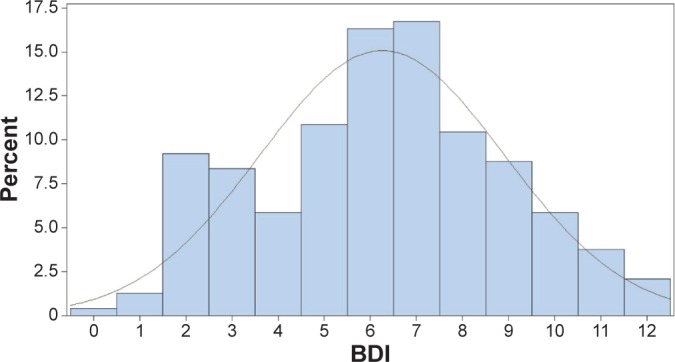
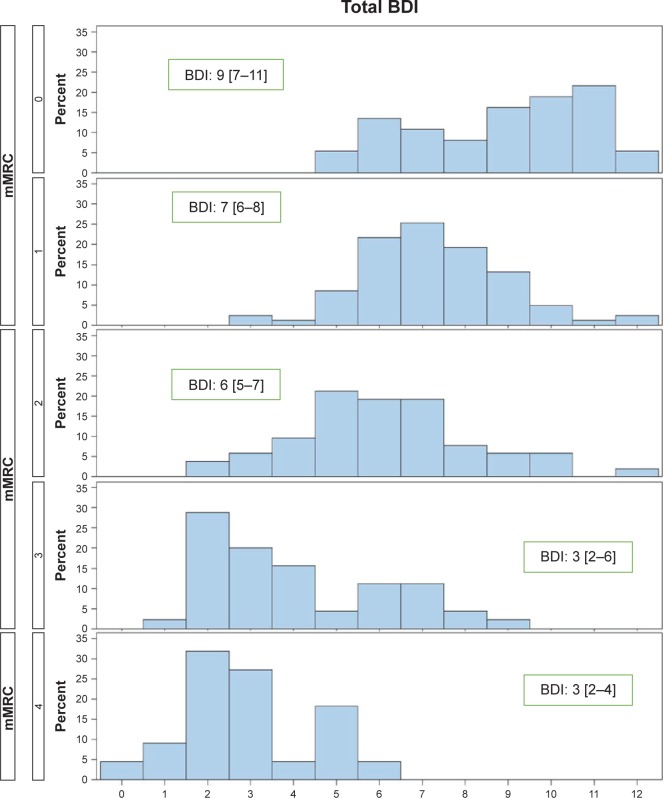
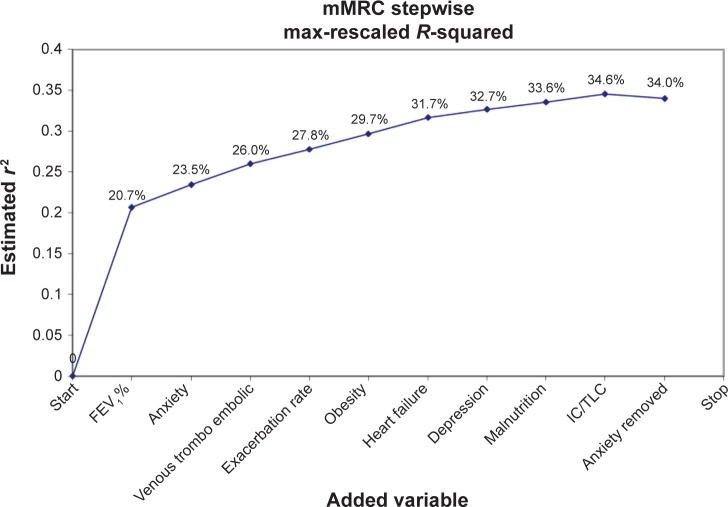
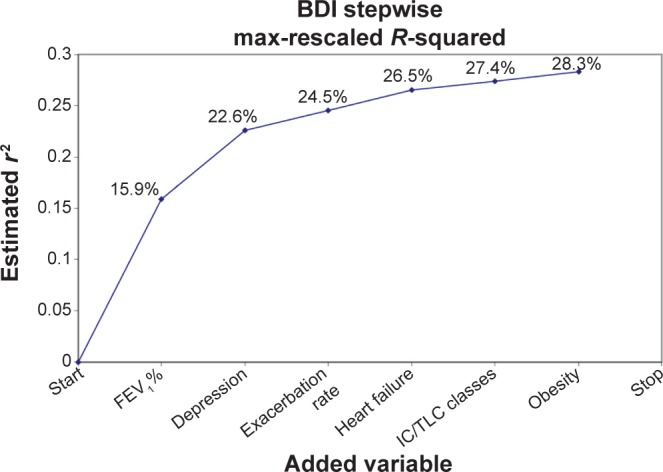
Results: Data are given as median (interquartile ranges, [IQR]). Two-hundred thirty-nine COPD subjects were analyzed (men 78%, age 65.0 years [57.0; 73.0], forced expiratory volume in 1 second [FEV1] 48% predicted [34; 67]). The mMRC grade and BDI score were, respectively, 1 [1-3] and 6 [4-8]. Both BDI and mMRC scores were significantly correlated at the group level (rho =-0.67; P<0.0001), but analysis of individual data revealed a large scatter of BDI scores for any given mMRC grade. In multivariate analysis, both mMRC grade and BDI score were independently associated with lower FEV1% pred, higher exacerbation rate, obesity, depression, heart failure, and hyperinflation, as assessed by the inspiratory capacity/total lung capacity ratio. The mMRC dyspnea grade was also associated with the thromboembolic history and low body mass index.
Conclusion: Dyspnea is a complex symptom with multiple determinants in COPD patients. Although related to similar factors (including hyperinflation, depression, and heart failure), BDI and mMRC scores likely explore differently the dyspnea intensity in COPD patients and are clearly not interchangeable.
Keywords: BDI; COPD; comorbidities; depression; dyspnea; hyperinflation; mMRC; quality of life.
Figures
References
-
- Halbert RJ, Natoli JL, Gano A, Badamgarav E, Buist AS, Mannino DM. Global burden of COPD: systematic review and global analysis. Eur Respir J. 2006;28(3):523–532. - PubMed
-
- GOLD. Global Strategy for the Diagnosis, Management and Prevention of COPD, Global Initiative for Chronic Obstructive Lung Disease (GOLD) 2010. [Accessed April 25th, 2015]. Available from: http://www.goldcopd.org/guidelines-global-strategy-for-diagnosis-managem....
-
- Mahler DA, Weinberg DH, Wells CK, Feinstein AR. The measurement of dyspnea. Contents, interobserver agreement, and physiologic correlates of two new clinical indexes. Chest. 1984;85(6):751–758. - PubMed
-
- Ferrari K, Goti P, Misuri G, et al. Chronic exertional dyspnea and respiratory muscle function in patients with chronic obstructive pulmonary disease. Lung. 1997;175(5):311–319. - PubMed
-
- Fabbri LM, Luppi F, Beghe B, Rabe KF. Complex chronic comorbidities of COPD. Eur Respir J. 2008;31:204–212. - PubMed
Publication types
MeSH terms
LinkOut - more resources
Full Text Sources
Medical
