


Elevation of urinary liver-type fatty acid binding protein after cardiac catheterization related to cardiovascular events
- PMID: 26316797
- PMCID: PMC4547648
- DOI: 10.2147/IJNRD.S88467
Elevation of urinary liver-type fatty acid binding protein after cardiac catheterization related to cardiovascular events
Abstract
Purpose: Contrast medium (CM) induces tubular hypoxia via endothelial damage due to direct cytotoxicity or viscosity. Urinary liver-type fatty acid binding protein (L-FABP) increases along with tubular hypoxia and may be a detector of systemic circulation injury. The aim of this study was to evaluate the clinical usefulness of detecting increases in urinary L-FABP levels due to administration of CM, as a prognostic biomarker for cardiovascular disease in patients without occurrence of CM-induced nephropathy undergoing cardiac catheterization procedure (CCP).
Methods: Retrospective longitudinal analyses of the relationship between urinary L-FABP levels and occurrence of cardiovascular events were performed (n=29). Urinary L-FABP was measured by ELISA before CCP, and at 6, 12, 24, and 48 hours after CCP.
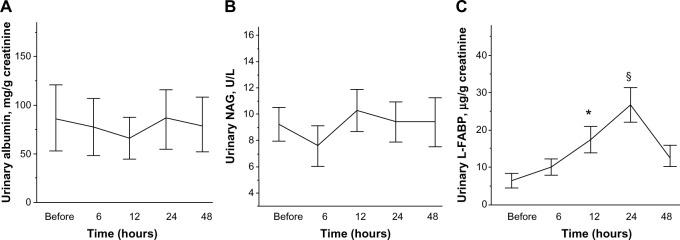
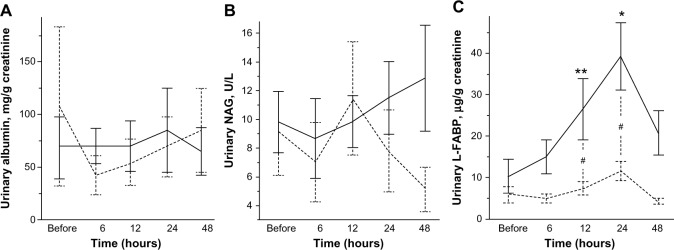
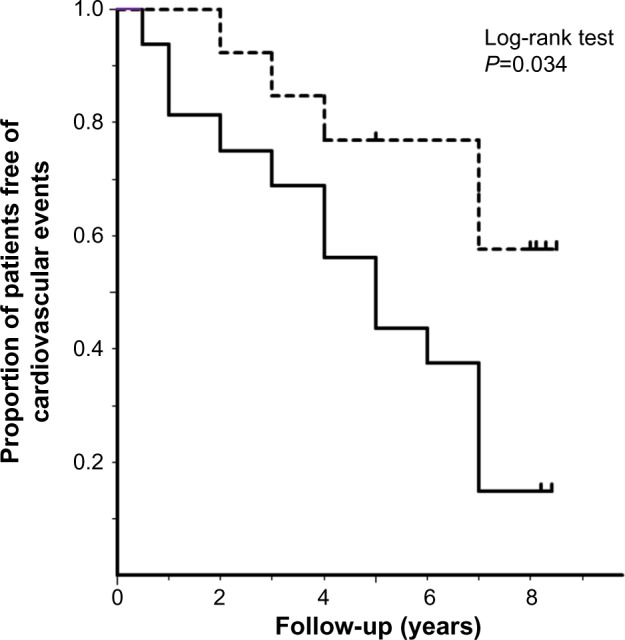
Results: Urinary L-FABP levels were significantly higher at 12 hours (P<0.05) and 24 hours (P<0.005) after CCP compared with before CCP, only in the patients with occurrence of cardiovascular events (n=17), but not in those without cardiovascular events (n=12). The parameter with the largest area under the curve (0.816) for predicting the occurrence of cardiovascular events was the change in urinary L-FABP at 24 hours after CCP. The difference in urinary L-FABP levels (ΔL-FABP ≥11.0 μg/g creatinine) between before CCP and at 24 hours after CCP was a risk factor for the occurrence of cardiovascular events (hazard ratio, 4.93; 95% confidence interval, 1.27-19.13; P=0.021).
Conclusion: Measurement of urinary L-FABP before CCP and at 24 hours after CCP in patients with mild to moderate renal dysfunction may be an important indicator for risk stratification of onset of cardiovascular events.
Keywords: L-FABP; cardiovascular event; chronic kidney disease; contrast medium; renal dysfunction; urinary biomarker; urinary liver-type fatty acid binding protein.
Figures
References
-
- Sarnak MJ, Levey AS, Schoolwerth AC, et al. Kidney disease as a risk factor for development of cardiovascular disease: A statement from the American Heart Association Councils on Kidney in Cardiovascular Disease, High Blood Pressure Research, Clinical Cardiology, and Epidemiology and Prevention. Circulation. 2003;108(17):2154–2169. - PubMed
-
- Diercks GF, van Boven AJ, Hillege HL, et al. Microalbuminuria is independently associated with ischaemic electrocardiographic abnormalities in a large non-diabetic population. The PREVEND (Prevention of REnal and Vascular ENdstage Disease) study. Eur Heart J. 2000;21(23):1922–1927. - PubMed
-
- Deckert T, Feldt-Rasmussen B, Borch-Johnsen K, Jensen T, Kofoed-Enevoldsen A. Albuminuria reflects widespread vascular damage. The Steno hypothesis. Diabetologia. 1989;32(4):219–226. - PubMed
-
- Stehouwer CD, Henry RM, Dekker JM, Nijpels G, Heine RJ, Bouter LM. Microalbuminuria is associated with impaired brachial artery, flow-mediated vasodilation in elderly individuals without and with diabetes: Further evidence for a link between microalbuminuria and endothelial dysfunction – the Hoorn Study. Kidney Int Suppl. 2004;(92):S42–S44. - PubMed
LinkOut - more resources
Full Text Sources
Medical
