


Pathophysiological role of enhanced bone marrow adipogenesis in diabetic complications
- PMID: 26317050
- PMCID: PMC4550679
- DOI: 10.4161/adip.32215
Pathophysiological role of enhanced bone marrow adipogenesis in diabetic complications
Abstract
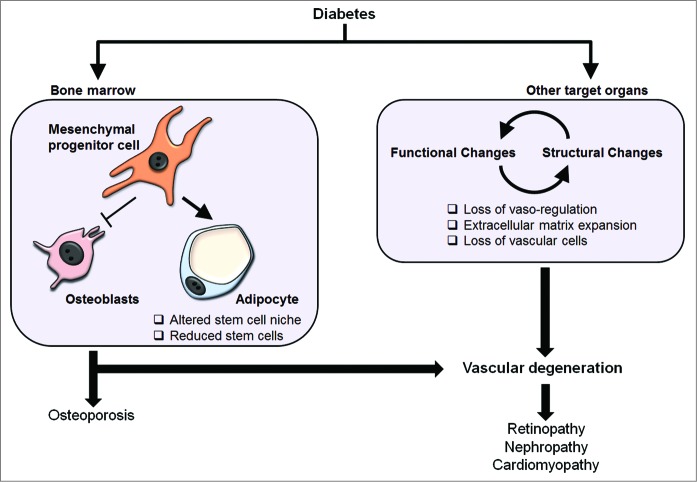
Diabetes leads to complications in select organ systems primarily by disrupting the vasculature of the target organs. These complications include both micro- (cardiomyopathy, retinopathy, nephropathy, and neuropathy) and macro-(atherosclerosis) angiopathies. Bone marrow angiopathy is also evident in both experimental models of the disease as well as in human diabetes. In addition to vascular disruption, bone loss and increased marrow adiposity have become hallmarks of the diabetic bone phenotype. Emerging evidence now implicates enhanced marrow adipogenesis and changes to cellular makeup of the marrow in a novel mechanistic link between various secondary complications of diabetes. In this review, we explore the mechanisms of enhanced marrow adipogenesis in diabetes and the link between changes to marrow cellular composition, and disruption and depletion of reparative stem cells.
Keywords: adipogenesis; angiogenesis; diabetes; osteoblasts; repair; stem cells.
Figures
References
-
- Danaei G, Finucane MM, Lu Y, Singh GM, Cowan MJ, Paciorek CJ, Lin JK, Farzadfar F, Khang YH, Stevens GA, et al.; Global Burden of Metabolic Risk Factors of Chronic Diseases Collaborating Group (Blood Glucose). National, regional, and global trends in fasting plasma glucose and diabetes prevalence since 1980: systematic analysis of health examination surveys and epidemiological studies with 370 country-years and 2·7 million participants. Lancet 2011; 378:31-40; PMID:21705069; http://dx.doi.org/ 10.1016/S0140-6736(11)60679-X - DOI - PubMed
-
- Amos AF, McCarty DJ, Zimmet P. The rising global burden of diabetes and its complications: estimates and projections to the year 2010. Diabet Med 1997; 14(Suppl 5):S1-85; PMID:9450510; http://dx.doi.org/ 10.1002/(SICI)1096-9136(199712)14:5±≤S7::AID-DIA522≥3.3.CO;2-I - DOI - PubMed
-
- Wild S, Roglic G, Green A, Sicree R, King H. Global prevalence of diabetes: estimates for the year 2000 and projections for 2030. Diabetes Care 2004; 27:1047-53; PMID:15111519; http://dx.doi.org/ 10.2337/diacare.27.5.1047 - DOI - PubMed
-
- An economic tsunami, the cost of diabetes in Canada. Toronto, Ontario: Canadian Diabetes Association, 2009.
-
- 2011 National Diabetes Fact Sheet, National Center for Chronic Disease Prevention and Health Promotion. American Diabetes Association; 2011.
LinkOut - more resources
Full Text Sources
Other Literature Sources
