. 2015 Aug 28;10(8):e0136407.
doi: 10.1371/journal.pone.0136407. eCollection 2015.

Exome Sequencing of Cell-Free DNA from Metastatic Cancer Patients Identifies Clinically Actionable Mutations Distinct from Primary Disease

Affiliations

Exome Sequencing of Cell-Free DNA from Metastatic Cancer Patients Identifies Clinically Actionable Mutations Distinct from Primary Disease

Timothy M Butler et al. PLoS One. .

Abstract

The identification of the molecular drivers of cancer by sequencing is the backbone of precision medicine and the basis of personalized therapy; however, biopsies of primary tumors provide only a snapshot of the evolution of the disease and may miss potential therapeutic targets, especially in the metastatic setting. A liquid biopsy, in the form of cell-free DNA (cfDNA) sequencing, has the potential to capture the inter- and intra-tumoral heterogeneity present in metastatic disease, and, through serial blood draws, track the evolution of the tumor genome. In order to determine the clinical utility of cfDNA sequencing we performed whole-exome sequencing on cfDNA and tumor DNA from two patients with metastatic disease; only minor modifications to our sequencing and analysis pipelines were required for sequencing and mutation calling of cfDNA. The first patient had metastatic sarcoma and 47 of 48 mutations present in the primary tumor were also found in the cell-free DNA. The second patient had metastatic breast cancer and sequencing identified an ESR1 mutation in the cfDNA and metastatic site, but not in the primary tumor. This likely explains tumor progression on Anastrozole. Significant heterogeneity between the primary and metastatic tumors, with cfDNA reflecting the metastases, suggested separation from the primary lesion early in tumor evolution. This is best illustrated by an activating PIK3CA mutation (H1047R) which was clonal in the primary tumor, but completely absent from either the metastasis or cfDNA. Here we show that cfDNA sequencing supplies clinically actionable information with minimal risks compared to metastatic biopsies. This study demonstrates the utility of whole-exome sequencing of cell-free DNA from patients with metastatic disease. cfDNA sequencing identified an ESR1 mutation, potentially explaining a patient's resistance to aromatase inhibition, and gave insight into how metastatic lesions differ from the primary tumor.


Conflict of interest statement

Competing Interests: Chritopher Corless received honoraria and research support from Ion Torrent/ ThermoFisher. This does not alter the authors' adherence to PLOS ONE policies on sharing data and materials.

Figures

Fig 1
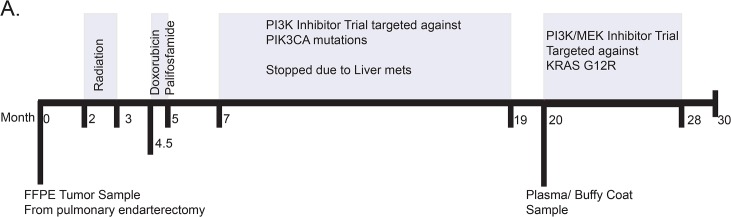
Fig 1. Overview of metastatic sarcoma patient treatment history.
A) Patient diagnosed with intimal spindle cell sarcoma of the pulmonary artery. Treatments and sample collection indicated in months.
Fig 2
Fig 2. Patient #1 mutation calls and validation.
A) Using a cutoff of 1.5% variant allele percentage, 46 of the 47 mutations present in the tumor were identified in the cfDNA. Estimating from the average variant allele percentage of 3.8%, 7.5% of the cfDNA was derived from the tumor. B) Fifteen additional mutations were called in the cfDNA which were not called in the tumor sample. Four of these are present in the tumor, but below our calling cutoff of 10% for the tumor. Genes highlighted in red were successfully validated via sequencing on the Ion Torrent PGM. Approximately 4,000 genomes of cfDNA were used as input to the validations, giving us a lower sensitivity bound of 0.025–0.5% depending on the site-specific background error rate.
Fig 3
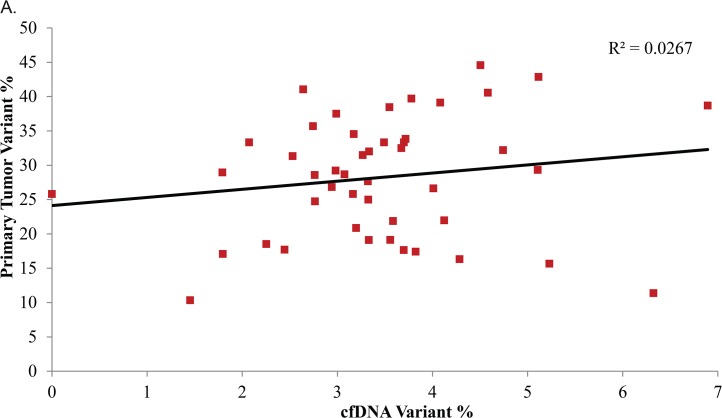
Fig 3. Variant allele percentage correlation.
A) cfDNA variant allele percentage is poorly correlated with Primary tumor variant allele percentage.
Fig 4
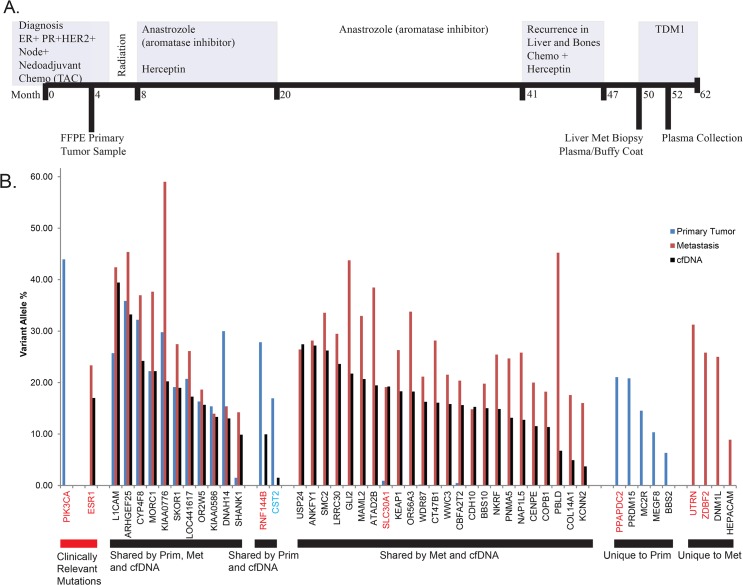
Fig 4. Patient #2 diagnosed with ER+/PR+/HER2+/Node+ breast carcinoma.
A) Treatments and sample collection indicated in months. B) 48 total somatic mutations were called in the primary breast tumor and/or liver metastasis. 38 mutations were called in the cfDNA using a variant allele percentage cutoff of 1.5%. Genes in red were successfully validated on the Ion Torrent PGM, genes in blue failed to validate, genes were black were not validated.
Fig 5
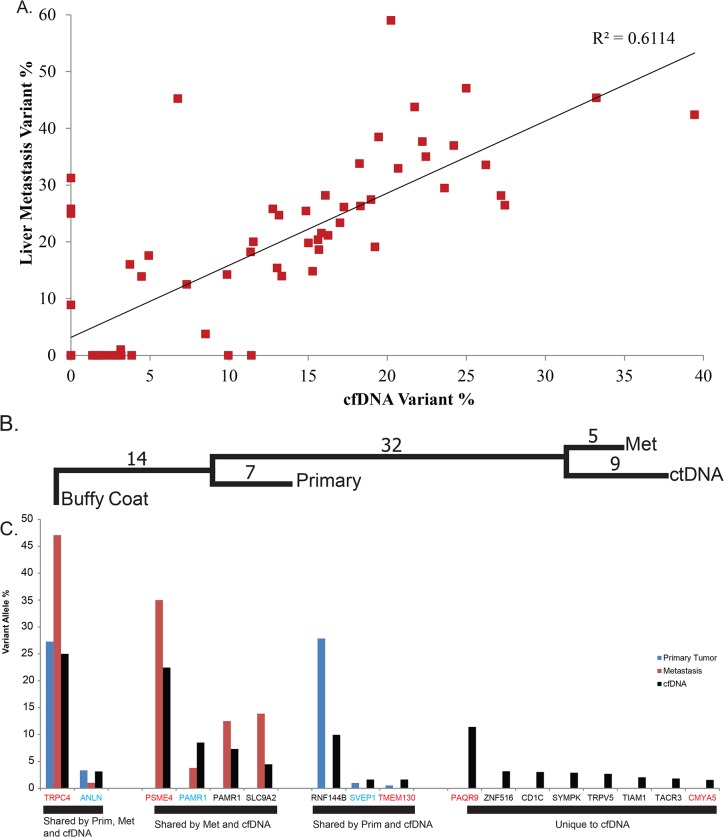
Fig 5. cfDNA and liver metastasis DNA are well correlated.
A) cfDNA variant allele percentage is correlated with liver metastasis variant allele percentage B) Maximum parsimony tree showing relatedness of samples, branch length are number of somatic, nonsynonymous mutations C) Seventeen additional mutations were identified uniquely in cfDNA, 9 of which have reads supporting them in the primary and/or met, but where not called due to insufficient sequencing depth or variant allele percentage. Genes in red were successfully validated on the Ion Torrent PGM, genes in blue failed to validate, genes were black were not validated.
Fig 6
Fig 6. Patient #2 targeted resequencing.
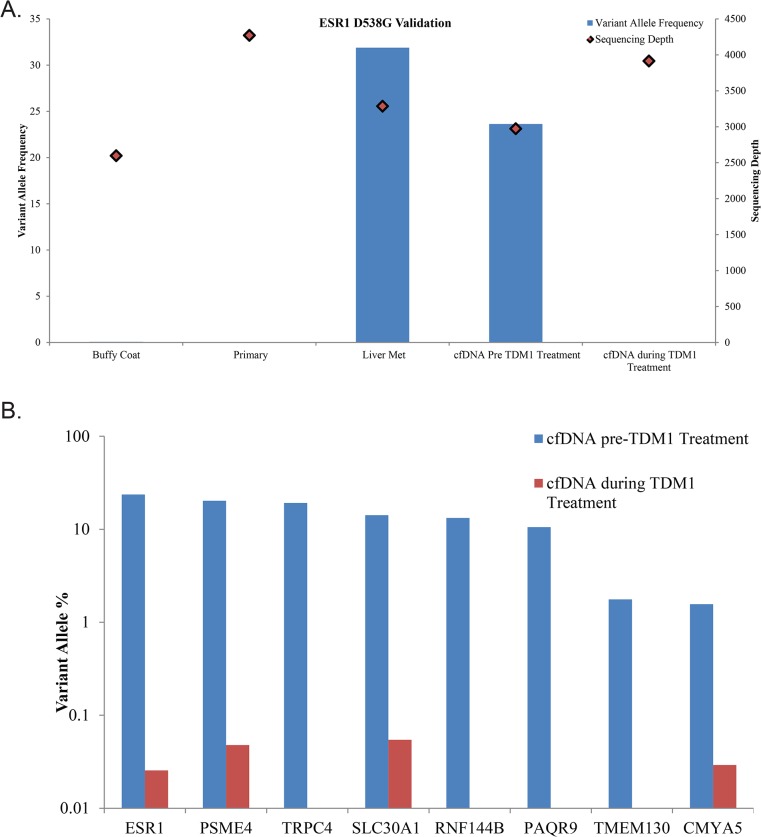
A) The ESR1 mutation was sequenced to greater depth on the Ion Torrent PGM. B) Comparison of allele frequencies between pre- and during-TDM1 treatment cfDNA samples for eight mutations present in the pre-treatment sample.

References

    1. Howlader NNA, Krapcho M, Garshell J, Miller D, Altekruse SF, Kosary CL, et al. National Cancer Institue.
    1. Spano D, Heck C, De Antonellis P, Christofori G, Zollo M. Molecular networks that regulate cancer metastasis. Seminars in cancer biology. 2012;22(3):234–49. 10.1016/j.semcancer.2012.03.006 . - DOI - PubMed
    1. Gerlinger M, Rowan AJ, Horswell S, Larkin J, Endesfelder D, Gronroos E, et al. Intratumor heterogeneity and branched evolution revealed by multiregion sequencing. The New England journal of medicine. 2012;366(10):883–92. 10.1056/NEJMoa1113205 . - DOI - PMC - PubMed
    1. Aparicio S, Caldas C. The implications of clonal genome evolution for cancer medicine. The New England journal of medicine. 2013;368(9):842–51. 10.1056/NEJMra1204892 . - DOI - PubMed
    1. Diaz LA Jr, Williams RT, Wu J, Kinde I, Hecht JR, Berlin J, et al. The molecular evolution of acquired resistance to targeted EGFR blockade in colorectal cancers. Nature. 2012;486(7404):537–40. 10.1038/nature11219 - DOI - PMC - PubMed