


Review
doi: 10.1016/j.cell.2015.08.006.
Not All DDRs Are Created Equal: Non-Canonical DNA Damage Responses
Affiliations
- PMID: 26317463
- PMCID: PMC4560361
- DOI: 10.1016/j.cell.2015.08.006
Item in Clipboard
Review
Not All DDRs Are Created Equal: Non-Canonical DNA Damage Responses
Cell.
.
Abstract
It is commonly assumed that there is a single canonical DNA damage response (DDR) that protects cells from various types of double-strand breaks and that its activation occurs via recognition of DNA ends by the DDR machinery. Recent work suggests that both assumptions may be oversimplifications. Here, we discuss several variations of the DDR in which the pathway is activated by diverse cellular events and/or generates distinct signaling outcomes. The existence of multiple non-canonical DDRs provides insights into how DNA damage is sensed and suggests a highly modular organization of the DDR.
Copyright © 2015 Elsevier Inc. All rights reserved.
Figures
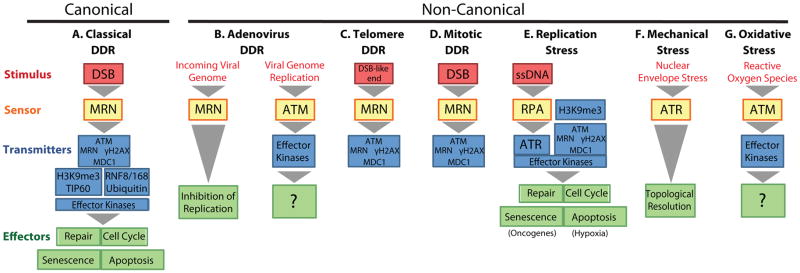
Modular structure of canonical and non-canonical DDRs. Stimuli are in red: damage stimuli, boxes; non-damage stimuli, text. Sensors (yellow) lead to activation of various transmission modules (blue boxes) and downstream effectors (green), each of which can be disengaged for different DDR outcomes.
References
-
- Bakkenist CJ, Kastan MB. DNA damage activates ATM through intermolecular autophosphorylation and dimer dissociation. Nature. 2003;421:499–506. - PubMed
-
- Bensimon A, Aebersold R, Shiloh Y. Beyond ATM: the protein kinase landscape of the DNA damage response. FEBS Lett. 2011;585:1625–1639. - PubMed
-
- Bruhn C, Zhou ZW, Ai H, Wang ZQ. The essential function of the MRN complex in the resolution of endogenous replication intermediates. Cell Rep. 2014;6:182–195. - PubMed
Publication types
MeSH terms
Substances
Grants and funding
LinkOut - more resources
Full Text Sources
Other Literature Sources
