. 2015 Sep 22;6(28):26079-89.
doi: 10.18632/oncotarget.4581.

Stemness and chemotherapeutic drug resistance induced by EIF5A2 overexpression in esophageal squamous cell carcinoma

Affiliations

Stemness and chemotherapeutic drug resistance induced by EIF5A2 overexpression in esophageal squamous cell carcinoma

Hong Yang et al. Oncotarget. .

Abstract

Esophageal squamous cell carcinoma (ESCC) is one of the most lethal malignancies of the digestive tract in East Asian countries. Multimodal therapies, including adjuvant chemotherapy and neo-adjuvant chemotherapy, have become more often used for patients with advanced ESCC. However, the chemotherapy effect is often limited by patients' drug resistance. This study demonstrated that EIF5A2 (eukaryotic translation initiation factor 5A2) overexpression induced stemness and chemoresistance in ESCC cells. We showed that EIF5A2 overexpression in ESCC cells resulted in increased chemoresistance to 5-fluorouracil (5-FU), docetaxel and taxol. In contrast, shRNAs suppressing eIF5A2 increased tumor sensitivity to these chemotherapeutic drugs. In addition, EIF5A2 overexpression was correlated with a poorer overall survival in patients with ESCC who underwent taxane-based chemotherapy after esophagectomy (P < 0.05). Based on these results, we suggest that EIF5A2 could be a predictive biomarker for selecting appropriate chemo-treatment for ESCC patients and EIF5A2 inhibitors might be considered as combination therapy to enhance chemosensitivity in patients with ESCC.

Keywords: EIF5A2; chemoresistance; esophageal squamous cell carcinoma (ESCC); stemness.


Conflict of interest statement

CONFLICTS OF INTEREST

The authors declare no conflict of interest.

Figures
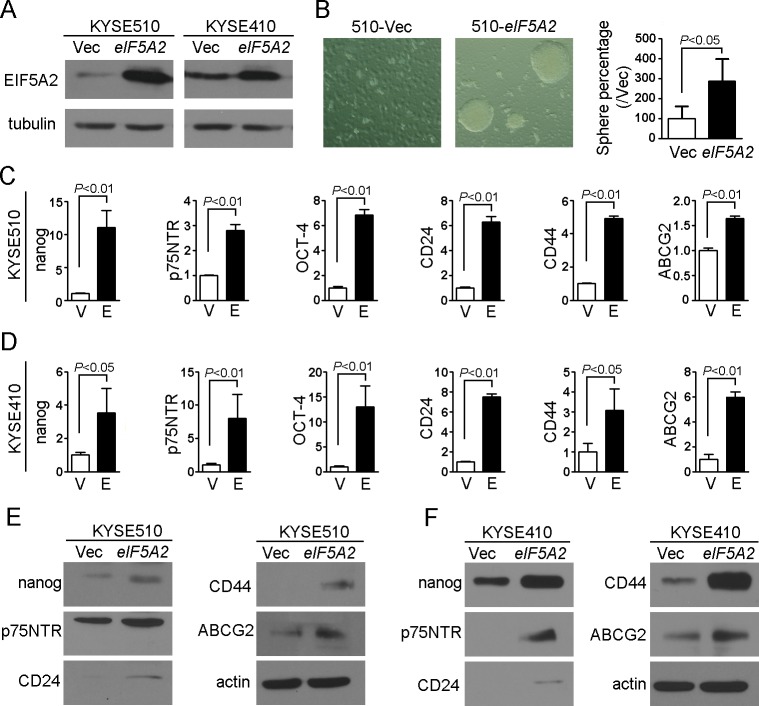
Figure 1
Figure 1. EIF5A2 overexpression increased the stemness of ESCC cells
A. The protein level was determined in EIF5A2 overexpressed cells (510-eIF5A2 and 410-eIF5A2) and vector control cells (510-Vec and 410-Vec) by western blotting assay. Tubulin was used as loading control. B. Representative pictures showing increased sphere-forming ability in 510-eIF5A2 compared with 510-Vec cells. The results are summarized as the mean ± SEM of three independent assays. C, D. Relative expression of stemness-associated genes (nanog, p75NTR and OCT-4), surface antigens associated with ESCC cancer stem cells (CD24 and CD44) and multi drug-resistant transporter gene (ABCG2) were compared by qRT-PCR between EIF5A2 overexpressed cells (510-eIF5A2 and 410-eIF5A2) and corresponding vector control cells. E, F. The protein levels of nanog, p75NTR, CD24, CD44, ABCG2 increased in EIF5A2 overexpressed cells (510-eIF5A2 and 410-eIF5A2) compared with vector control cells (510-Vec and 410-Vec). Actin was set as loading control.
Figure 2
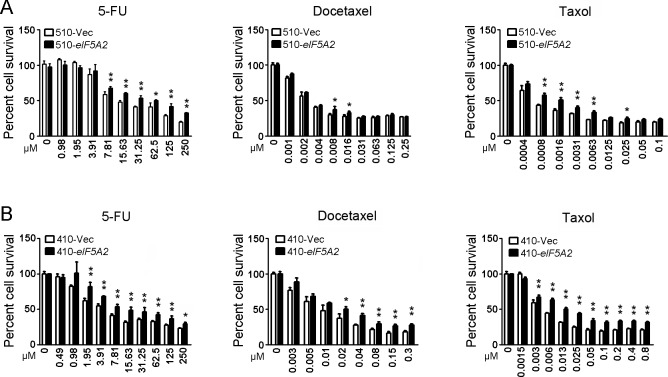
Figure 2. EIF5A2 overexpression induced chemoresistance in ESCC cells
A. 510-eIF5A2 cells are more chemoresistant than 510-Vec cells at individual doses of 5-FU, docetaxel and taxol, as shown by XTT assay. *, P < 0.05; **, P < 0.01. B. 410-eIF5A2 cells are more chemoresistant than 410-Vec cells at individual doses of 5-FU, docetaxel and taxol, as shown by XTT assay. *, P < 0.05; **, P < 0.01.
Figure 3
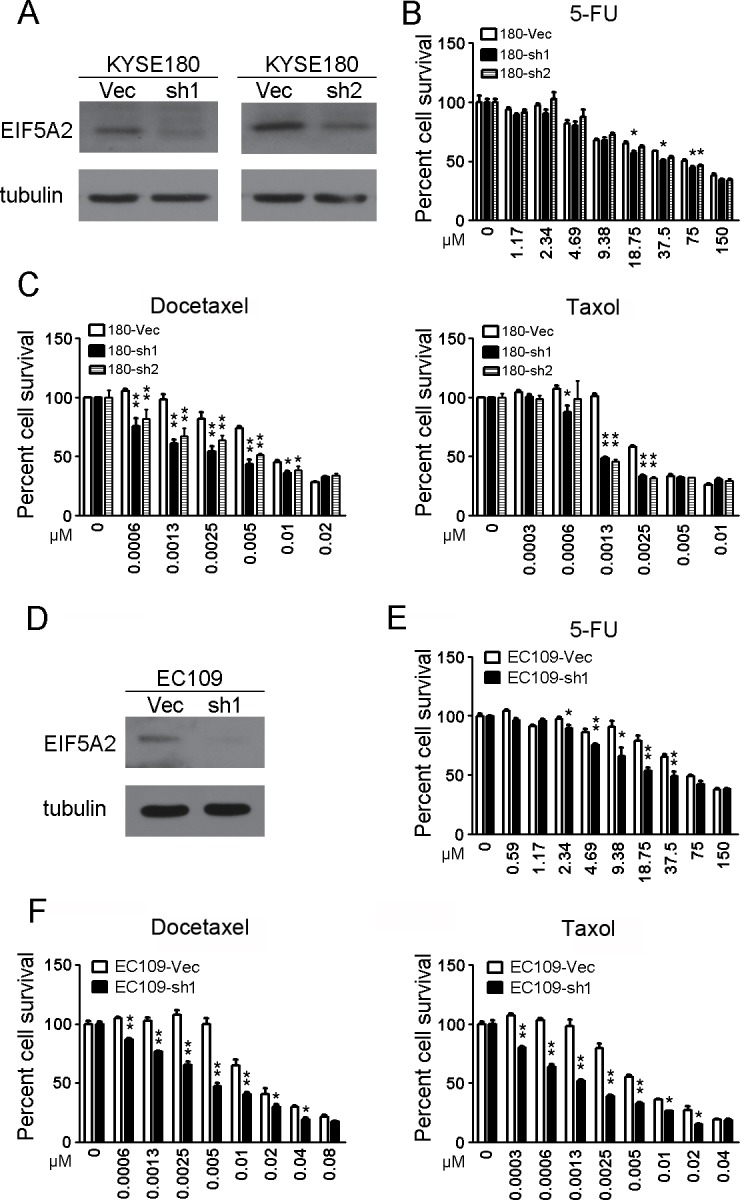
Figure 3. Knock-down of eIF5A2 increased chemosensitivity
A. Knock-down of eIF5A2 by shRNAs (sh1 and sh2) compared with vector control was confirmed in KYSE180 cells by western blotting analysis. Tubulin was set as loading control. B, C. The eIF5A2 knock-down cells (180-sh1 and 180-sh2) were significantly more sensitive than the vector cells at individual 5-FU (B), docetaxel and taxol (C) doses. *, P < 0.05; **, P < 0.01. D. Knock-down of eIF5A2 was confirmed in EC109 cells by western blotting analysis. Tubulin was set as loading control. E. F. The eIF5A2 knock-down EC109 cells were significantly more sensitive than the vector cells at individual 5-FU (E), docetaxel and taxol (F) doses. *, P < 0.05; **, P < 0.01.
Figure 4
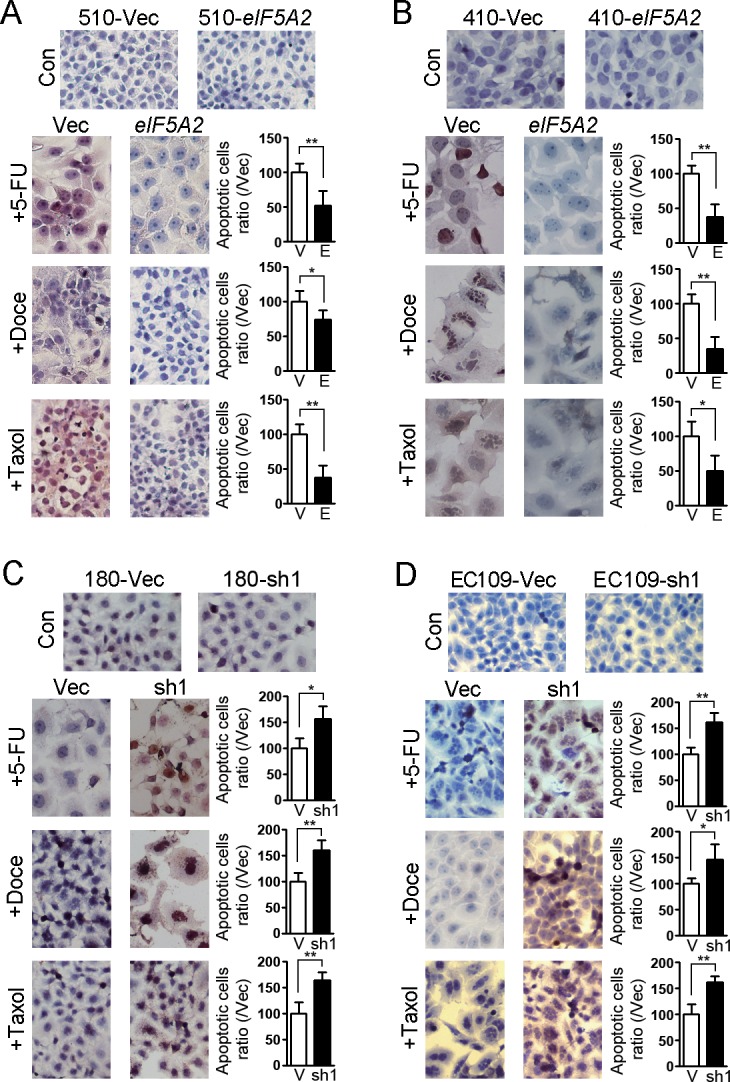
Figure 4. in situ cell death assay showed the effect of EIF5A2 on chemoresistance of ESCC cells
After treatment with 5-FU, docetaxel and taxol for 48 h, in situ TUNEL assays were performed on cells. Representative images of TUNEL assay are shown. The apoptotic cells were stained a brown color, and the nuclei were counterstained with hematoxylin. EIF5A2 overexpressed 510 A. and 410 B. cells showed fewer apoptotic cells than their respective vector controls, whereas eIF5A2 knock-down increased apoptotic cells in 180 C. and EC109 cells D. compared with their respective vector controls (original magnification: 20×). Summary of apoptotic cells ratio (/Vec) was shown (right). *, P < 0.05; **, P < 0.01.
Figure 5
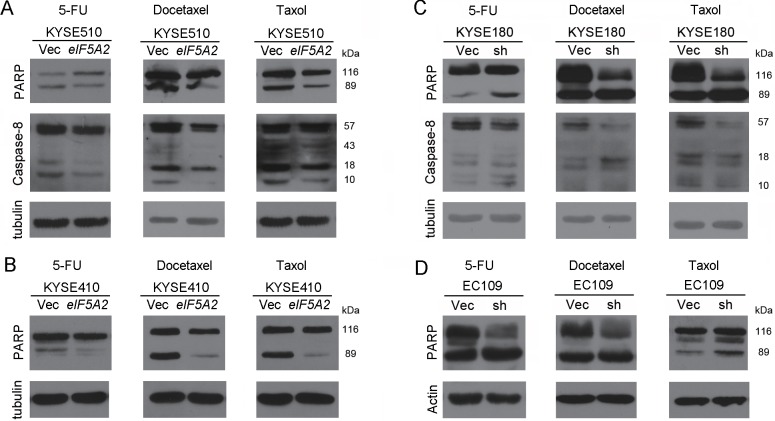
Figure 5. EIF5A2 conferred chemoresistance by inhibiting apoptosis
A. Cleaved PARP and Caspase-8 were found to be inhibited in EIF5A2 overexpressed 510 cells in response to 5-FU (50 μM), docetaxel (0.02 μM) and taxol (0.001 μM) when analyzed by western blotting analysis. B. Activation of PARP was inhibited in 410-eIF5A2 cells when treated with 5-FU (5 μM), docetaxol (0.01 μM) and taxol (0.0075 μM) compared with 410-Vec cells. C. Cleaved PARP and Caspase-8 were increased in eIF5A2 knock-down 180 cells treated with 5-FU (60 μM), docetaxel (0.01 μM) and taxol (0.003 μM) compared with 180-Vec cells. D. Activation of PARP was increased in EC109-sh cells when treated with 5-FU (50 μM), docetaxel (0.015 μM) and taxol (0.007 μM) compared with vector control cells. Tubulin or actin was set as loading control.
Figure 6
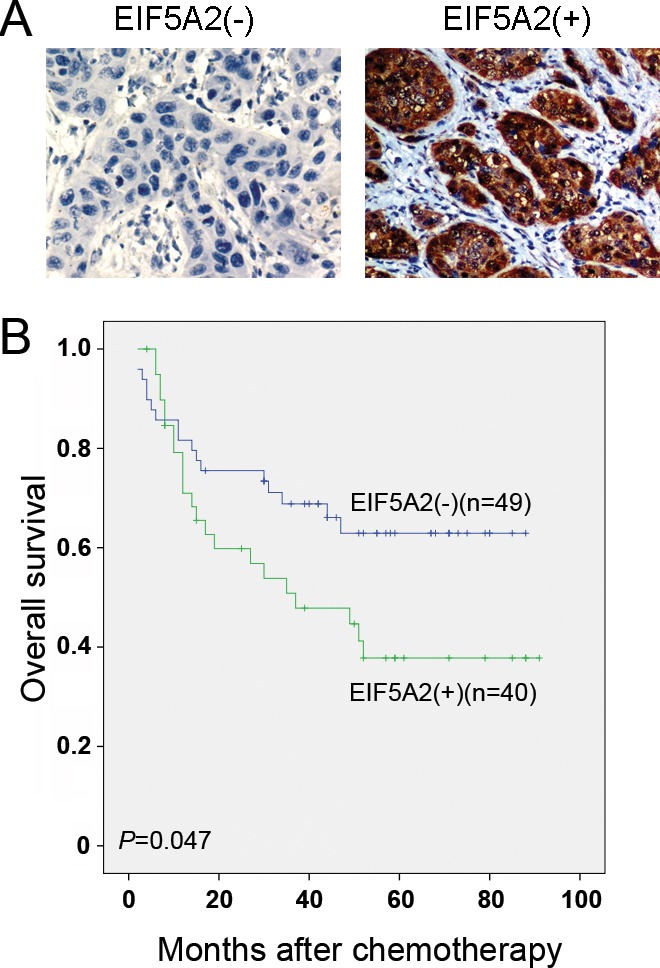
Figure 6. EIF5A2 expression correlated with a poorer outcome of chemotherapy
A. The representative images of EIF5A2 negative and positive expression in ESCC tissues (original magnification: 20×). B. Kaplan-Meier analysis indicated that the overall survival rate of patients with ESCC who received postoperative taxane-based chemotherapy was significantly decreased in the EIF5A2(+) group compared with the EIF5A2(−) group (P = 0.047).

References

    1. Ferlay J, Shin HR, Bray F, Forman D, Mathers C, Parkin DM. Estimates of worldwide burden of cancer in 2008: GLOBOCAN 2008. International journal of cancer Journal international du cancer. 2010;127:2893–2917. - PubMed
    1. Ando N, Iizuka T, Ide H, Ishida K, Shinoda M, Nishimaki T, Takiyama W, Watanabe H, Isono K, Aoyama N, et al. Surgery plus chemotherapy compared with surgery alone for localized squamous cell carcinoma of the thoracic esophagus: a Japan Clinical Oncology Group Study—JCOG9204. Journal of clinical oncology: official journal of the American Society of Clinical Oncology. 2003;21:4592–4596. - PubMed
    1. Iinuma H, Fukushima R, Inaba T, Tamura J, Inoue T, Ogawa E, Horikawa M, Ikeda Y, Matsutani N, Takeda K, et al. Phase I clinical study of multiple epitope peptide vaccine combined with chemoradiation therapy in esophageal cancer patients. Journal of translational medicine. 2014;12:84. - PMC - PubMed
    1. Lyu X, Huang J, Mao Y, Liu Y, Feng Q, Shao K, Gao S, Jiang Y, Wang J, He J. Adjuvant chemotherapy after esophagectomy: is there a role in the treatment of the lymph node positive thoracic esophageal squamous cell carcinoma? Journal of surgical oncology. 2014;110:864–868. - PubMed
    1. Li Y, Fu L, Li JB, Qin Y, Zeng TT, Zhou J, Zeng ZL, Chen J, Cao TT, Ban X, et al. Increased expression of EIF5A2, via hypoxia or gene amplification, contributes to metastasis and angiogenesis of esophageal squamous cell carcinoma. Gastroenterology. 2014;146:1701–1713. e1709. - PubMed

Publication types

MeSH terms