


The Val66Met brain-derived neurotrophic factor gene variant interacts with early pain exposure to predict cortisol dysregulation in 7-year-old children born very preterm: Implications for cognition
- PMID: 26318333
- PMCID: PMC4769966
- DOI: 10.1016/j.neuroscience.2015.08.044
The Val66Met brain-derived neurotrophic factor gene variant interacts with early pain exposure to predict cortisol dysregulation in 7-year-old children born very preterm: Implications for cognition
Abstract
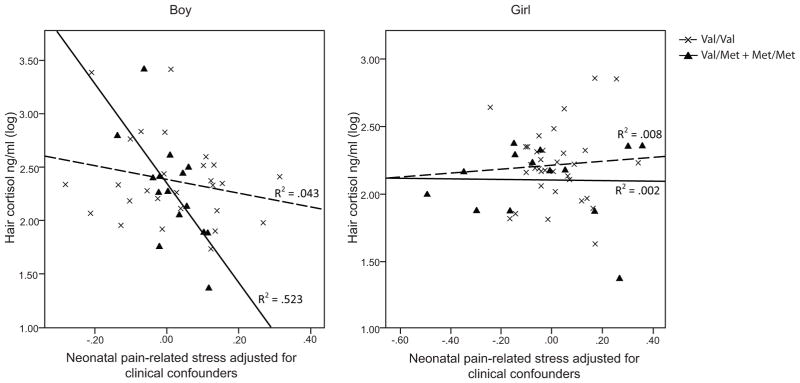
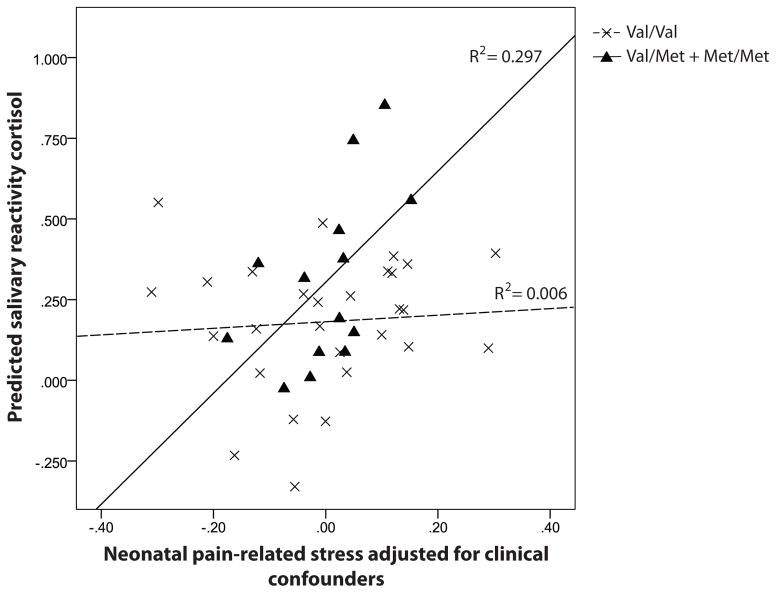
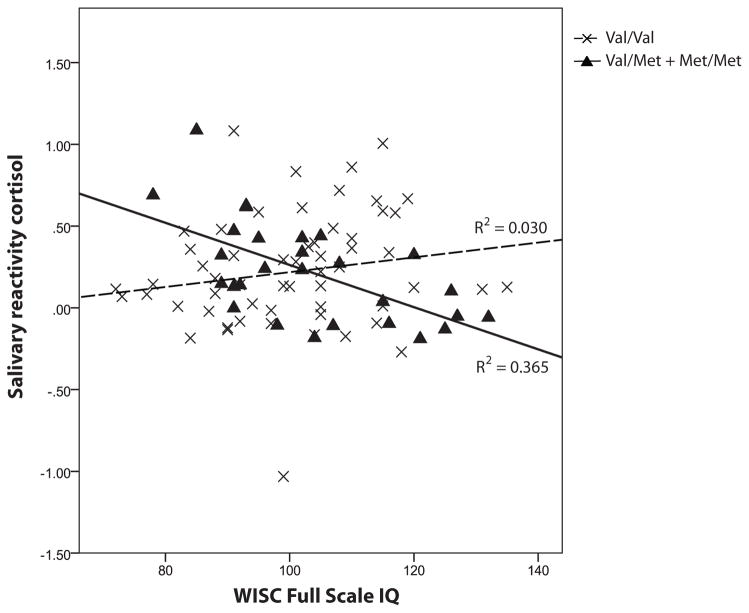
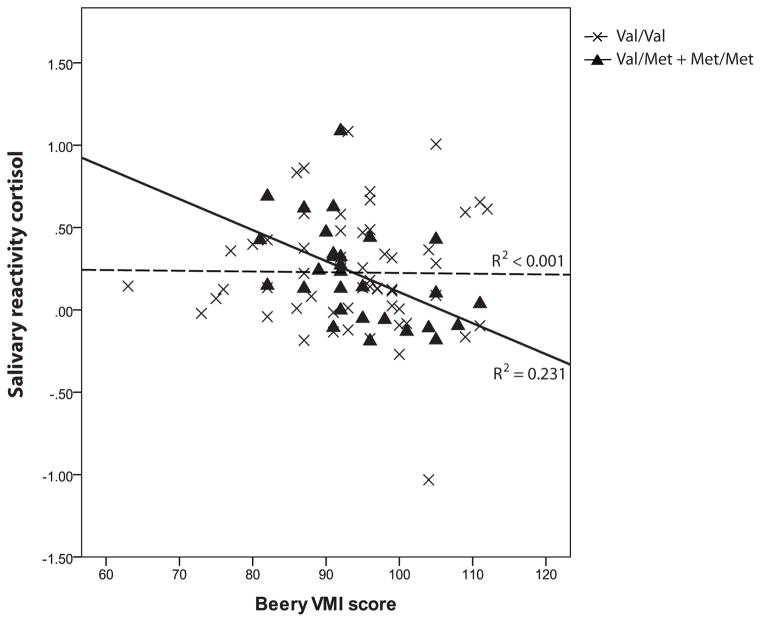
Early stress in the form of repetitive neonatal pain, in infants born very preterm, is associated with long-term dysregulation of the hypothalamic-pituitary-adrenal (HPA) axis and with poorer cognitive performance. Brain-derived neurotrophic factor (BDNF) which is important in synaptic plasticity and cognitive functions is reduced by stress. Therefore the BDNF Val66Met variant, which affects secretion of BDNF, may interact with early exposure to pain-related stress in children born very preterm, to differentially affect HPA regulation that in turn may be associated with altered cognitive performance. The aims of this study were to investigate whether in children born very preterm, the BDNF Val66Met variant modulates the association between neonatal pain-related stress and cortisol levels at age 7years, and if cortisol levels were related to cognitive function. Furthermore, we examined whether these relationships were sex-specific. Using a longitudinal cohort design, N=90 children born very preterm (24-32weeks gestation) were followed from birth to age 7years. Cortisol was assayed from hair as an index of cumulative stress and from saliva to measure reactivity to a cognitive challenge. BDNF Val66Met variant was genotyped at 7years using real-time polymerase chain reaction (PCR). Using generalized linear modeling, in boys with the Met allele, greater neonatal pain-related stress (adjusted for clinical risk factors) predicted lower hair cortisol (p=0.006) and higher reactivity salivary cortisol (p=0.002). In both boys and girls with the Met allele, higher salivary cortisol reactivity was correlated with lower IQ (r=-0.60; p=0.001) and poorer visual-motor integration (r=-0.48; p=0.008). Our findings show associations between lower BDNF availability (presence of the Met allele) and vulnerability to neonatal pain/stress in boys, but not girls. This exploratory study suggests new directions for research into possible mechanisms underlying how neonatal pain/stress is related to cognitive performance in children born very preterm.
Keywords: BDNF rs6265; cortisol; infant; pain; preterm; sex.
Copyright © 2015 IBRO. Published by Elsevier Ltd. All rights reserved.
Conflict of interest statement
statement None declared.
Figures
References
-
- Aarnoudse-Moens CS, Duivenvoorden HJ, Weisglas-Kuperus N, Van Goudoever JB, Oosterlaan J. The profile of executive function in very preterm children at 4 to 12 years. Dev Med Child Neurol. 2012;54:247–253. - PubMed
-
- Aarnoudse-Moens CS, Weisglas-Kuperus N, van Goudoever JB, Oosterlaan J. Meta-analysis of neurobehavioral outcomes in very preterm and/or very low birth weight children. Pediatrics. 2009;124:717–728. - PubMed
-
- Bale TL. Sex differences in prenatal epigenetic programming of stress pathways. Stress. 2011;14:348–356. - PubMed
Publication types
MeSH terms
Substances
Grants and funding
LinkOut - more resources
Full Text Sources
Other Literature Sources
Medical
Miscellaneous
