Meta-Analysis
. 2015 Aug 29:15:96.
doi: 10.1186/s12872-015-0068-3.

Colchicine in cardiac disease: a systematic review and meta-analysis of randomized controlled trials

Affiliations
Meta-Analysis

Colchicine in cardiac disease: a systematic review and meta-analysis of randomized controlled trials

Subodh Verma et al. BMC Cardiovasc Disord. .

Abstract

Background: Colchicine has unique anti-inflammatory properties that may be beneficial in various cardiovascular conditions. This systematic review and meta-analysis of randomized controlled trials (RCTs) examines this issue.

Methods: We searched MEDLINE, EMBASE, and the Cochrane Database from inception to June 2014 for RCTs using colchicine in adult patients with cardiac diseases. Results were pooled using random effects.

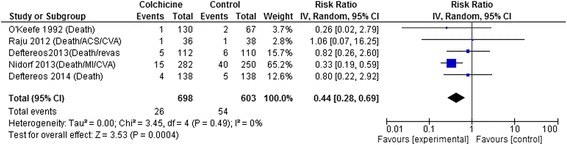
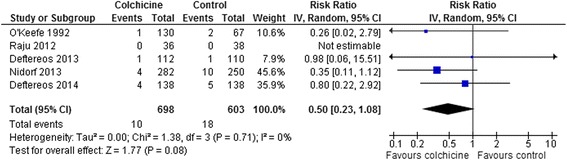
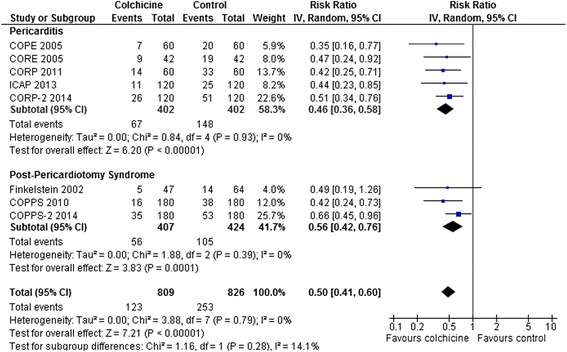
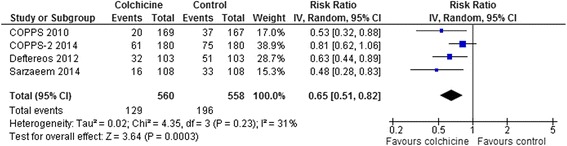
Results: 15 RCTs (n = 3431 patients, median treatment 3 and follow-up 15 months) were included. All but 2 used colchicine 1 mg/day. In 5 trials, n = 1301) at risk for cardiovascular disease (coronary artery disease, acute coronary syndrome or stroke, post-angioplasty [2 RCTs], or congestive heart failure), colchicine reduced composite cardiovascular outcomes by ~60 % (risk ratio [RR] 0.44, 95 % confidence interval [CI] 0.28-0.69, p = 0.0004; I(2) = 0 %) and showed a trend towards lower all-cause mortality (RR 0.50, 95 % CI 0.23-1.08, p = 0.08; I(2) = 0 %). In pericarditis or post-cardiotomy, colchicine decreased recurrent pericarditis or post-pericardiotomy syndrome (RR 0.50, 95 % CI 0.41-0.60, p < 0.0001; I(2) = 0 %; 8 RCTs, n = 1635), and post-pericardiotomy or ablation induced atrial fibrillation (RR 0.65, 95 % CI 0.51-0.82, p = 0.0003; I(2) = 31 %; 4 RCTs, n = 1118). The most common adverse event was diarrhea. Treatment discontinuation overall and due to adverse events (RR 4.34, 95 % CI 1.70-11.07, p = 0.002; I(2) = 29 %; 7 RCTs, 83/790 [10.5 %] vs. 11/697 [1.6 %]) was higher in colchicine-assigned patients.

Conclusions: Current RCT data suggests that colchicine may reduce the composite rate of cardiovascular adverse outcomes in a range of patients with established cardiovascular disease. Furthermore, colchicine reduces rates of recurrent pericarditis, post-pericardiotomy syndrome, and peri-procedural atrial fibrillation following cardiac surgery. Further RCTs evaluating the potential of colchicine for secondary prevention of cardiovascular events would be of interest.


Figures
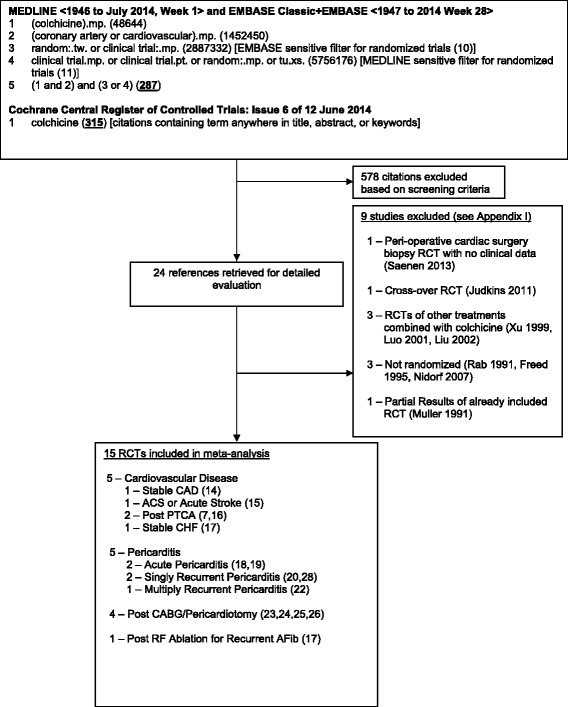
Fig 1.
Fig 1.
Search Strategy and Trial Flow. Flow chart for the systematic review and meta-analysis showing the search strategy, and the number of studies retained and number of studies excluded with reason for exclusion at each stage of the study selection process. For description of excluded studies see Table 5
Fig. 2
Fig. 2
Forest Plot for Composite Cardiovascular Outcome. Individual and pooled risk ratios (RR) with 95 % confidence intervals (CI) for randomized controlled trials (RCTs) enrolling patients with cardiovascular diseases comparing colchicine to placebo or control. The pooled RRs with 95 % CI were calculated using random-effects models. Weight refers to the contribution of each study to the overall pooled estimate of treatment effect. Each square and horizontal line denotes the point estimate and 95 % CI for each trial’s RR. The diamonds signify the pooled RR; the diamond’s centre denotes the point estimate and width denotes the 95 % CI. The composite cardiovascular outcome includes the components indicated for each RCT, except for Nidorf 2013 [14] also includes cardiac arrests. Abbreviations: ACS, acute coronary syndrome; CI, confidence interval; CVA, cerebrovascular attack; IV, inverse variance; MI, myocardial infarction; revasc, revascularization
Fig. 3
Fig. 3
Forest Plot for All-Cause Mortality. Individual and pooled risk ratios (RR) with 95 % confidence intervals (CI) for randomized controlled trials (RCTs) enrolling patients with cardiovascular diseases comparing colchicine to placebo or control. [RCTs enrolling patients with pericarditis [–22], post-pericardiotomy syndrome [–26], or post-RF ablation [27] are excluded. Only two of these RCTs [24, 25] reported any deaths: 2/169 vs. 2/167 patients [24], and 6/180 vs. 2/180 [25]. Including these RCTs does not significantly change the pooled result: RR 0.74, 95 % CI 0.37-1.49, p = 0.40. The pooled RRs with 95 % CI were calculated using random-effects models. Weight refers to the contribution of each study to the overall pooled estimate of treatment effect. Each square and horizontal line denotes the point estimate and 95 % CI for each trial’s RR. The diamonds signify the pooled RR; the diamond’s centre denotes the point estimate and width denotes the 95 % CI
Fig. 4
Fig. 4
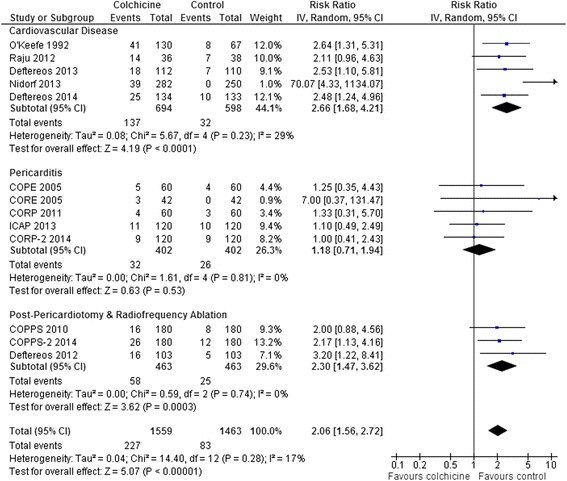
Forest Plot for Pericarditis and Post Cardiac Surgery Pericardiotomy. Individual and pooled risk ratios (RR) with 95 % confidence intervals (CI) for randomized controlled trials (RCTs) comparing colchicine to placebo or control in patients with pericarditis or post cardiac surgery pericardiotomy. The pooled RRs with 95 % CI were calculated using random-effects models. Weight refers to the contribution of each study to the overall pooled estimate of treatment effect. Each square and horizontal line denotes the point estimate and 95 % CI for each trial’s RR. The diamonds signify the pooled RR; the diamond’s centre denotes the point estimate and width denotes the 95 % CI. The decreases in risks were similar for pericarditis vs. pericardiotomy RCTs (interaction p = 0.28), and, as described in the manuscript text, also for acute vs. recurrent vs. multiple recurrent pericarditis RCTs with non-significant interaction p-values for all comparisons
Fig. 5
Fig. 5
Forest Plot for Atrial Fibrillation. Individual and pooled risk ratios (RR) with 95 % confidence intervals (CI) for randomized controlled trials (RCTs) comparing colchicine to placebo or control in patients post cardiac surgery pericardiotomy, or post radiofrequency (RF) ablation for recurrent atrial fibrillation. The pooled RRs with 95 % CI were calculated using random-effects models. Weight refers to the contribution of each study to the overall pooled estimate of treatment effect. Each square and horizontal line denotes the point estimate and 95 % CI for each trial’s RR. The diamonds signify the pooled RR; the diamond’s centre denotes the point estimate and width denotes the 95 % CI
Fig. 6
Fig. 6
Forest Plot for Gastrointestinal Adverse Events. Individual and pooled risk ratios (RR) with 95 % confidence intervals (CI) for randomized controlled trials (RCTs) comparing colchicine to placebo or control in patients with cardiovascular diseases, pericarditis, and post pericardiotomy or radiofrequency (RF) ablation. The pooled RRs with 95 % CI were calculated using random-effects models. Weight refers to the contribution of each study to the overall pooled estimate of treatment effect. Each square and horizontal line denotes the point estimate and 95 % CI for each trial’s RR. The diamonds signify the pooled RR; the diamond’s centre denotes the point estimate and width denotes the 95 % CI. The pericarditis patient trials [–22] which reduced the dose of colchicine for intolerance or low body weight (<70 kg) and enrolled generally younger patients (mean age 48–57), showed no significant increase in gastrointestinal side effects. This was different than the results from the other trials which showed a doubling of risk (interaction p = 0.01). Including data from all 7 RCTs that reduced the dose of colchicine for intolerance or body weight <70 kg [–22, 24, 25], the increase in gastrointestinal adverse events was lower but still statistically significant (RR 1.56, 95 % CI 1.09-2.24, p = 0.01, I2 = 0 %; 7 RCTs, 1524 patients) suggesting that dose reduction by itself is not sufficient to eliminate gastrointestinal side effects. For two RCTs that reported non-diarrhea gastrointestinal side effects separately from the diarrhea side effects we assumed that the 5/130 vs. 4/67 patients with nausea or vomiting and 0/130 vs. 1/67 patients with dyspepsia were different than the 36/130 vs. 3/67 patients with diarrhea [16] and the 6/103 vs. 3/103 patients with nausea were different than the 10/103 vs. 2/103 patients with diarrhea [27]. Results are similar if one assumes that these events occurred in the same patients for these 2 RCTs (overall RR 2.11, 95 % CI 1.54-2.89, p < 0.0001, I2 = 26 %; 216/1559 [13.9 %] vs. 77/1463 [5.3 %])
Fig. 7
Fig. 7
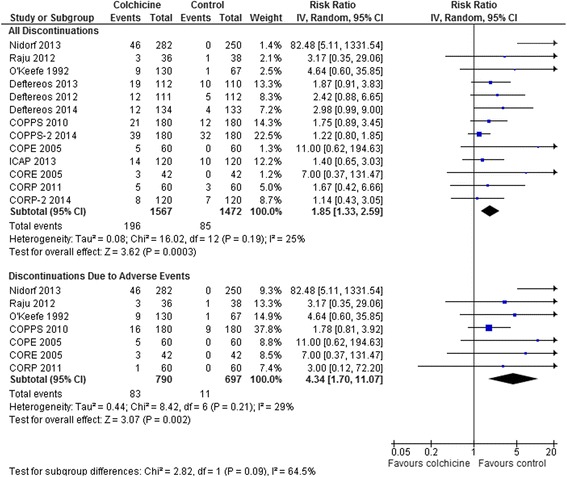
Forest Plot for All Medication Discontinuation and Discontinuation Due to Side Effects. Individual and pooled risk ratios (RR) with 95 % confidence intervals (CI) for randomized controlled trials (RCTs) comparing colchicine to placebo or control in patients with various cardiac conditions. The pooled RRs with 95 % CI were calculated using random-effects models. Weight refers to the contribution of each study to the overall pooled estimate of treatment effect. Each square and horizontal line denotes the point estimate and 95 % CI for each trial’s RR. The diamonds signify the pooled RR; the diamond’s centre denotes the point estimate and width denotes the 95 % CI. Including only data from the 7 RCTs that reduced the dose of colchicine for intolerance or body weight <70 kg [–22, 24, 25], the rates of medication discontinuation were still increased: discontinuation overall, RR 1.40, 95 % CI 1.04-1.89, p = 0.03, I2 = 0 %; 7 RCTs, n = 1524; and discontinuation due to adverse events, RR 2.22, 95 % CI 1.08-4.56, p = 0.03, I2 = 0 %; 4 RCTs, n = 684. There were no differences in medication discontinuation overall or discontinuation due to adverse events between subgroups of cardiovascular disease, pericarditis, and post-pericardiotomy or radiofrequency ablation patient trials (interaction p = 0.16-0.18) (results not shown)

References

    1. Terkeltaub RA, Furst DE, Bennett K, Kook KA, Crockett RS, Davis MW. High versus low dosing of oral colchicine for early acute gout flare: Twenty-four-hour outcome of the first multicenter, randomized, double-blind, placebo-controlled, parallel-group, dose-comparison colchicine study. Arthritis Rheum. 2010;62:1060–1068. doi: 10.1002/art.27327. - DOI - PubMed
    1. Ben-Chetrit E, Levy M. Colchicine prophylaxis in familial Mediterranean fever: reappraisal after 15 years. Semin Arthritis Rheum. 1991;20:241–246. doi: 10.1016/0049-0172(91)90019-V. - DOI - PubMed
    1. Bhat A, Naguwa SM, Cheema GS, Gershwin ME. Colchicine revisited. Ann N Y Acad Sci. 2009;1173:766–773. doi: 10.1111/j.1749-6632.2009.04674.x. - DOI - PubMed
    1. Zemer D, Livneh A, Danon YL, Pras M, Sohar E. Long-term colchicine treatment in children with familial Mediterranean fever. Arthritis Rheum. 1991;34:973–977. doi: 10.1002/art.1780340806. - DOI - PubMed
    1. Evereklioglu C. Current concepts in the etiology and treatment of Behcet disease. Surv Ophthalmol. 2005;50:297–350. doi: 10.1016/j.survophthal.2005.04.009. - DOI - PubMed

Publication types

MeSH terms