Review
. 2015 Oct;62(5):1227-40.
doi: 10.1016/j.pcl.2015.05.012.

Epigenetics and Understanding the Impact of Social Determinants of Health

Affiliations
Review

Epigenetics and Understanding the Impact of Social Determinants of Health

Daniel A Notterman et al. Pediatr Clin North Am. 2015 Oct.

Abstract

Recently, a new research agenda emphasizing interactions between social factors and health has emerged. The term social determinant of health often refers to any nonmedical factor directly influencing health. Health across the life span is strongly and adversely affected by social disadvantage. Research in epigenetics indicates that alterations in DNA methylation may provide a causal link between social adversity and health disparity. Likewise, accelerated loss of telomeres is correlated with chronic stress. Research is still required to develop an understanding of the role of epigenetics and perturbed telomere function in linking social adversity with health outcome.

Keywords: DNA; Epigenetics; Health disparity; Methylation; Social disparity; Telomere.


Figures

Figure 1
Figure 1
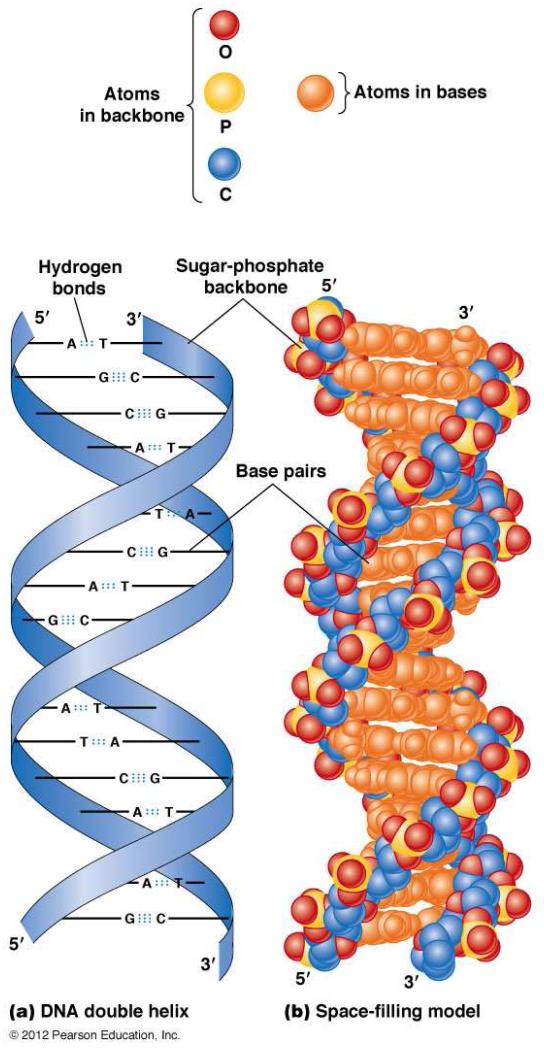
(a) A schematic representation of the double helical structure of DNA. A = adenosine; T = thymidine; C = cytosine; G = guanine. The strips represent the helical structure formed by the phosphodiester bonds (the “double helix,”) and the horizontal bars represent paired bases. (b) A space-filling model of the DNA double helix. The color-coded atoms are shown at the top of the figure. From Hardin J, Bertoni, G, Kleinsmith, LJ. Becker’s World of the Cell – 8th ed. San Francisco: Benjamin Cummings; 2006; with permission.
Figure 2
Figure 2
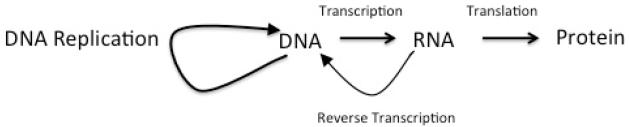
The Central Dogma of Molecular Biology, modified to include reverse transcription.
Figure 3
Figure 3
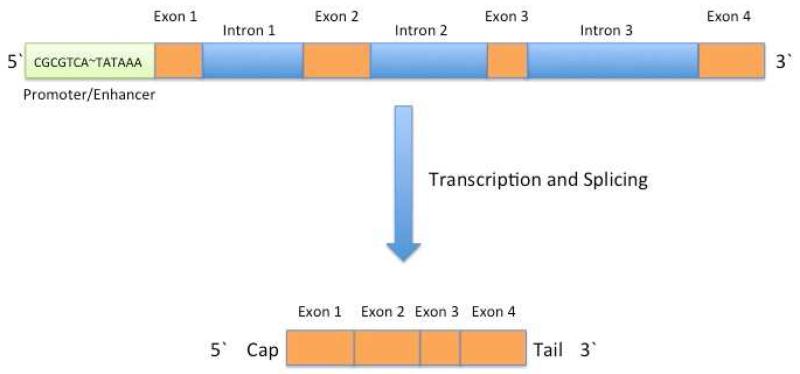
Schematic of a typical human gene. The 5′ end of the gene contains a promoter/enhancer region that is enriched for CpG sequence. The promoter also contains a special sequence, TATTAAA, which is a target for the transcription factors to bind. Several other sequences may intervene between the CpG island and the TATTAAA. Introns are shown in blue, and exons in orange. During transcription and splicing, an RNA copy of the gene is made, and the introns are excised. A 5′ cap and a 3′ tails are added to the final mRNA copy of the gene.
Figure 4
Figure 4
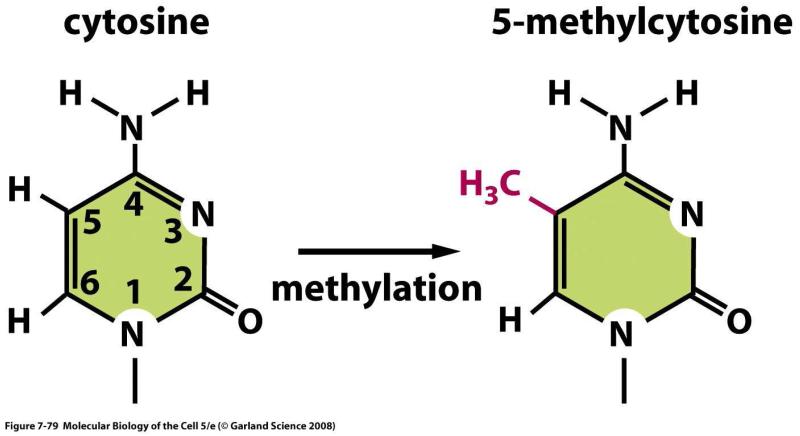
5-methylcytosine is formed by the addition of a methyl (--CH3) group to cytosine. From Alberts, Bruce, Johnson A, Lewis J, et al. Molecular Biology of the Cell, 5th ed New York: Garland Science, 2008; with permission.
Figure 5
Figure 5
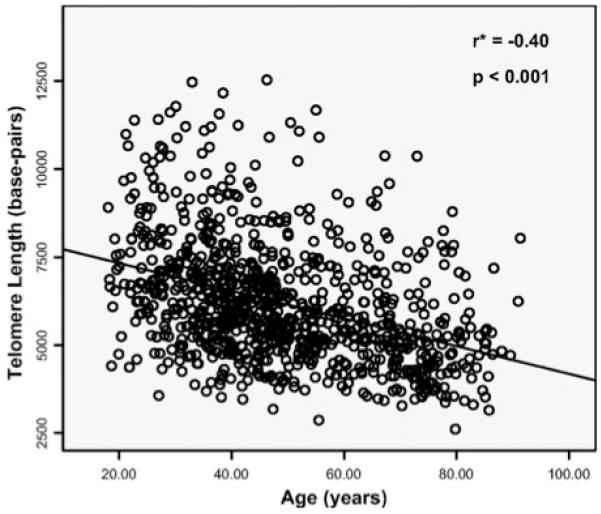
Correlation between leukocyte telomere length and age. From Njajou OT, Cawthon RM, Damcott CM, Wu SH, et al. Telomere length is paternally inherited and is associated with parental lifespan PNAS 2007;104:12135-12139; with permission.
Figure 6
Figure 6
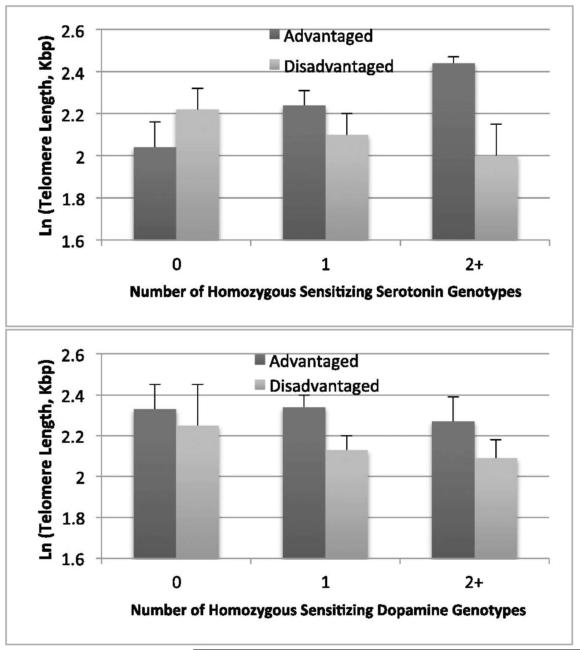
ln(telomere length) by environment type (advantaged vs. disadvantaged) and serotonin pathway (Upper) and dopamine pathway (Lower) homozygous genotype counts. For the serotonin pathway genotypes, the environment effect is borderline for 0 genotypes (P = 0.09), not significant for 1 genotype (P = 0.32), and significant for 2+ genotypes (P = 0.02). For the dopamine pathway genotypes, the environment difference is not significant for 0 genotypes (P = 0.63), significant for 1 genotype (P = 0.05), and borderline for 2+ genotypes (P = 0.08). This indicates that specific alleles in neurotransmitter pathways moderate the effect of social stress on telomere length. From Mitchell C, Hobcraft J, McLanahan, SS, et al. Social disadvantage, genetic sensitivity, and children’s telomere length PNAS 2014; 16: 5944-5949; with permission.

References

    1. Rosen G. The History of Public Health. Johns Hopkins Univ. Press; Baltimore, MD: 1993.
    1. Braveman P, Egerter S, Williams DR. The social determinants of health: coming of age. Annual Review of Public Health. 2011;32:381–398. - PubMed
    1. Adler NE, Ostrove JM. Socioeconomic status and health: what we know and what we don’t. Annals of the New York Academy of Sciences. 1999;896(1):3–15. - PubMed
    1. Williams DR, Mohammed SA, Leavell J, Collins C. Race, socioeconomic status, and health: complexities, ongoing challenges, and research opportunities. Annals of the New York Academy of Sciences. 2010;1186(1):69–101. - PMC - PubMed
    1. Williams DR, Collins C. Racial residential segregation: a fundamental cause of racial disparities in health. Public Health Reports. 2001;116(5):404. - PMC - PubMed

Publication types